

What if the boundary between your home and the serene greenery of your garden could be blurred entirely without the time-consuming process of obtaining a building permit? Many property owners feel a justified concern reg…
Attefall Rules for Extensions 2026: A Guide to the New Permit-Free Opportunities
1 juli 2026
What if the boundary between your home and the serene greenery of your garden could be blurred entirely without the time-consuming process of obtaining a building permit? Many property owners feel a justified concern regarding the extensive legislative changes that came into effect at the end of 2025, where the fear of technical missteps often overshadows the joy of creation. By understanding the new Attefall rules for extensions 2026, now formally referred to as permit-free extensions, you can transform this uncertainty into a concrete opportunity to realize an architectural vision. We understand that balancing strict legal requirements with an uncompromising aesthetic ambition is challenging; however, the new rules open doors for projects that previously felt out of reach.
In this guide, you will learn how the latest adjustments to the Planning and Building Act enable exclusive extensions of up to 30 m² without the need for a building permit, provided they are designed with respect for both legislation and aesthetics. We will go through how Boverket's new function-based regulations from July 2026 give you greater freedom, but also increased responsibility for the quality of craftsmanship and technical execution. You will get a clear picture of exactly what can be erected, how to navigate away from the risk of future complications, and how a well-planned winter garden or a classic orangery can permanently enhance your property's character and market value.
Key Takeaways
- Discover how the revised legal requirements from 2026 replace the old Attefall concept with more generous opportunities for permit-free extensions of up to 30 m².
- Learn to navigate Boverket's new function-based building regulations, which place higher demands on you as a builder to ensure technical precision and long-term sustainability.
- Get inspiration on how to combine modern law with timeless architecture by creating an exclusive winter garden or an orangery that seamlessly integrates with your main building.
- Understand the importance of correct technical documentation and how the new Attefall rules for extensions 2026 affect both your planning process and the future value of your property.
- Insights into why material choices such as genuine glass, cast iron, and stone are crucial for meeting the new requirements for load-bearing capacity and aesthetics in a permit-free environment.
New Building Permit Rules 2026: From Attefall to Increased Freedom
December 1, 2025, marked the end of an era and the beginning of another for the Swedish villa garden. The concept of Attefallshus, which for a decade has been synonymous with small-scale construction, has been formally removed from the Planning and Building Act. Instead, in 2026, we encounter a legal reality where the term permit-free extension dominates. This linguistic change reflects a deeper ambition to simplify things for those who wish to enhance their home with quality and care. For those who dream of an architectural extension of their living room, this means that legal obstacles have become fewer, while the scope for creativity has grown significantly.
To gain a deeper understanding of how these changes affect the building process and what the chaos in the legislative changes actually means, you can watch this informative overview:
What does the PBL reform mean for you as a homeowner?
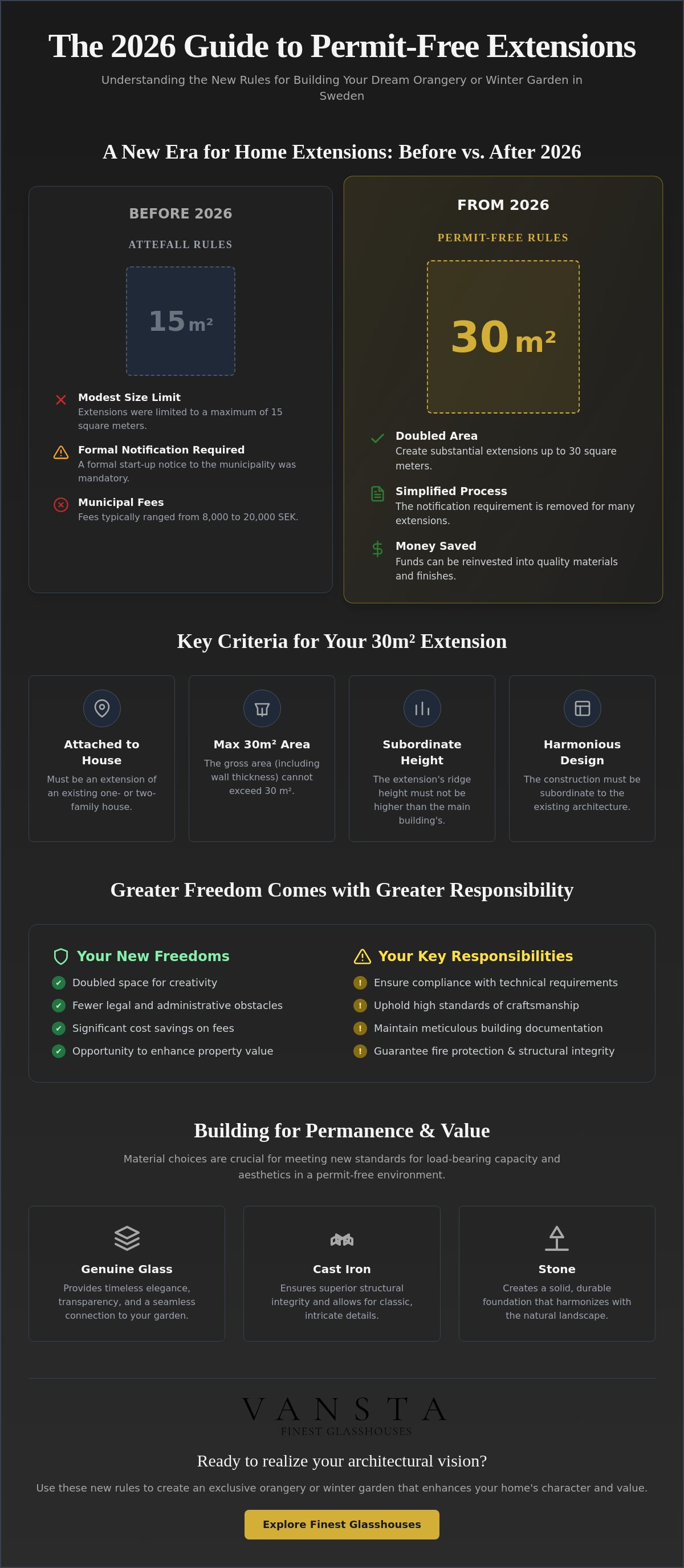
The reform is about more than just new terminology. The biggest relief lies in the removal of the previous notification requirement for many extensions. Previously, a formal start-up notice and a municipal fee, often between 8,000 and 20,000 SEK, were required. This money can now instead be invested in top-quality material choices or custom-made details. However, it's an important balancing act. Even if the process is permit-free, the construction must still comply with technical requirements regarding fire protection and structural integrity according to the new function-based rules. Carefully documenting the building process is still essential, especially to secure the property's value for future sales.
From 15 to 30 square meters: A new era for extensions
The most tangible change in the new Attefall rules for extensions 2026 is the significantly expanded area. Where we were previously limited to a modest 15 square meters, extensions of up to 30 square meters are now permitted without a building permit. This doubling completely changes the game for those who want to create a substantial orangery or an airy winter garden. It provides space for both a flourishing indoor Mediterranean garden and generous social areas for relaxation. The requirement is clear, however; the main building must be an existing one- or two-family house for the rules to apply. It is in the meeting between the old house's character and the new extension's transparency that true architectural magic arises. By wisely utilizing these 30 square meters, an investment is created that measures not only space but pure quality of life.
Criteria for Permit-Free 30 m² Extension
Navigating legal frameworks requires both precision and an understanding of architectural balance. According to the new building permit rules 2026, a permit-free extension may now comprise a maximum of 30 square meters of gross area. It is important to distinguish between gross area, which includes all floors and wall thicknesses, and building area, which is the area the building occupies on the ground. For those planning a timeless single-story winter garden, these measurements often coincide, but every square meter must be utilized with care to create a harmonious extension of the home.
Height restrictions play a crucial role in the aesthetic success of the project. A golden rule is that the extension must never dominate the main building. Its ridge height must not exceed the roof ridge of the dwelling, and the construction must be subordinate to the existing architecture. By allowing the extension to speak the same design language as the original house, a visual symbiosis is created where new and old meet in an elegant unity.
Distance to neighbor and consent
When planning your extension, its placement on the plot is central. The standard rule prescribes a distance of at least 4.5 meters to the property boundary. If you wish to place your structure closer to the neighbor than that, written and formal consent from the affected parties is required. This provides security for both sides, ensuring good neighborly relations and legal correctness. If the neighbor denies their approval, the project is not necessarily lost, but it then requires a regular building permit review by the municipality. Understanding these Attefall rules for extensions 2026 is the first step towards transforming your garden dream into a legal and lasting reality.
Architectural adaptation and cultural environments
For properties located in particularly valuable environments, such as areas with q-marking or historical protection, special rules apply. Here, carefulness is statutory, and building permit exemption may be limited to protect our common cultural heritage. Even outside these areas, the quality of the underlying documentation is crucial. By investing in professional architect-designed greenhouse drawings, you ensure that your extension not only complies with the technical requirements of Boverket's new function-based rules but also becomes the work of art your home deserves. We are happy to guide you through the entire process, from the first sketches to the completed construction, through our expertise in architect-designed greenhouses & orangeries.
Create an Exclusive Orangery with the New Rules
When we consider the new Attefall rules for extensions 2026 from an aesthetic perspective, we see a horizon of possibilities that extends far beyond simple wooden building kits. With a generous area of 30 square meters, an extension can be transformed into a complete winter garden, where the boundary between the security of home and the wild beauty of the garden is blurred. It's about choosing materials that not only age with dignity but also carry a history. The slender profiles of cast iron, the vibrant reflections of hand-blown glass, and the cool weight of natural stone together create an environment that feels both ancient and modern.
For such a structure to function as an integrated part of the dwelling year-round, technical precision is required. By integrating sophisticated systems for ventilation and underfloor heating, a climate is created where both exotic plants and people thrive, whether snow is swirling outside or the summer sun is at its highest. An architect-designed solution under the new rules ensures that every detail, from roof angles to glazing bars, harmonizes with the main building's unique character.
The orangery as a value-preserving investment
A well-planned extension is significantly more than just extra square meters; it is a strategic investment in the property's future. The difference between a mass-produced standard greenhouse and an architect-designed orangery lies in the craftsmanship and the durability of the material choices. By using classic materials such as steel and glass instead of short-lived alternatives, you create a structure that withstands the test of time and weathered Nordic winters. This artisanal quality is what ultimately increases the property's market value and makes it unique in a competitive market.
Design possibilities with 30 square meters
Thirty square meters offer a space that allows for thoughtful room division. You can easily create a dining room for grand dinners under the stars, combined with a lush lounge area for the first cup of coffee in the morning. The challenge lies in maximizing light entry without compromising Boverket's strict energy requirements. By using high-performance insulating glass and strategically placed glass sections, we can invite daylight deep into the main building. The result is a seamless connection between inside and out, where the garden becomes a constantly present backdrop in your daily life. It is here, in the meticulous planning of light and volume, that your dream of an exclusive outdoor life takes shape.
Technical Requirements and Notification: What You Still Need to Know
Realizing a dream of a glazed extension without a building permit does not mean building outside the bounds of the law. It is a common misconception that permit-free means total freedom from regulatory requirements. In fact, the new Attefall rules for extensions 2026 place high demands on the construction to comply with Boverket's building regulations. From July 1, 2026, a new, more function-based regulatory framework will also apply. This means that you as a builder bear a heavier responsibility to prove that your extension is safe, energy-efficient, and sustainable over time. Every load-bearing beam and every glass section must be dimensioned to withstand both wind loads and heavy snowfall, which requires technical expertise already at the planning stage.
Even if the volume of 30 square meters itself does not require a building permit, you must still make a technical notification to the municipality for certain installations. Are you planning to equip your orangery with water, sewage, or a fireplace for chilly evenings? Then a start-up notice is required before work begins. For more complex projects, where the extension is deeply integrated into the main building's load-bearing structure, it is wise to hire a control officer. This expert ensures that the control plan is followed and that your investment rests on a stable legal and technical foundation.
Energy efficiency and year-round use
For your new winter garden to function as a harmonious living space year-round, it must meet specific requirements for energy efficiency. This primarily concerns the insulation capacity of the glass sections and the roof, measured in U-values. A permanently heated extension often requires energy calculations showing that the house's total energy consumption does not exceed the permitted limit values. By choosing high-performance insulating glass and a well-insulated foundation, an environment is created that is as pleasant in January as in July. It is a balancing act between inviting light and retaining heat, where every material choice plays a crucial role in the final result.
Fire protection and safety during extension
Safety must never take a back seat to architectural beauty. If your extension is placed near another building or property boundary, requirements for fire-rated walls may become relevant to prevent the spread of fire. In addition, the use of tempered or laminated safety glass is mandatory in doors and window sections placed near floor level. This minimizes the risk of personal injury in the event of accidents. When the construction is complete, a final notice from the municipality is required for you to formally take the area into use. To ensure that your vision meets all these requirements, we offer expert support through our building permit drawings and application services.
Realize Your Dream with Vansta Trädgård
When legal frameworks expand, as they do with the new Attefall rules for extensions 2026, the responsibility to manage that freedom with great care also grows. At Vansta Trädgård, we see every extension as an architectural work of art that should breathe the same soul as the main building. We understand that the process from a dreamy sketch to a completed winter garden can feel overwhelming, especially with the new function-based requirements that demand higher levels of documentation and technical precision. By letting us be your partner, you gain access to a deep knowledge base where we combine international craftsmanship with an intuitive understanding of the Nordic light and its impact on our living environments.
Our role extends far beyond merely delivering materials of the highest quality. We act as your reliable advisor throughout the entire journey, from the very first thoughts about placement and light entry to the moment you can move your first olive trees into your new room. Our expertise in building permit drawings and application processes is your security in a time of legal change. We ensure that the technical documents not only meet the strict requirements of the law but also serve as an exact blueprint for a life in harmony with nature, where every detail is carefully considered to create timeless elegance.
Architect-designed solutions adapted to the new rules
Maximizing the permitted 30 square meters is not about building as large as possible, but as beautiful and functional as possible. We tailor each glasshouse to harmonize with your property's unique character, whether it's a turn-of-the-century villa with gingerbread trim or a stark, modern stone house. In our curated collections, such as the timeless Vansta Classic or the elegant THE ROSE greenhouse collection, you will find inspiration for constructions that defy the test of time. By consistently choosing exclusive materials such as cast iron, steel, and tempered glass, we create environments that not only follow the new Attefall rules for extensions 2026 but also become a value-preserving investment for the future.
A secure process from idea to completion
We take care of the entire process so you can focus on what truly matters: visualizing your future life in your new orangery. We navigate the complex technical and legal issues for you, ensuring that every detail of the construction meets Boverket's latest requirements for load-bearing capacity, fire protection, and energy efficiency. Your extension will become a seamless part of your home, a place for relaxation and social gatherings that feels as natural as it is exclusive. The next step in your journey is to book a personal consultation with us. Let us together explore how we can realize your vision with elegance and precision, bringing joy for many decades to come.
Take the Next Step Towards Your Architectural Masterpiece
The legal changes we are now seeing mark a new era for the Swedish villa garden. By understanding how the new Attefall rules for extensions 2026 work, you can transform a simple addition into a timeless extension of your home. We have seen how the opportunity to build up to 30 square meters without a building permit provides space for both magnificent orangeries and technically advanced winter gardens. It is the balance between the aesthetic vision and Boverket's new function-based requirements that determines the project's long-term success and durability.
As a family-owned company with over 20 years of experience in exclusive garden architecture, we at Vansta Trädgård have a deep passion for genuine craftsmanship. We specialize in building permit drawings and the Planning and Building Act, which makes us a reliable partner throughout the entire process. We ensure that your extension not only complies with the new rules but also becomes a place for relaxation that increases the property's value for generations to come. Let us help you navigate the legalities so you can focus entirely on the joy of creation.
Book a consultation for your future extension with Vansta Trädgård and let us together explore how we can realize your vision with elegance and precision. Your garden dream is closer than you think.
Frequently Asked Questions About Permit-Free Extensions
Do I need to apply for a building permit for a 30 m² extension in 2026?
No, you generally do not need to apply for a building permit for an extension of up to 30 square meters of gross area in 2026. These revised Attefall rules for extensions 2026 mean that you can start your project significantly faster than before. However, it is a prerequisite that the extension is subordinate to the main building's architecture and is not placed closer to the property boundary than 4.5 meters without the neighbor's consent.
What is the difference between an Attefallshus and the new rules for extensions?
The biggest difference lies in the terminology and the administrative process, as the concept of Attefallshus has been formally removed from the Planning and Building Act. Instead, we now talk about permit-free extensions that can comprise 30 square meters, in contrast to the previous rules which allowed 15 square meters. Furthermore, the requirement for a building notification and start-up notice has been abolished for the building construction itself, which reduces both waiting times and municipal fees.
Can I build a winter garden as an extension without a building permit?
Yes, a winter garden is considered an extension and can be erected permit-free as long as it stays within the 30 square meter limit. It is an excellent way to create a light-filled oasis that integrates seamlessly with your existing home. However, you must ensure that the glass structure meets technical requirements for energy efficiency and safety for it to be used as a permanent living space year-round.
Do I still need to notify the municipality about my extension even if it is permit-free?
The building volume itself no longer requires notification since December 2025, but technical installations are still subject to notification. If you plan to equip your orangery with water, sewage, or a fireplace, you must submit a technical notification and await a start-up notice. It is the builder's responsibility to ensure that all Attefall rules for extensions 2026 are correctly followed to avoid future sanction fees.
How close to the property boundary can I place my new extension?
The standard distance to the property boundary is 4.5 meters for the extension to be completely building permit-free. If you wish to build closer to the boundary than that, written approval from your neighbor is required. If the extension borders public land, such as a road or park, it is not possible to build closer than 4.5 meters without applying for a formal building permit from your municipality.
Do the new rules also apply to houses in culturally valuable areas?
No, houses located in areas with special conservation values or that have a q-marking are rarely covered by the building permit exemption. In these environments, the requirement for carefulness is very high to protect the architectural cultural heritage. You should therefore always check the detailed development plan for your area before you begin planning a glazed extension in a historically valuable environment.
What technical requirements must a winter garden meet in 2026?
As of July 2026, Boverket's new function-based building regulations apply, which set requirements for load-bearing capacity, fire protection, and energy efficiency. Your winter garden must have glass sections with the correct U-values to minimize heat loss if it is to be permanently heated. In addition, the use of safety glass is required in all sections placed near floor level to minimize the risk of personal injury in the event of accidents.
Can I build both a detached ancillary building and an extension permit-free?
Yes, the rules for permit-free extensions and ancillary buildings are independent of each other and can be combined on the same property. You can therefore utilize the right to a 30 square meter extension and at the same time erect detached buildings totaling 45 square meters within a detailed development plan area. This gives you great opportunities to create a cohesive and harmonious outdoor environment with both social areas and storage.