

An eagle statue makes the greatest impression when size, material, and placement harmonize. It depicts an eagle, often with wings folded or outstretched, and the weight of the stone lends the subject a distinct presence …
How to Choose an Eagle Statue for the Garden
20. okt. 2026
An eagle statue makes the greatest impression when size, material, and placement harmonize. It depicts an eagle, often with wings folded or outstretched, and the weight of the stone lends the subject a distinct presence in the garden. Choose a form that suits the scale of the setting and the garden’s aesthetic, rather than letting the statue's dimensions dictate everything.
It is easy to focus primarily on the eagle motif at first, but material and execution dictate how the statue is experienced over time. A sculpted stone figure provides a classic and substantial character, while surface texture and level of detailing determine whether the expression feels serene or dramatic. The surroundings also play an essential role: the statue can stand out against low planting or become part of a more formal composition.
Here you will discover what characterizes an eagle statue and how material, style, and proportions can guide your choice. We explore how to evaluate the statue in relation to garden architecture and outdoor climates, ensuring it finds a natural place and a well-considered presence.
Key takeaways
- Compare the statue’s height and width with the proportions of the site. Market examples range from 31.4 to 78 inches in height.
- Decide whether the eagle should feature folded or outstretched wings; the silhouette influences how the statue is perceived from a distance.
- Examine the material’s surface and detailing. These determine whether the aesthetic feels classical, naturalistic, or more dramatic.
- Choose a location where the statue's form is given adequate space to engage with the surrounding garden architecture.
- Read on to learn how balanced proportions and material choices help you establish an enduring, cohesive garden environment.
Eagle Statue
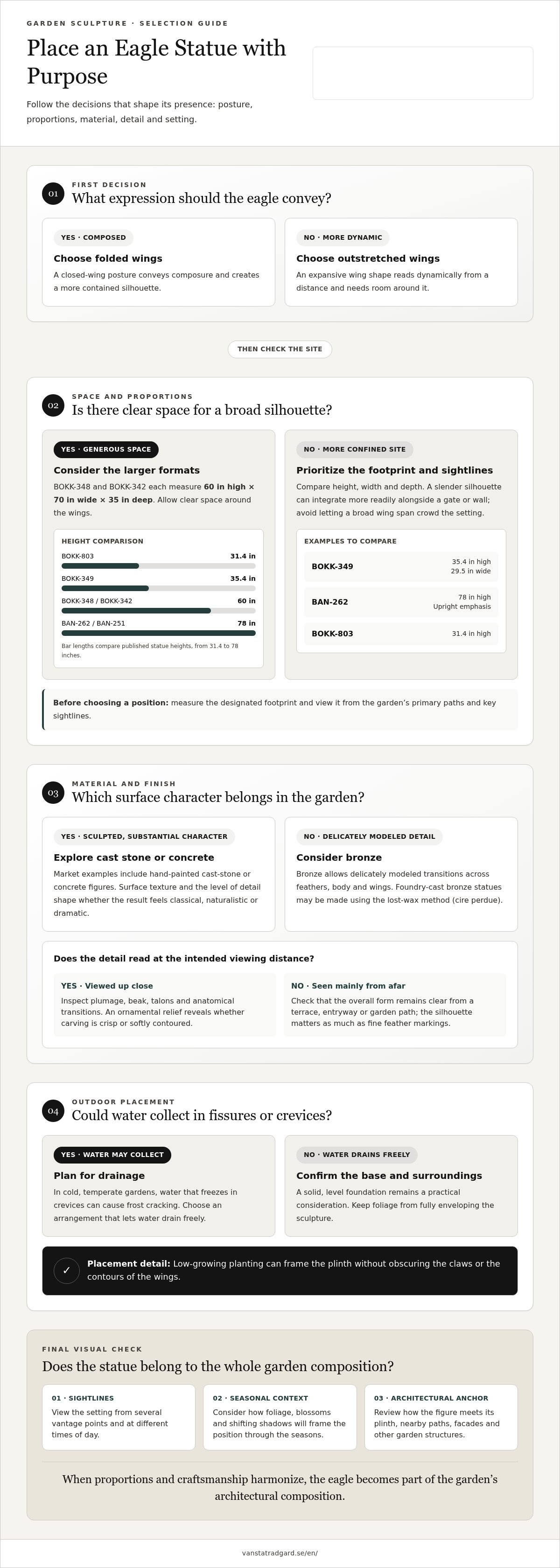
A classic eagle statue combines a distinct natural subject with a presence often associated with strength and vigilance. The eagle’s posture defines its expression: a bird with closed wings conveys composure, whereas outstretched wings yield a more dynamic silhouette. An eagle statue in stone can serve both as a primary focal point and as an integrated element of a broader garden composition. Begin by determining the mood you wish the motif to impart.
Dimensions must be evaluated in relation to the site, rather than merely as figures in a product description. Market examples demonstrate a variety of formats: BOKK-803 measures 31.4 inches in height, while BOKK-349 stands 35.4 inches high with a width of 29.5 inches. The larger models BOKK-348 and BOKK-342 each measure 60 inches in height, 70 inches in width, and 35 inches in depth. BAN-262 and BAN-251 reach 78 inches in height. These dimensions illustrate how significantly statues sharing the same eagle motif can vary.
Therefore, compare height, width, and depth before settling on a position. A 78-inch statue requires a completely different visual setting than BOKK-803 at 31.4 inches. Measure the designated footprint and view it from the garden’s primary pathways and key sightlines. For instance, a broad statue such as BOKK-348 requires ample clear space around the wings, while a slender silhouette integrates more readily alongside a gate or wall.
The eagle's posture also influences how the work reads from afar. BOKK-342 is designed as an eagle in flight and shares the same published dimensions as BOKK-348: 60 inches in height, 70 inches in width, and 35 inches in depth. This expansive composition makes the wing span crucial to its placement. A more upright figure, such as BAN-262, emphasizes verticality instead. Contrast these silhouettes against hedges, facades, and trees before making your decision.
The material defines both the surface texture and how the details are articulated. Examples on the market include hand-painted cast stone or concrete figures as well as bronze eagles. A painted figure of a bald eagle features colored accents. Bronze allows for delicately modeled transitions across feathers, body, and wings. Foundry-cast bronze statues are crafted using the lost-wax method (cire perdue). While this method describes the manufacturing technique, the statue’s silhouette and surface finish determine its presence in the garden.
Examine the plumage, beak, talons, and anatomical transitions individually. An ornamental relief viewed up close reveals whether the carving is crisp or softly contoured, whereas viewing from a distance reveals whether the form retains clarity. On an eagle with outstretched wings, delicate feather markings are appreciated at close range, yet the wing silhouette must also resonate from a terrace or entryway. Calibrate the level of detail to the intended viewing distance.
In cold, temperate garden environments, placement must take into account rain, snow, and fluctuating freeze-thaw cycles. Water that pools in fissures or crevices can cause frost cracking when temperatures drop. A solid, level foundation and an arrangement that allows water to drain freely are therefore vital practical considerations. Avoid letting foliage entirely envelop the sculpture. Low-growing plantings can frame the plinth without obscuring the claws or the contours of the wings.
Follow four steps to finalize your selection: first choose the eagle's posture, then compare dimensions, evaluate the material and detailing, and conclude by testing the placement visually. Use BOKK-349 as an example of a wider, lower figure, and BAN-262 as an example of a taller stature. Also review how the statue meets the plinth, adjacent paths, and nearby structures. When proportions and craftsmanship harmonize, the eagle figure becomes an accomplished architectural anchor in the garden.
Vansta Trädgård: Vansta Orangeries
Vansta Trädgård is a natural partner when you want garden architecture to harmonize seamlessly with refined garden art. An orangery can establish a visual backdrop and unite the home's architectural language with the garden's outdoor rooms, walkways, and plantings. This is especially fitting when designing a larger ensemble and seeking building proportions that balance beautifully with other distinguished features.
Vansta Orangeries, Vansta Classic, and custom glasshouses provide varied architectural expressions to guide your outdoor design. THE ROSE represents another distinguished option if you are seeking a prominent garden building as an integral part of the whole. The choice depends on the specific character of the site and how the structure will be utilized.
Contact Vansta Trädgård or visit vanstatradgard.se to explore the collection.
Let the Garden’s Overall Context Guide the Next Step
Before finalizing your choice, envision how the garden evolves across the seasons. A position that appears open in winter may later be framed by dense foliage, blossoms, or shifting shadows. Observe the intended setting from several vantage points and at different times of day. This will help determine whether the eagle statue should serve as a commanding focal point or a more understated element within the landscape.
A well-considered statue does not need to stand in isolation to make an impression. Complementary materials, facades, and plantings can create a coherent setting in which the sculpture acquires its own distinct character. Allow the spirit of the site and the ambiance you wish to encounter in your garden to guide your decision. In doing so, the statue becomes part of a broader architectural harmony rather than an isolated decorative addition.
When you are ready to develop your concepts further, you can explore the possibilities together with Vansta Trädgård. A thoughtfully chosen detail bestows enduring character upon the garden for years to come.