

Τι θα γινόταν αν ο πιο εκλεπτυσμένος κοινωνικός σας χώρος δεν κατέληγε στον εξωτερικό τοίχο του σπιτιού σας, αλλά συνέχιζε σε έναν κόσμο όπου τα όρια μεταξύ εσωτερικού και εξωτερικού χώρου ήταν μόνιμα ασαφή; Πολλοί ιδιοκτήτες σπιτιού ονειρεύονται…
Μονωμένο Ωδείο όλο το χρόνο: Ένας οδηγός για την αποκλειστική αρχιτεκτονική και θερμική άνεση 2026
10 Ιούν 2026
Τι θα γινόταν αν ο πιο εκλεπτυσμένος κοινωνικός σας χώρος δεν τελείωνε στον εξωτερικό τοίχο του σπιτιού σας, αλλά συνέχιζε σε έναν κόσμο όπου τα όρια μεταξύ εσωτερικού και εξωτερικού χώρου έχουν οριστικά θολώσει; Πολλοί ιδιοκτήτες σπιτιών ονειρεύονται μια γυάλινη επέκταση, αλλά συχνά διστάζουν στη σκέψη ότι το δωμάτιο θα γίνει ένα ενεργοβόρο βάρος κατά τους πιο κρύους μήνες ή μια αρχιτεκτονική ανωμαλία που δεν εναρμονίζεται με την ψυχή του κεντρικού κτιρίου. Αυτή είναι μια εύλογη ανησυχία. Ωστόσο, με τη σωστή τεχνική ακρίβεια και μια βαθιά αίσθηση δεξιοτεχνίας, το όνειρο ενός μονωμένου θερμοκηπίου που θα λειτουργεί όλο το χρόνο μπορεί να γίνει πραγματικότητα, βελτιώνοντας σημαντικά τόσο την ποιότητα ζωής όσο και την αξία του ακινήτου.
Σε αυτόν τον οδηγό, θα μάθετε πώς να συνδυάσετε την αισθητική κομψότητα με τη σύγχρονη θερμική άνεση για να δημιουργήσετε μια μόνιμη επέκταση του σπιτιού σας. Εξερευνούμε την πορεία από τα αρχικά αρχιτεκτονικά σκίτσα και τις προκλήσεις της διαδικασίας έκδοσης οικοδομικής άδειας έως τις κρίσιμες επιλογές υλικών που εξασφαλίζουν ένα ευχάριστο εσωτερικό κλίμα, είτε στροβιλίζεται χιόνι έξω από το τζάμι είτε όχι. Αντιμετωπίζοντας κάθε λεπτομέρεια ως έργο τέχνης, δημιουργούμε ένα περιβάλλον όπου τόσο τα εξωτικά φυτά όσο και οι κοινωνικές συγκεντρώσεις μπορούν να ανθίσουν σε μια ατμόσφαιρα που αποπνέει αποκλειστικότητα και μακροπρόθεσμη βιωσιμότητα.
Βασικά σημεία
- Κατανοήστε την τεχνική διαφορά μεταξύ ενός εποχιακού ηλιόλουστου δωματίου και ενός θερμοκηπίου με πλήρη οικιακή χρήση για χρήση όλο το χρόνο.
- Μάθετε πώς οι προηγμένες λύσεις τριπλών υαλοπινάκων και τα θερμοδιακοπές στο κουφώμα επιτρέπουν μια μονωμένο θερμοκήπιο όλο το χρόνο με διατηρούμενη ενεργειακή απόδοση.
- Ανακαλύψτε γιατί η προσαρμοσμένη αρχιτεκτονική και οι προσεκτικές επιλογές υλικών είναι ζωτικής σημασίας για να εναρμονιστεί η επέκταση με την ψυχή του σπιτιού και να αυξηθεί η αξία του ακινήτου.
- Αποκτήστε μια σαφή εικόνα της διαδρομής από τα αρχικά σκίτσα έως τα σχέδια οικοδομικών αδειών και το τελικό αποτέλεσμα μέσω μιας δομημένης διαδικασίας σχεδιασμού.
Τι ορίζει ένα μονωμένο θερμοκήπιο όλο το χρόνο;
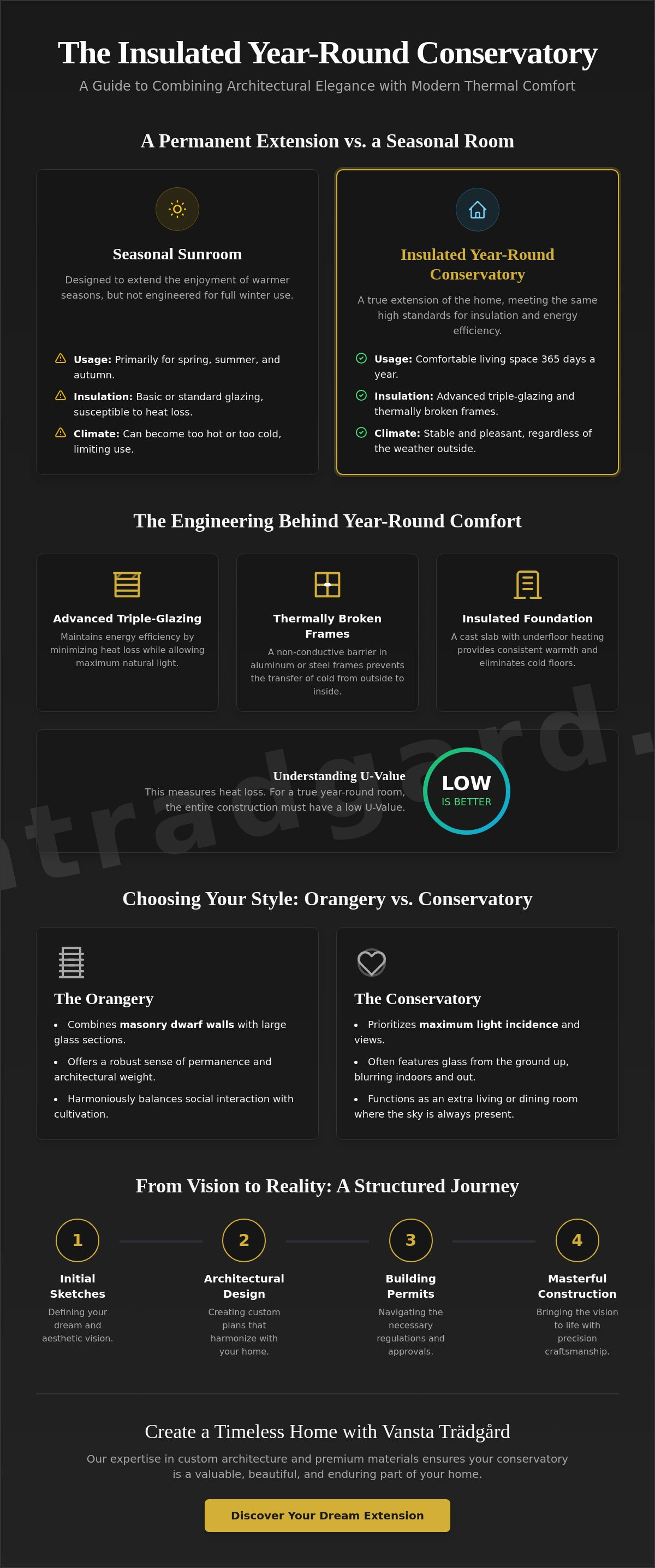
Η δημιουργία ενός γυάλινου δωματίου που αψηφά τις σκανδιναβικές εποχές απαιτεί κάτι περισσότερο από μια απλή αισθητική. Απαιτεί μια βαθιά κατανόηση της θερμικής φυσικής και της αρχιτεκτονικής ακεραιότητας. Πολλοί συχνά συγχέουν ένα μονωμένο ηλιόλουστο δωμάτιο με ένα πραγματικό θερμοκήπιο, αλλά η διαφορά είναι θεμελιώδης. Ενώ ένα ηλιόλουστο δωμάτιο παρατείνει την εποχή, ένα μονωμένο θερμοκήπιο όλο το χρόνο αποτελεί μόνιμο μέρος του κλιματικού περιβλήματος του σπιτιού. Αυτό σημαίνει ότι η κατασκευή πληροί τις ίδιες αυστηρές απαιτήσεις για μόνωση και αεροστεγανότητα με το υπόλοιπο σπίτι σας, επιτρέποντάς σας να το εξοπλίσετε με κανονικά υφάσματα και να απολαύσετε το δωμάτιο είτε το θερμόμετρο δείχνει είκοσι βαθμούς υπό το μηδέν είτε καυτό καλοκαιρινό ήλιο.
Η έννοια του «όλο το χρόνο» σε αυτό το πλαίσιο δεν αφορά μόνο το πάχος του γυαλιού. Πρόκειται για ένα αδιάσπαστο θερμικό φράγμα όπου το πλαίσιο, το γυαλί και τα θεμέλια συνεργάζονται για την εξάλειψη των θερμογεφυρών. Για να κατανοήσουμε πώς εξελίχθηκαν αυτές οι γυάλινες κατασκευές μέσα στην ιστορία, θα μπορούσε κανείς να αναρωτηθεί: Τι είναι ένα θερμοκήπιο; Από τα θερμοκήπια των Βρετανών αριστοκρατών μέχρι τις σημερινές τεχνικά προηγμένες επεκτάσεις, ο σκοπός ήταν πάντα να θολώσει η γραμμή μεταξύ του προστατευμένου εσωτερικού περιβάλλοντος και της άγριας ομορφιάς του κήπου.
Για να κατανοήσετε καλύτερα πώς ένα θερμοκήπιο μπορεί να λειτουργήσει ως ζωντανό μέρος του σπιτιού ακόμα και κατά τη διάρκεια του πιο σκοτεινού χειμώνα, σας προτείνουμε αυτό το εμπνευσμένο βίντεο:
Ωδείο εναντίον Πορτοκαλεώνα: Ποια διαδρομή πρέπει να επιλέξετε;
Η επιλογή μεταξύ ενός θερμοκηπίου και ενός πορτοκαλεώνα συχνά καθορίζεται από τον τρόπο με τον οποίο σκοπεύετε να χρησιμοποιήσετε τον χώρο. Ιστορικά, ο πορτοκαλεώνας ήταν ένας χώρος όπου η καλλιέργεια και η κοινωνική αλληλεπίδραση συναντώνται σε αρμονική ισορροπία. Μια μητέρα πορτοκαλεώνας Η λύση συχνά συνδυάζει τοίχους από τοιχοποιία με μεγάλα γυάλινα τμήματα, δίνοντας μια έντονη αίσθηση μονιμότητας. Το θερμοκήπιο, από την άλλη πλευρά, συχνά δίνει προτεραιότητα στη μέγιστη πρόσπτωση φωτός και λειτουργεί ως ένα επιπλέον σαλόνι ή τραπεζαρία όπου ο ουρανός είναι πάντα παρών. Και οι δύο επιλογές, ωστόσο, απαιτούν την ίδια τεχνική ακρίβεια για να λειτουργήσουν ως μονωμένο θερμοκήπιο όλο το χρόνο.
Απαιτήσεις για μόνιμη παράταση
Όταν ένα θερμοκήπιο σχεδιάζεται ως αναπόσπαστο μέρος της κατοικίας, το Σουηδικό Εθνικό Συμβούλιο Στέγασης, Δόμησης και Σχεδιασμού (Boverket) θέτει συγκεκριμένες απαιτήσεις για την ενεργειακή απόδοση. Αυτό δεν αφορά μόνο τη διατήρηση της θερμότητας, αλλά και τη σωστή διαχείριση του αερισμού και της ισορροπίας υγρασίας. Ένα θερμοκήπιο που χρησιμοποιείται μόνιμα απαιτεί ένα καλά σχεδιασμένο σύστημα ανταλλαγής αέρα για την αποφυγή συμπύκνωσης στις μεγάλες γυάλινες επιφάνειες. Η βάση είναι η βάση για κάθε άνεση. μια καλά μονωμένη χυτή πλάκα με ενδοδαπέδια θέρμανση είναι συχνά η καλύτερη λύση για τη δημιουργία ενός ευχάριστου κλίματος κάτω από τα πόδια, ακόμα και όταν ο παγετός πλήττει το έδαφος έξω.
Τεχνική εμπειρογνωμοσύνη: Επιλογές υλικών και μόνωση για το σκανδιναβικό κλίμα
Η κατασκευή μιας γυάλινης κατασκευής που αντέχει στον σκανδιναβικό χειμώνα απαιτεί μια μηχανική τέχνη που σπάνια είναι ορατή με γυμνό μάτι. Πρόκειται για την τιθάσευση του φωτός ενώ ταυτόχρονα κρατάμε έξω το κρύο. Όταν μιλάμε για ένα μονωμένο θερμοκήπιο όλο το χρόνο, Οι τεχνικές λεπτομέρειες είναι αυτές που καθορίζουν αν το δωμάτιο θα γίνει χώρος απόλαυσης ή πηγή απογοήτευσης. Κεντρική θέση σε αυτό κατέχει η κατανόηση του συντελεστή θερμοπερατότητας (U-value), ο οποίος μετρά πόση θερμότητα διέρχεται από ένα τετραγωνικό μέτρο της κατασκευής. Όσο χαμηλότερη είναι η τιμή, τόσο καλύτερη είναι η θερμομονωτική ικανότητα. Για μια μόνιμη επέκταση, στοχεύουμε σε λύσεις όπου ολόκληρη η κατασκευή, όχι μόνο το γυαλί, διατηρεί υψηλό θερμομονωτικό πρότυπο.
Για να επιτευχθεί η βέλτιστη ισορροπία μεταξύ μετάδοσης θερμότητας και φωτός, απαιτείται βαθιά γνώση αρχές θερμικής άνεσης απαιτείται, όπου οι ιδιότητες του γυαλιού παίζουν τον κύριο ρόλο. Σήμερα, βλέπουμε ότι το αλουμίνιο και ο χάλυβας κυριαρχούν στα πιο αποκλειστικά έργα. Αυτά τα υλικά επιτρέπουν λεπτά προφίλ που μεγιστοποιούν την επιφάνεια του γυαλιού χωρίς να θυσιάζουν τη σταθερότητα. Επενδύοντας σε ένα μονωμένο θερμοκήπιο όλο το χρόνο σημαίνει τη δημιουργία ενός δωματίου που λειτουργεί ως φυσικό μέρος του οικοσυστήματος του σπιτιού.
Μονωτικό γυαλί και οι τεχνικές του ιδιότητες
Το μοντέρνο γυαλί σε μια λύση που λειτουργεί όλο το χρόνο αποτελεί ένα θαύμα υψηλής τεχνολογίας. Χρησιμοποιώντας τριπλά τζάμια με επιστρώσεις χαμηλής εκπομπής, η θερμότητα αντανακλάται πίσω στο δωμάτιο αντί να διαφεύγει. Ο χώρος μεταξύ των τζαμιών γεμίζει με αργό, ένα ευγενές αέριο που μονώνει σημαντικά καλύτερα από τον συνηθισμένο αέρα. Για την αποφυγή θερμογεφυρών στις άκρες του γυαλιού, χρησιμοποιούνται οι λεγόμενοι θερμοί διαχωριστές άκρων. Είναι επίσης σημαντικό να ενσωματωθεί γυαλί ηλιακού ελέγχου. Αυτό διασφαλίζει ότι το δωμάτιο παραμένει δροσερό κατά τις φωτεινές καλοκαιρινές ώρες, αντανακλώντας ένα μεγάλο μέρος της ακτινοβολούμενης θερμότητας του ήλιου. Για όσους θέλουν να εξερευνήσουν πώς μπορούν να εφαρμοστούν στην πράξη αυτές οι τεχνικές επιλογές, η... θερμοκήπια αποτελούν ένα εξαιρετικό παράδειγμα συνάρτησης συνάντησης φόρμας.
Ο ρόλος του πλαισίου στη θερμική σταθερότητα
Μια συνηθισμένη παρανόηση είναι ότι το γυαλί κάνει όλη τη δουλειά. Ωστόσο, το πλαίσιο είναι εξίσου σημαντικό.Σε μια μόνιμη επέκταση, χρησιμοποιούνται προφίλ με θερμοδιακοπή. Αυτό σημαίνει ότι τα εσωτερικά και εξωτερικά μέρη του μεταλλικού προφίλ διαχωρίζονται από ένα μονωτικό υλικό, το οποίο εμποδίζει το κρύο να εισχωρήσει προς τα μέσα και να προκαλέσει συμπύκνωση στο εσωτερικό. Η ακρίβεια στη συναρμολόγηση είναι απολύτως ζωτικής σημασίας εδώ. Το παραμικρό κενό μπορεί να οδηγήσει σε απώλειες ενέργειας. Συνδυάζοντας αυτά τα θερμικά βελτιστοποιημένα προφίλ με γυαλί ασφαλείας, δημιουργείται ένα περιβάλλον τόσο ασφαλές όσο και όμορφο, όπου μπορείτε να κάθεστε προστατευμένοι ενώ η χιονοθύελλα μαίνεται έξω.
Κομψότητα σχεδιασμένη από αρχιτέκτονα έναντι τυποποιημένων λύσεων
Η διαφορά μεταξύ της προσθήκης ενός γυάλινου όγκου και της ενσωμάτωσης ενός νέου δωματίου σε ένα υπάρχον περιβάλλον είναι ανεπαίσθητη αλλά απολύτως κρίσιμη για το τελικό αποτέλεσμα. Η αγορά κατακλύζεται από τυποποιημένες λύσεις πακέτων που υπόσχονται απλότητα, αλλά αυτά τα κιτ συχνά υποφέρουν από μια αρχιτεκτονική ακαμψία που σπάνια αποδίδει δικαιοσύνη σε ένα μοναδικό σπίτι. Κατά τον σχεδιασμό ενός... μονωμένο θερμοκήπιο όλο το χρόνο, Στόχος είναι να δημιουργηθεί μια απρόσκοπτη επέκταση της ψυχής του σπιτιού. Επιλέγοντας μια εξατομικευμένη λύση, διασφαλίζετε ότι οι γωνίες της στέγης, οι υαλοπίνακες και οι αναλογίες των προφίλ μιλούν την ίδια γλώσσα με το κυρίως κτίριο, αποτρέποντας την επέκταση να εκληφθεί ως δεύτερη σκέψη.
Ένα προσαρμοσμένο σχέδιο δεν είναι απλώς μια αισθητική προτίμηση. Είναι μια στρατηγική επένδυση που αυξάνει την αγοραία αξία του ακινήτου. Η ποιότητα στις λεπτομέρειες, όπως οι χειροποίητοι μεντεσέδες, οι μηχανισμοί κλειδώματος με ακρίβεια φρεζαρίσματος και το φινίρισμα επιφάνειας που αντέχει στη δοκιμασία του χρόνου, δημιουργούν μια αίσθηση μονιμότητας. Για να επιτευχθεί αυτό το επίπεδο... κομψότητα σχεδιασμένη από αρχιτέκτονα που μετατρέπει μια απλή επέκταση σε ένα αρχιτεκτονικό αριστούργημα, απαιτείται προσοχή τόσο στο σύνολο όσο και στη λεπτομέρεια. Εδώ είναι που η τεχνική απόδοση συναντά την καλλιτεχνική έκφραση σε μια αρμονική ένωση.
Η αξία της αρχιτεκτονικής συμβουλευτικής
Ένας αρχιτέκτονας βλέπει πέρα από τους φυσικούς τοίχους και αναλύει πώς το φως κινείται μέσα στο δωμάτιο όλες τις ώρες της ημέρας. Μέσω επαγγελματικής συμβουλευτικής, οι ροές μεταξύ του εσωτερικού περιβάλλοντος και του κήπου μπορούν να βελτιστοποιηθούν με τρόπο που μια λύση καταλόγου δεν μπορεί ποτέ να φτάσει. Πρόκειται για τη δημιουργία οπτικών γραμμών και ακολουθιών δωματίων που αισθάνονται φυσικά. Ενσωμάτωση θερμοκήπια σχεδιασμένα από αρχιτέκτονες ή θερμοκηπίων στο υπάρχον περιβάλλον κήπου απαιτεί κατανόηση της τοπογραφίας του οικοπέδου και του ρόλου της βλάστησης στη δημιουργία καταφυγίου και ιδιωτικότητας.
Επιλογές υλικών που ενισχύουν τη συνολική εντύπωση
Τα υλικά που επιλέγετε καθορίζουν τον χαρακτήρα του δωματίου. Η χρήση κλασικών λεπτομερειών, όπως ένας όμορφα κατασκευασμένος νάνο τοίχος ή διακοσμητικές ζωφόροι οροφής, μπορούν να σας δώσουν μονωμένο θερμοκήπιο όλο το χρόνο μια ιστορική βάση παρά τη σύγχρονη τεχνολογία. Η επιλογή του χρώματος για τα προφίλ είναι ένα άλλο ισχυρό εργαλείο. Συνδυάζοντας το χρώμα με τα υπάρχοντα κουφώματα του σπιτιού, δημιουργείται μια οπτική ενότητα. Είτε προτιμάτε διακριτικό μοντερνισμό με μεγάλες γυάλινες επιφάνειες είτε ένα κλασικό βικτωριανό στυλ με πλούσια διακόσμηση, η αυθεντικότητα των υλικών και η ποιότητα της κατασκευής είναι αυτά που καθορίζουν εάν το σχέδιο γερνάει με αξιοπρέπεια ή χάνει τη λάμψη του μετά από μερικές σεζόν.
Αυτή η έμφαση στην αυθεντικότητα των υλικών και την κατασκευή είναι χαρακτηριστικό γνώρισμα του Κατασκευή Mighty Oak, των οποίων τα ειδικά διαμορφωμένα δωμάτια και γραφεία σε κήπο έχουν σχεδιαστεί για να παρέχουν άνεση όλο το χρόνο, ενισχύοντας παράλληλα τον αρχιτεκτονικό χαρακτήρα οποιουδήποτε ακινήτου.
Η διαδικασία σχεδιασμού: Από τα σχέδια οικοδομικών αδειών έως το ολοκληρωμένο ηλιόλουστο δωμάτιο
Η πορεία προς ένα πραγματοποιημένο όνειρο ξεκινά πολύ πριν τοποθετηθεί το πρώτο τζάμι.Για ένα άλλο μονωμένο θερμοκήπιο όλο το χρόνο Για να γίνει αυτή η αρμονική επέκταση του σπιτιού, απαιτείται μια μεθοδική διαδικασία σχεδιασμού όπου κάθε βήμα διαπερνά την τεχνογνωσία της κατασκευής. Ξεκινά με μια εις βάθος ανάλυση αναγκών και μια προσωπική επίσκεψη στο χώρο, όπου αξιολογούμε το αρχιτεκτονικό DNA του σπιτιού και τις μοναδικές συνθήκες του οικοπέδου. Εδώ βλέπουμε πώς πέφτει το φως και πώς μπορούν να αξιοποιηθούν καλύτερα οι ροές μεταξύ των υπαρχόντων δωματίων. Με βάση αυτές τις γνώσεις, προκύπτουν αρχιτεκτονικά σκίτσα και φωτορεαλιστικές τρισδιάστατες απεικονίσεις, επιτρέποντάς σας να περπατήσετε στο μελλοντικό σας δωμάτιο και να νιώσετε την ατμόσφαιρα πριν καν υπάρξει.
Η διαδικασία έκδοσης άδειας οικοδομής είναι συχνά το βήμα που προκαλεί τη μεγαλύτερη αβεβαιότητα, αλλά με την επαγγελματική τεκμηρίωση, η πορεία προς την έγκριση γίνεται σημαντικά πιο ομαλή. Σε αντίθεση με τα απλά προϊόντα καταλόγου, μια μόνιμη επέκταση απαιτεί λεπτομερή σχέδια τομών και τεχνικές περιγραφές που δείχνουν πώς η κατασκευή πληροί τις τρέχουσες απαιτήσεις για ενεργειακή απόδοση και προσβασιμότητα. Μόλις εξασφαλιστεί η άδεια, ξεκινά ο τεχνικός σχεδιασμός. Εδώ, συντονίζεται η επιλογή του εργολάβου για τις εργασίες βάσης, όπου μια καλά μονωμένη πλάκα σκυροδέματος αποτελεί τη βάση για το έργο σας. μονωμένο θερμοκήπιο όλο το χρόνο. Τέλος, ακολουθεί η εγκατάσταση, η οποία πραγματοποιείται με ακρίβεια χιλιοστού, και ένας ενδελεχής τελικός έλεγχος που εγγυάται ότι κάθε λεπτομέρεια ανταποκρίνεται στα υψηλά μας πρότυπα ποιότητας και αισθητικής.
Πλοήγηση στη ζούγκλα των αδειών οικοδομής
Μια επέκταση που προορίζεται να λειτουργεί ως χώρος διαβίωσης όλο το χρόνο υπόκειται σε αυστηρότερους κανονισμούς από ένα απλό ηλιόλουστο δωμάτιο. Απαιτεί ακριβή σχέδια τοποθεσίας και σχέδια πρόσοψης που δείχνουν πώς ο νέος όγκος αλληλεπιδρά με το περιβάλλον του και διατηρεί τον χαρακτήρα του σπιτιού. Ζητώντας βοήθεια από επαγγελματίες. σχέδια και αιτήσεις αδειών οικοδομής, διασφαλίζετε ότι όλες οι τεχνικές παράμετροι, από την πυροπροστασία έως τους υπολογισμούς του ενεργειακού ισοζυγίου, παρουσιάζονται σωστά από την αρχή. Αυτό δημιουργεί ασφάλεια σε όλη τη διαδικασία και ελαχιστοποιεί τον κίνδυνο δαπανηρών προσθηκών.
Κλιματισμός και θέρμανση
Για να επιτευχθεί απόλυτη θερμική άνεση, απαιτείται ένα καλά μελετημένο σχέδιο φωτισμού και θέρμανσης που αποπνέει διαχρονικότητα. Η ενδοδαπέδια θέρμανση παρέχει μια ομοιόμορφη και ευχάριστη βασική θέρμανση που κάνει το δωμάτιο να αισθάνεται φιλόξενο ακόμα και τις πιο κρύες χειμωνιάτικες νύχτες. Τα διακριτικά θερμαντικά σώματα που τοποθετούνται κατά μήκος των γυάλινων τμημάτων λειτουργούν ως αποτελεσματικό φράγμα ενάντια στα κρύα ρεύματα αέρα και διατηρούν το γυαλί απαλλαγμένο από την ομίχλη. Πολλοί επιλέγουν επίσης να ενσωματώσουν ένα τζάκι, το οποίο δεν είναι μόνο μια πηγή θερμότητας αλλά και ένα αισθητικό σημείο εστίασης που προσκαλεί παρέα. Για τη διαχείριση της ηλιακής ακτινοβολίας κατά τους καλοκαιρινούς μήνες, ο αυτοματοποιημένος αερισμός και η ενσωματωμένη σκίαση είναι απαραίτητα εργαλεία που δημιουργούν ένα ισορροπημένο εσωτερικό κλίμα. Τέλος, ο φωτισμός σχεδιάζεται με προσοχή ώστε να αναδεικνύει την αρχιτεκτονική και τον κήπο έξω, δημιουργώντας μια ονειρική ατμόσφαιρα ακόμα και όταν πέφτει το σκοτάδι.
Δημιουργήστε ένα διαχρονικό σπίτι με τα πορτοκαλεώνες και τους θερμοκήπια Vansta
Μόλις οι τεχνικές επιλογές και ο αρχιτεκτονικός σχεδιασμός ολοκληρωθούν σε ένα όραμα, το πιο σημαντικό καθήκον παραμένει: να δοθεί ψυχή στο δωμάτιο. Επενδύοντας σε ένα μονωμένο θερμοκήπιο όλο το χρόνο είναι κάτι περισσότερο από απλή προσθήκη τετραγωνικών μέτρων. είναι μια επιλογή ενός τρόπου ζωής που χαρακτηρίζεται από ποιότητα και αισθητική απόλαυση. Στην Vansta Trädgård, κάθε έργο βασίζεται σε μια σταθερή βάση δεξιοτεχνίας και σε μια επιλεγμένη επιλογή διεθνών συνεργασιών. Συνδυάζοντας την εμπειρία μας με διάσημους κατασκευαστές, μπορούμε να προσφέρουμε λύσεις όπως η Vansta Classic και η αποκλειστική συλλογή THE ROSE, και οι δύο σχεδιασμένες για να καλύπτουν τις υψηλότερες απαιτήσεις για θερμική απόδοση και διαχρονικό σχεδιασμό.
Ο ρόλος μας εκτείνεται πολύ πέρα από τον απλό προμηθευτή. Λειτουργούμε ως σύμβουλοί σας σε όλη τη διαδικασία, από το πρώτο κιόλας σκίτσο μέχρι την τελευταία λεπτομέρεια του εσωτερικού σχεδιασμού.Βλέπουμε ένα μονωμένο θερμοκήπιο όλο το χρόνο ως ένα έργο τέχνης από μόνο του, όπου κάθε προφίλ και κάθε τζάμι αποτελεί μέρος μιας ευρύτερης αρμονίας. Αυτή η ολιστική προσέγγιση διασφαλίζει ότι οι κατασκευές μας όχι μόνο γίνονται μέρος του σπιτιού, αλλά και ένας κεντρικός χώρος χαλάρωσης και κοινωνικής αλληλεπίδρασης όλες τις ώρες της ημέρας, ανεξάρτητα από την εποχή.
Κήπος Βάνστα: Όπου τα όνειρα γίνονται πραγματικότητα
Το πάθος μας για την κλασική αρχιτεκτονική και τα αυθεντικά υλικά διαπερνά όλα όσα κάνουμε. Κατανοούμε ότι κάθε σπίτι έχει τον μοναδικό του χαρακτήρα και, ως εκ τούτου, κάθε έργο προσαρμόζεται στον συγκεκριμένο τρόπο ζωής του πελάτη και στις συνθήκες του σπιτιού. Ένα καλά σχεδιασμένο ωδείο έχει τη δύναμη να μεταμορφώσει εντελώς την εμπειρία ζωής. Γίνεται ένας χώρος όπου ο πρωινός καφές απολαμβάνεται με τον ήχο της βροχής που χτυπάει στο τζάμι ή όπου τα δείπνα συνεχίζονται μέχρι τις πρώτες πρωινές ώρες κάτω από έναν έναστρο χειμωνιάτικο ουρανό, τυλιγμένο σε ζεστασιά και φως.
Συμπληρώστε με αποκλειστική διακόσμηση κήπου
Για να θολώσει πραγματικά η γραμμή μεταξύ εσωτερικού και εξωτερικού χώρου, απαιτούνται λεπτομέρειες που συνδέουν το δωμάτιο με τον εξωτερικό κήπο. Η ατμόσφαιρα μπορεί να βελτιωθεί σημαντικά ενσωματώνοντας κλασικά στοιχεία όπως σιντριβάνια ή όμορφα πατιναρισμένες γλάστρες από Haddonstone. Αυτές οι λεπτομέρειες δίνουν στο δωμάτιο μια αίσθηση ιστορικής βάσης και μονιμότητας. Για να δημιουργήσετε έναν φιλόξενο κοινωνικό χώρο, προτείνουμε τα διαχρονικά έπιπλα εξωτερικού χώρου από την Oxleys furniture, τα οποία συνδυάζουν την άνεση με μια κομψότητα που ταιριάζει με την αρχιτεκτονική του θερμοκηπίου. Σας προσκαλούμε σε μια προσωπική συμβουλευτική συνάντηση όπου μπορούμε να διερευνήσουμε από κοινού πώς μπορούμε να υλοποιήσουμε το επόμενο μεγάλο σας έργο και να δημιουργήσουμε ένα περιβάλλον που αποπνέει αποκλειστικότητα και αρμονία.
Πραγματοποιήστε το όνειρό σας για ένα διαχρονικό γυάλινο δωμάτιο
Το ταξίδι προς μια μόνιμη επέκταση από γυαλί αφορά τον συνδυασμό της τεχνικής τελειότητας με μια αρχιτεκτονική έκφραση που αποπνέει αρμονία. Δίνοντας σταθερά προτεραιότητα σε υλικά με χαμηλές τιμές U και θερμοδιακοπές, ένα μονωμένο θερμοκήπιο όλο το χρόνο δημιουργείται έτσι ώστε να λειτουργεί ως φυσική επέκταση του σπιτιού σας. Έχουμε δει πώς ο προσαρμοσμένος σχεδιασμός όχι μόνο διατηρεί αλλά και ενισχύει τον χαρακτήρα και την αξία του ακινήτου με τρόπο που οι τυποποιημένες λύσεις δεν μπορούν ποτέ να επιτύχουν. Κάθε λεπτομέρεια, από τη μόνωση των θεμελίων μέχρι τα κομψά διακοσμητικά στοιχεία της στέγης, συμβάλλει σε ένα περιβάλλον όπου τα όρια μεταξύ εσωτερικού και εξωτερικού χώρου είναι μόνιμα θολά.
Με πάνω από 20 χρόνια εμπειρίας στην αποκλειστική αρχιτεκτονική κήπων και βαθιά εξειδίκευση σε σύνθετες διαδικασίες έκδοσης οικοδομικών αδειών, είμαστε δίπλα σας σε κάθε βήμα. Ως εκπρόσωποι κορυφαίων κατασκευαστών παγκοσμίως, εγγυόμαστε ποιότητα κατασκευής που διαρκεί για γενιές και φέρνει χαρά κάθε μέρα. Είστε έτοιμοι να μετατρέψετε το όραμά σας σε ένα σχέδιο από σκυρόδεμα και να κάνετε το πρώτο βήμα προς έναν χώρο χαλάρωσης και κοινωνικής αλληλεπίδρασης κάτω από τα αστέρια;
Κλείστε μια προσωπική συμβουλευτική συνεδρία για το μελλοντικό σας θερμοκήπιο
Συχνές ερωτήσεις σχετικά με τα μονωμένα θερμοκήπια
Ποια είναι η διαφορά μεταξύ ενός θερμοκηπίου και ενός μονωμένου ηλιόλουστου δωματίου;
Η διαφορά έγκειται κυρίως στην αεροστεγανότητα και την ικανότητα μόνωσης της κατασκευής. Ένα θερμοκήπιο λειτουργεί ως μόνιμο μέρος του κλιματικού περιβλήματος του σπιτιού με πλήρη οικιστικά πρότυπα, ενώ ένα μονωμένο ηλιόλουστο δωμάτιο συνήθως προορίζεται για να παρατείνει την εποχή από τις αρχές της άνοιξης έως τα τέλη του φθινοπώρου. Το θερμοκήπιο απαιτεί λύσεις τριπλών υαλοπινάκων και θερμοδιακοπές σε ολόκληρο το πλαίσιο για να αντέχει σε θερμοκρασίες υπό το μηδέν χωρίς απώλειες ενέργειας ή συμπύκνωση.
Χρειάζομαι άδεια οικοδομής για ένα μονωμένο θερμοκήπιο που θα χρησιμοποιείται όλο το χρόνο;
Ναι, στις περισσότερες περιπτώσεις, απαιτείται άδεια οικοδομής επειδή ένα θερμοκήπιο θεωρείται μόνιμη επέκταση.Δεδομένου ότι προορίζεται για χρήση όλο το χρόνο, οι απαιτήσεις για τα σχέδια και τις τεχνικές περιγραφές είναι υψηλότερες από ό,τι για τις απλούστερες κατασκευές. Είναι σημαντικό η εφαρμογή να καταδεικνύει πώς η επέκταση εναρμονίζεται με την αρχιτεκτονική του κύριου κτιρίου και πληροί τις τρέχουσες ενεργειακές απαιτήσεις σύμφωνα με τους κανονισμούς της Boverket.
Πόσο κοστίζει η θέρμανση ενός θερμοκηπίου το χειμώνα;
Το κόστος θέρμανσης καθορίζεται από τη συνολική τιμή U της κατασκευής και την επιλογή της πηγής θερμότητας. Μια καλά μονωμένη κατασκευή με τριπλά τζάμια και θερμοδιακοπές ελαχιστοποιεί σημαντικά την απώλεια θερμότητας. Συνδυάζοντας την ενδοδαπέδια θέρμανση με ενεργειακά αποδοτικά γυάλινα τμήματα, δημιουργείται ένα ευχάριστο κλίμα χωρίς η κατανάλωση ενέργειας να γίνει υπερβολικά υψηλή, αλλά τα ακριβή στοιχεία ποικίλλουν ανάλογα με τις τοπικές συνθήκες και τα άλλα συστήματα του σπιτιού.
Μπορώ να έχω φυτά στο θερμοκήπιό μου ακόμα κι αν είναι σαλόνι;
Είναι απολύτως σωστό να συνδυάζονται οι κοινωνικοί χώροι με τη βλάστηση. Ωστόσο, για να ευδοκιμήσουν τόσο οι άνθρωποι όσο και τα φυτά, απαιτείται ισορροπημένος έλεγχος του κλίματος για τη σωστή διαχείριση της υγρασίας και του αερισμού. Πολλοί επιλέγουν να ενσωματώσουν αυτόματα συστήματα που ρυθμίζουν τη θερμοκρασία, δημιουργώντας ένα βέλτιστο περιβάλλον για τα μεσογειακά φυτά, ενώ το δωμάτιο παραμένει ένα άνετο μέρος για κοινωνικοποίηση όλες τις ώρες της ημέρας.
Τι τιμή U πρέπει να έχει ένα θερμοκήπιο όλο το χρόνο;
Για ένα άλλο μονωμένο θερμοκήπιο όλο το χρόνο, Θα πρέπει να επιδιώκεται η χαμηλότερη δυνατή τιμή U για ολόκληρη την κατασκευή. Τα γυάλινα τμήματα θα πρέπει να είναι περίπου 0,5 έως 0,7, ενώ η συνολική κατασκευή, συμπεριλαμβανομένου του σκελετού και της στέγης, συχνά στοχεύει σε τιμή περίπου 1,0 ή χαμηλότερη. Αυτό διασφαλίζει ότι το δωμάτιο πληροί τις απαιτήσεις για μόνιμη κατοίκηση και διατηρεί υψηλή θερμική άνεση ακόμη και σε έντονο κρύο.
Πώς μπορώ να αποτρέψω την υπερβολική ζέστη στο θερμοκήπιο το καλοκαίρι;
Το γυαλί ηλιακού ελέγχου και ο αποτελεσματικός αερισμός είναι τα πιο σημαντικά εργαλεία για τη ρύθμιση της θερμότητας. Χρησιμοποιώντας γυαλί που αντανακλά ένα μεγάλο μέρος της ακτινοβολούμενης θερμότητας του ήλιου, αποτρέπεται το φαινόμενο του θερμοκηπίου κατά τους καλοκαιρινούς μήνες. Συνιστάται η συμπλήρωση με αυτοματοποιημένους αεραγωγούς οροφής ή συστήματα εξαερισμού που ενεργοποιούνται όταν αυξάνεται η θερμοκρασία, καθώς και ενσωματωμένη σκίαση για να διατηρείται μια δροσερή και ευχάριστη ατμόσφαιρα ακόμα και τις πιο ηλιόλουστες ημέρες.
Μπορεί η Vansta Trädgård να βοηθήσει με ολόκληρη τη διαδικασία αδειοδότησης οικοδομής;
Ναι, προσφέρουμε μια ολοκληρωμένη ιδέα που περιλαμβάνει την προετοιμασία σχεδίων οικοδομικής άδειας και τη διεκπεραίωση της αίτησης. Η εμπειρία μας σε πολύπλοκες διαδικασίες σημαίνει ότι μπορούμε να σας καθοδηγήσουμε στις απαιτήσεις του δήμου και να διασφαλίσουμε ότι όλη η τεχνική τεκμηρίωση έχει προετοιμαστεί σωστά. Αυτό εξοικονομεί χρόνο και αυξάνει τις πιθανότητες γρήγορης έγκρισης, επιτρέποντάς σας να εστιάσετε στις αισθητικές επιλογές για το έργο σας.
Ποια υλικά είναι τα καλύτερα για ένα ανθεκτικό και μονωμένο θερμοκήπιο;
Το αλουμίνιο και ο χάλυβας με θερμοδιακοπές είναι τα κύρια υλικά για μια ανθεκτική μονωμένο θερμοκήπιο όλο το χρόνο. Αυτά τα υλικά επιτρέπουν πολύ λεπτά προφίλ με υψηλή φέρουσα ικανότητα, μεγιστοποιώντας τη μετάδοση του φωτός χωρίς να διακυβεύεται η μόνωση. Επίσης, ουσιαστικά δεν απαιτούν συντήρηση και αντέχουν στο σκανδιναβικό κλίμα με ανθεκτικότητα που διασφαλίζει ότι η επένδυσή σας θα παλαιώσει με αξιοπρέπεια και θα διατηρήσει την κομψότητά της με την πάροδο του χρόνου.