

Can a single element transform how a garden is experienced? A fountain that draws the eye, an urn marking an entrance, or a balustrade framing a terrace can become much more than a decorative detail. With Haddonstone, ca…
Haddonstone in the Garden: Cast Stone as Timeless Architecture
12 oct. 2026
Can a single element transform how a garden is experienced? A fountain that draws the eye, an urn marking an entrance, or a balustrade framing a terrace can become much more than a decorative detail. With Haddonstone, cast stone takes on a distinct architectural role. Form, scale, and placement dictate how harmoniously the piece interacts with the residence and the surrounding planting.
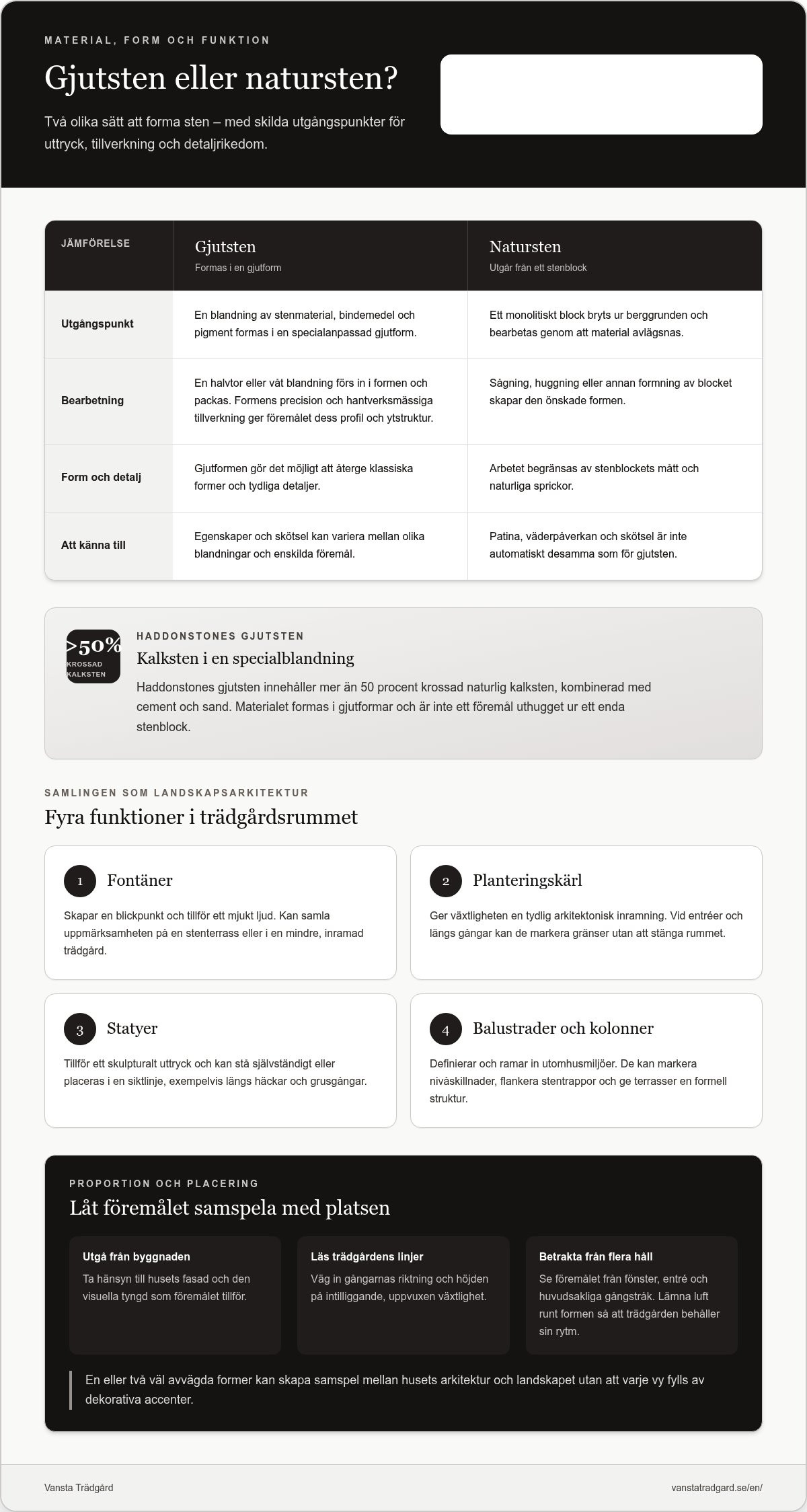
Material selection and proportions require careful consideration, particularly because cast stone is easily confused with quarried natural stone. Haddonstone cast stone consists of a bespoke mix containing more than 50 percent crushed natural limestone, combined with cement and sand. This imparts a unique character to the material, distinguishing it from an object carved directly from a single block of stone.
Here you will find an introduction to Haddonstone fountains, planters, statues, balustrades, and columns, alongside guidance for selecting pieces based on garden scale and aesthetic expression. We also examine how placement, planting, and considerations for Northern winters contribute to a coherent design where every detail finds its enduring place over time.
Key Takeaways
- Distinguish between cast stone as a material and Haddonstone as a maker of architectural garden ornaments.
- Select fountains, planters, statues, and architectural features based on their intended spatial function in the garden.
- Assess an object's scale and visual weight in proportion to the residence, pathways, and plantings to achieve a balanced whole.
- Plan placement with sub-bases, surrounding greenery, and cold winters in mind, specifically to prevent frost cracking.
- With Haddonstone, a thoughtfully chosen feature can lend character to the garden and anchor the building's architectural language within the landscape.
What Is Haddonstone? Understanding the Role of Cast Stone in the Garden
Haddonstone is an established brand of architectural cast stone stonework, not the name of a specific variety of quarried natural stone. Vansta Trädgård’s collection encompasses fountains, planters, and statues, as well as balustrades and classical columns. These creations can serve as refined garden art, but they also structure the landscape. A garden urn can demarcate an entryway, while a statue can draw the gaze toward a focal point or terminate an axis.
Cast stone is a refined building material where stone aggregate, binders, and pigments are blended and compacted into bespoke moulds. Once cured, the piece acquires its distinct profile and surface texture through the precision of the mould and artisan manufacturing techniques. Haddonstone cast stone pieces are crafted from a blend enriched with crushed natural limestone, cement, and high-grade sand. For an overarching overview of the material’s production and historical usage, consult the guide on cast stone on Wikipedia. Physical properties and maintenance requirements can vary depending on specific mixes and individual pieces.
Cast Stone and Natural Stone – What Is the Difference?
A natural stone object begins as a monolithic quarried block, shaped by the removal of material through sawing, chiselling, or dressing. Cast stone, by contrast, is shaped by introducing a semi-dry or wet limestone mix into precision moulds. This process allows for the faithful reproduction of classical forms and crisp details, whereas working a solid stone block is dictated by the dimensions and natural fissures of the quarry block. This manufacturing distinction does not mean the materials automatically share identical patinas, weathering characteristics, or maintenance routines.
From Garden Ornament to Architectural Anchor
In landscape design, the term architectural anchor refers to a structural element that provides visual stability to a garden space and helps organize outdoor rooms. It represents a planning philosophy rather than an inherent guarantee of performance. A fountain sited along a principal vista or a pair of classical columns framing a walkway establishes clear direction and architectural weight. The result depends on context: the piece must respect the facade of the house, the alignment of paths, and the mature height of adjacent plantings.
Never view a garden urn or sculpture in isolation from its surroundings. Envision it from the interior windows, from the entrance, and along primary garden paths. A feature meant to be appreciated from afar demands a different scale and presence than an element placed near a seating terrace, where profile and tactile surface texture are experienced up close. The negative space framing the object is equally critical. If every vantage point is filled with an assertive accent, the garden loses its rhythm and composure.
Cast stone brings deliberate visual weight and defined grounding between built architecture and nature. A sophisticated garden scheme is rarely about maximizing the number of decorative features. Instead, allow one or two exceptional forms to harmonize with the proportions and architectural character of the property.
Haddonstone's Collection: Fountains, Planters, Statues, and Architectural Details
The collection is best understood by assessing what each element contributes to the garden room, rather than viewing it merely as an itemized catalogue. A fountain acts as an eye-catching focal point while introducing ambient acoustics, whereas planters provide plantings with crisp architectural framing. Statues impart sculptural expression, and balustrading and columns define and frame outdoor living spaces.
Haddonstone’s portfolio spans four primary disciplines: water features as focal points, planters for specimen greenery, statues as sculptural accents, and architectural stonework framing the landscape. Begin by evaluating the functional needs of the space. Does the courtyard lack a clear center? Is a transition needed between distinct garden rooms? Would a planting border benefit from elevated height and structure?
Fountains and Planters Shaping the Garden Room
A fountain can serve as an intuitive gathering point on a stone terrace or within an intimate walled garden. The movement of water captures the eye, while its gentle sound enriches the ambiance of the outdoor room. Planters function differently. Sited at an entrance, along a formal walk, or where paved terraces meet the lawn, they delineate boundaries without walling off the space.
Consider how the height and placement of planters relate to the surrounding foliage. A solitary, grand garden urn can command a vista, whereas a series of identical planters establishes classical rhythm along a terrace facade or parterre. Uniformity in design language can provide cohesion without demanding strictly identical arrangements. Plant choices and spacing provide natural variation, while negative space around each vessel lets its form shine.
Statues, Balustrades, and Columns as Architectural Details
A statue can stand as an independent work of sculpture or form part of a grander vista aligned with hedges and gravel avenues. Balustrades and columns provide essential structural definition. They define level changes, flank stone staircases, and lend formal composure to elevated terraces. Carved details and ornamental relief make the greatest impact when their scale and intricacy remain in proportional harmony with the house and surrounding architecture.
Before selecting pieces across multiple categories, picture how they converge within a single vantage point. A fountain and a statue placed in close proximity can compete for attention if they possess similar visual mass. It is far better to establish one dominant architectural focal point complemented by understated accents, such as low planters or structural coping that gently guides the eye. This ensures the garden composition achieves both rhythmic beauty and restful balance.
Explore Haddonstone garden architectural pieces at Vansta Trädgård to discover how authentic cast stone can elevate your landscape design.
How Haddonstone Harmonizes with Architectural Style and Garden Proportions
A cast stone ornament does not have to mimic the exact period of the house to complement it seamlessly. The key is ensuring the relationship between forms appears intentional. A classical piece can echo the rhythmic window bays of a facade, create a striking counterpoint to clean modernist lines, or bridge the gap between historic brickwork and contemporary garden additions. Always evaluate the ornament within its architectural setting rather than as an isolated decorative object.
Choosing Expression to Match the Home's Architecture
For properties with classical proportions, symmetry, accentuated entrance portals, and repeating geometries provide a natural design baseline. In contemporary architectural settings, strong silhouettes and clean detailing allow the home's minimalism to remain undisturbed. This is not about confining a specific design to a single period style, but about balancing massing, texture, and ornamental relief against the architecture of the residence.
Thoughtful repetition builds spatial unity without creating monotony. A shared material or profile can appear at the front entrance and carry through to the private rear terrace, even as planting palettes and layouts differ. This establishes a subtle familial connection across different garden zones while allowing each space its own distinct character. Maintaining an overarching design thread does not require identical objects throughout.
Evaluating Scale, Sightlines, and Visual Balance
In courtyard gardens and intimate courtyards, the visual mass of a stone ornament must be evaluated with great precision. Placement shapes perception just as significantly as dimension. Take into account the viewing distance from the house, the density of surrounding borders, and how guests navigate the grounds. A piece positioned in an open lawn vista commands attention quite differently from an urn partially veiled by perennials and climbing roses.
Assess any intended position using these four architectural criteria:
- Location: Is the feature intended for a formal entrance, entertaining terrace, garden axis, or an expansive lawn?
- Function: Is it designed to terminate a view, mark a threshold between garden rooms, or anchor a planting scheme?
- Scale: How do its height, diameter, and mass relate to pathway widths, building eaves, and mature vegetation?
- Architectural Relationship: Does the profile echo the window architraves and masonry courses of the main house, or does it offer deliberate textural contrast?
On a private terrace, a single, impeccably proportioned garden urn introduces gravitas without overwhelming the setting. At an entryway, proportions should complement the doorframe and the scale of the entrance steps. In extensive grounds, there is scope for grander focal points, though they must remain tethered to the geometry of paths and avenues. Siting multiple prominent sculptures within the same line of sight risks visual clutter. Designate one primary anchor and let surrounding elements assume a supporting role.
Always assess the composition from multiple perspectives before finalizing installation. Viewed through an interior window, down a flagstone path, or approaching the house from the driveway, the same piece will project varying visual weight. This comparative approach ensures the chosen scale feels deeply rooted in both home and garden.
Planning Placement and Care for Haddonstone in Nordic Climates
Successful placement begins with site conditions and structural practicalities. Before deciding on exact placement, observe circulation routes, adjacent masonry, garden beds, and everyday usage patterns. Sub-base stability, maintenance accessibility, and surrounding grading also dictate design choices. Because the weight of cast stone is substantial, foundation requirements must always be tailored to the specific product and local soil load capacity. One single foundation solution does not suit every application.
Preparing the Site Before Selecting the Ornament
Work through site planning methodically. This clarity ensures the installation performs gracefully both as an artistic centerpiece and in everyday outdoor living.
- Position: Select a location that enhances spatial flow without encroaching on primary pedestrian walkways.
- Sub-base: Evaluate soil conditions, paving substructures, and adjacent walls. Load stability and appropriate foundations depend entirely on the weight of the piece and site conditions.
- Proportions: Review the proposed height from key viewpoints, balancing mass against walls, hedges, and open space.
- Planting: Account for mature growth habits of nearby specimen plants to prevent overgrowth from obscuring fine carving or blocking paths.
- Maintenance: Familiarize yourself with the manufacturer's operational and winterization guidelines for the chosen piece.
Ensure adequate clearances remain for annual cleaning and winter preparation. A placement that appears balanced from a lounge chair must also align with sightlines from inside the house. Always refer to manufacturer specifications for assembly, anchor points, and ongoing care. Broad material advice should never override product-specific engineering instructions.
Accounting for Water, Frost, and Long-Term Care
In Northern climates subject to freeze-thaw cycles, moisture management is critical. Frost damage and spalling can occur when trapped water expands as it freezes within porous materials. This is an inherent physical phenomenon in exterior masonry, not an assessment of a single brand. Cast stone should never be assumed to withstand every winter condition without adhering to proven winterization protocols.
For water features, winter preparation is paramount. Haddonstone recommends that fountains be completely drained before freezing temperatures arrive each autumn to prevent frost cracking. Follow the official guidelines for each model, ensuring water cannot collect in bowls, pedestals, or concealed conduits. Cleaning should likewise follow manufacturer recommendations, as abrasive methods or harsh chemicals can degrade hand-finished surfaces and fine ornamental relief.
With a stable foundation, thoughtful siting, and proper seasonal care, cast stone will gracefully weather and patinate for generations. Explore Haddonstone for the garden and let architectural integrity guide your selection.
Discover Haddonstone at Vansta Trädgård – Choosing with the Whole in Mind
A rewarding garden investment begins with regarding each piece as an integral component of outdoor architecture. While cast stone possesses innate tactile beauty, it is placement, proportion, and contextual dialogue with the house that determine long-term success. First pinpoint the spatial role your landscape requires, then select the corresponding form and aesthetic treatment.
A Curated Portfolio for Every Garden Room
Vansta Trädgård presents Haddonstone fountains, planters, statues, balustrading, and classical columns crafted from premium cast limestone. Each architectural category offers unique ways to define space. A fountain establishes a commanding central axis; planters elevate specimen plantings where ground borders are absent; statues provide artistic depth; and balustrades or columns delineate sunken gardens, terraces, and formal porticos.
Reflect on how each garden area is enjoyed. An intimate seating terrace benefits from a self-contained feature that instills serenity, whereas a front driveway calls for classical symmetry that anchors the home’s facade. In larger acreage, architectural elements frame views across open lawns. Not every outdoor zone requires an ornate gesture—often a solitary stone urn stands out most strikingly when enveloped by naturalistic planting.
From Inspiration to Architectural Precision
Before placing an order, clarify three core parameters: exact location, primary spatial purpose, and visual relationship to your home’s architecture. Consider sightlines from multiple vantage points so the element enriches views both from afar and at close quarters. Understanding stone craftsmanship provides the baseline, but architectural harmony emerges only when scale, texture, and setting are resolved as one.
Vansta Trädgård specializes in comprehensive design and custom architectural solutions for greenhouses, orangeries, and conservatories. For Haddonstone stonework, our focus centers on how the outdoor rooms, building elevations, and landscape topography unite into a singular aesthetic vision.
Let your design journey start with deliberate spatial intent rather than an impulse to fill empty corners. Explore the Haddonstone collection at Vansta Trädgård and discover how an authentic fountain, garden urn, statue, or balustrade can enrich the architectural narrative of your property.
Let the Garden's Wholeness Lead the Way
Before making a final choice, stand within the exact space where the feature will reside. Observe the views from primary windows and follow the path of movement through the garden. Notice where the eye naturally rests and whether transitions between terraces or garden rooms would benefit from architectural definition. This spatial study will provide far greater clarity than evaluating an ornament solely in a showroom.
Consider also how the garden evolves across the seasons. A sculpted profile framed by soft spring growth assumes a different visual weight against late summer foliage or winter snow. Lasting elegance is found in the enduring dialogue between architecture, enduring stone, and living landscape.
Once location and function are defined, you can invest in Haddonstone with complete confidence. Explore Haddonstone at Vansta Trädgård and choose a classical piece designed to become a timeless part of your garden.
Frequently Asked Questions About Haddonstone
Is Haddonstone the same as quarried natural stone?
No. Haddonstone is a brand of cast stone, not quarried natural stone cut directly from a bedrock seam. It is produced from a high-specification mix of natural crushed limestone, sand, and cement compacted in precision moulds. Always review the product's technical specifications and maintenance guidance rather than judging by appearance alone, as structural properties and care requirements differ from cut stone blocks.
Can Haddonstone remain outdoors year-round?
Most Haddonstone ornaments can remain outdoors through the seasons, provided they are sited correctly and winterized according to manufacturer instructions. Special attention is required for pieces that hold water. A garden urn, a statue, and a tier fountain each have distinct winter care protocols, and water-retaining features must never be allowed to freeze full of water.
How does frost affect cast stone?
Severe freeze-thaw cycles present a risk of frost cracking or spalling if water penetrates micro-fissures and subsequently expands as ice. This is an inherent risk for exterior stone masonry. Ensure drainage holes in planters remain clear and drain fountains completely before sub-zero temperatures arrive. Following manufacturer seasonal care advice is essential to maintaining surface integrity.
Can a Haddonstone fountain operate without a permanent water supply?
Yes. Many models can be fitted with a closed-loop water system with a self-circulating pump, which recirculates water from a self-contained reservoir rather than requiring a dedicated mains water line. The choice between a self-contained pump system and a permanent plumbing supply will influence site groundwork, power routing, and foundation planning.
How should a Haddonstone garden urn be cleaned?
Always clean cast stone gently in accordance with manufacturer recommendations. Use clean water and a soft-bristled brush to remove surface debris and organic matter. Avoid high-pressure jet washers and harsh acidic cleaners, as aggressive cleaning methods can erode fine details, damage the natural stone face, and strip away desirable aged patina.
Does Haddonstone suit contemporary architecture?
Yes. Cast stone complements contemporary architecture when chosen with restraint. Clean-lined planters, minimalist pedestals, or classical urns positioned as deliberate sculptural counterpoints can add texture and historical depth against smooth render, glass, and steel facades.
Does a heavy stone statue require a reinforced concrete foundation?
Foundation requirements depend on the weight and height of the statue, local soil stability, and whether the installation is subject to public safety considerations. Taller, heavier statues require a solid, level, and well-drained concrete footing or stone plinth to prevent subsidence, tipping, and structural stress over time.