

Et si le détail le plus crucial de votre jardin n’était pas les fleurs, mais les fondations sur lesquelles elles reposent ? Un environnement extérieur sans points focaux verticaux clairs risque de paraître indéfini, alors que les bons éléments architecturaux…
Plinthes et socles : un guide d'achat pour l'architecture de jardin classique 2026
12 juin 2026
Et si l'élément le plus crucial de votre jardin n'était pas les fleurs, mais les fondations sur lesquelles elles reposent ? Un espace extérieur sans points de mire verticaux bien définis risque de paraître indéfini, tandis que des éléments architecturaux judicieux peuvent transformer un simple passage en une perspective magnifique. Nous comprenons la difficulté de concilier aspirations esthétiques et rigueur du climat nordique. Il est légitime de s'inquiéter d'investir dans de beaux aménagements pour ensuite voir le gel anéantir le travail artisanal, ou de douter de la solidité des lourdes urnes classiques face aux violentes tempêtes hivernales suédoises.
Dans ce guide, vous apprendrez comment sublimer vos œuvres d'art de jardin en choisissant les socles appropriés. & Des socles au design intemporel. Nous vous expliquons comment créer un socle stable et esthétique qui non seulement résiste à l'épreuve du temps, mais devient aussi un investissement précieux pour les générations futures. En maîtrisant les proportions et le choix des matériaux, vous pouvez créer un environnement harmonieux où chaque détail s'intègre parfaitement. Nous abordons le choix de matériaux résistants au gel comme le Haddonstone et la disposition des objets pour créer une expérience architecturale qui restera aussi impressionnante en 2026 que dans le futur.
Points clés à retenir
- Apprenez à distinguer les éléments fonctionnels d'un bâtiment des œuvres d'art architecturales pour créer du relief et de la verticalité dans l'aménagement de votre jardin.
- Découvrez pourquoi Haddonstone, résistant au gel, est le matériau de choix optimal pour socles & piédestaux qui doivent résister à l'hiver suédois sans perdre leurs détails complexes.
- Bénéficiez de conseils d'experts sur la façon d'équilibrer les proportions entre le socle et l'œuvre d'art afin de créer des points focaux harmonieux et impressionnants dans vos lignes de mire.
- Il est essentiel de comprendre l'importance d'une préparation adéquate du terrain et de fondations stables pour garantir que les lourdes structures en pierre restent solides et esthétiques pendant des décennies.
- Découvrez comment des modèles intemporels comme le socle élisabéthain peuvent être intégrés pour mettre en valeur le caractère architectural et le style uniques de votre maison.
Quelle est la différence entre un socle et un piédestal dans l'aménagement paysager ?
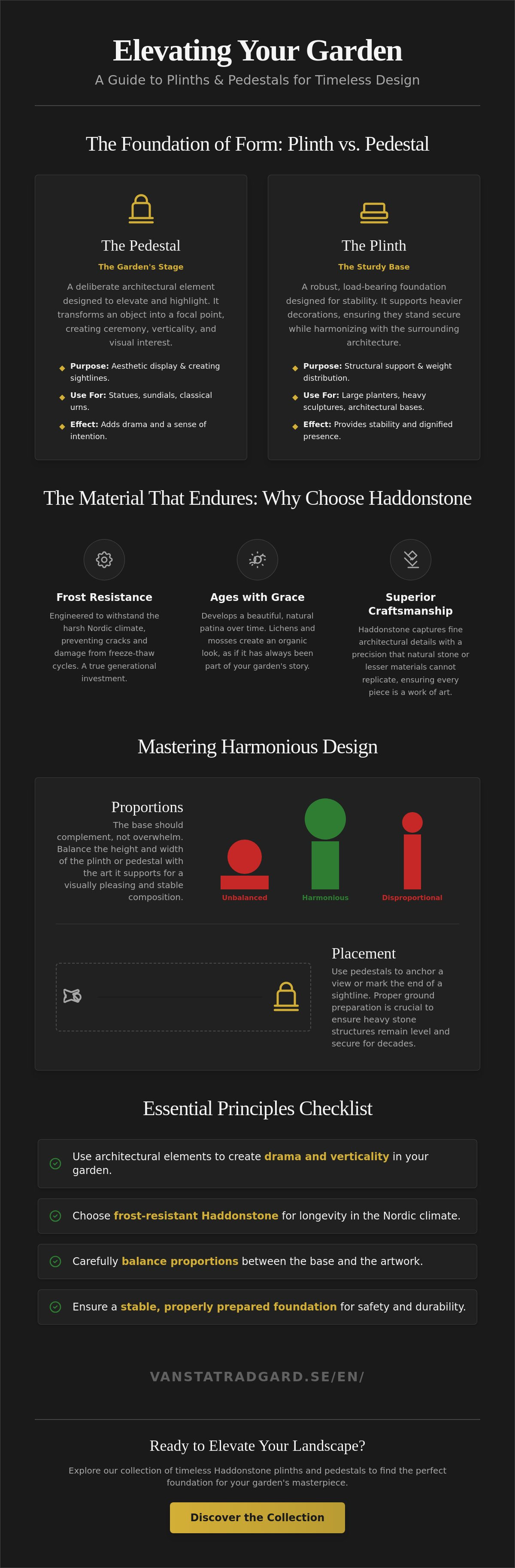
Dans l'architecture de jardin classique, la distinction entre le purement fonctionnel et le sublime esthétique est souvent subtile, mais absolument cruciale. Un piédestal architectural sert délibérément à mettre en valeur des éléments sculpturaux, tandis qu'un socle traditionnel est souvent considéré comme une base porteuse pour des constructions plus lourdes. Comprendre le différence entre un socle et un piédestal Le socle est fondamental pour créer un environnement qui respire à la fois stabilité et élégance. Alors que le secteur de la construction le perçoit souvent comme une solution purement technique d'ancrage, nous considérons ces éléments comme faisant partie intégrante de l'âme et de l'expression globale du jardin.
Pour un aperçu pratique de la manière dont les socles sont traditionnellement utilisés comme éléments porteurs dans les projets de construction plus fonctionnels, vous pouvez visionner cette vidéo pédagogique :
Le piédestal comme point d'exclamation du jardin
Le piédestal est la scène du jardin. Il change tout. En surélevant une statue, un cadran solaire ou une urne classique, on crée instantanément un sentiment de cérémonie et d'intention.Dans les jardins nordiques plats, le besoin de verticalité est primordial ; sans variations de hauteur, le regard se perd facilement à l’horizontale. Un piédestal judicieusement placé marque le point d’arrivée du regard et offre un répit à l’œil. Il ne s’agit pas simplement de surélever un objet, mais de transformer un coin discret en un élément de design délibéré qui invite à la réflexion. Lorsque vous choisissez socles & piédestaux Avec nos collections en pierre reconstituée, vous investissez dans un savoir-faire qui structure votre jardin même pendant les mois d'hiver sans feuilles.
Socles pour décorations plus lourdes
À mesure que l'on s'oriente vers des socles plus robustes, l'accent est mis sur la stabilité et la capacité de charge, sans pour autant sacrifier l'esthétique. Les grands pots, comme un magnifique vase Versailles rempli de terreau humide, nécessitent une base plus large afin d'éviter d'endommager le substrat ou de renverser le vase. Dans ce cas, l'harmonie esthétique entre le socle et l'objet qu'il supporte devient primordiale. Un socle en pierre reconstituée de Haddonstone s'intègre parfaitement à l'architecture de la maison, contrairement à un simple socle en béton. Il supporte le poids avec élégance. Le choix du matériau est ici crucial : un socle doit non seulement supporter un poids considérable, mais aussi résister à l'humidité du sol et aux dégâts du gel pendant des décennies sous le climat suédois. C'est cet équilibre entre précision technique et beauté intemporelle qui caractérise une architecture de jardin réussie.
Le matériau qui fait la différence : Pourquoi choisir la pierre reconstituée Haddonstone ?
Le choix des matériaux est fondamental pour la perception d'un jardin et sa pérennité. Haddonstone représente le summum de la pierre reconstituée, un matériau qui allie la beauté naturelle du calcaire à une durabilité souvent supérieure à celle de la pierre naturelle. Il est facile de se laisser séduire par les tendances éphémères des réseaux sociaux, qui mettent en avant des matériaux légers comme le plastique ou les composites, mais ces derniers manquent de la profondeur et de l'âme nécessaires pour ancrer un aménagement classique. Haddonstone, quant à lui, possède une richesse intrinsèque. histoire de la pierre reconstituée qui remonte à l'Antiquité, et sa capacité à saisir les détails architecturaux les plus fins fait de chaque objet une œuvre d'art unique.
L'une des propriétés les plus envoûtantes de ce matériau réside dans son interaction avec la nature. Au lieu de se décolorer ou de s'effriter, la pierre vieillit avec une grâce rare. Au fil des ans, une patine naturelle se développe, sur laquelle lichens et mousses peuvent s'installer, permettant ainsi à votre socles & piédestaux Elles se fondent harmonieusement dans la végétation, créant une impression d'intemporalité ; comme si elles avaient toujours veillé sur les allées et les perspectives du jardin.
Résistance au gel et longue durée de vie
Pour ceux d'entre nous qui vivons dans une région aux températures très variables, la résistance au gel n'est pas un luxe, mais une nécessité. La pierre reconstituée Haddonstone possède une densité extrêmement élevée, fruit d'un procédé de fabrication unique et rigoureusement contrôlé. En minimisant la porosité, on empêche l'eau de pénétrer au cœur de la pierre. Ceci est crucial durant les hivers suédois. En gelant, l'eau se dilate, ce qui, dans les matériaux plus poreux, entraîne inévitablement des fissures et une dégradation. Nos socles sont conçus pour rester à l'extérieur toute l'année, qu'ils soient recouverts d'un manteau de neige scintillant ou exposés aux pluies torrentielles d'automne. L'entretien est minimal : un léger brossage suffit généralement à préserver leur intégrité structurelle pendant des décennies.
Le savoir-faire derrière chaque détail
Chaque élément est le fruit d'un savoir-faire artisanal exigeant patience et précision. Le processus débute par la fabrication de moules à la main, où la pierre est façonnée avec précision pour garantir la perfection de chaque courbe. Un piédestal classique se compose généralement de trois parties distinctes : la base, le fût et le plateau. Cette division en trois parties n'est pas uniquement esthétique.Il permet au matériau de travailler naturellement et offre une résistance optimale capable de supporter des urnes ou des statues très lourdes sans risque d'affaissement.
Le choix des couleurs joue également un rôle crucial dans l'atmosphère finale. La lumière Portland donne une impression nette et classique, tandis que Bain offre une tonalité plus chaude et dorée qui rappelle les demeures de campagne anglaises. Pour ceux qui recherchent une chaleur d'inspiration méditerranéenne, il existe Terre cuite, une couleur qui resplendit magnifiquement sous le soleil couchant. Choisir la bonne socles & piédestaux Il s'agit de créer un lien visuel entre la façade de la maison et les espaces verts du jardin. Si vous souhaitez découvrir le rendu et le toucher de ces matériaux en situation réelle, vous pouvez consulter notre sélection sur [lien manquant]. Jardin Vansta.
Choisir la hauteur et le design appropriés pour votre point focal
Composer un jardin consiste en grande partie à guider le regard du spectateur à travers des perspectives harmonieuses. Ici, le choix judicieux de socles & piédestaux Le socle sert de repère architectural, structurant le paysage. On croit souvent, à tort, qu'il n'est qu'un support passif ; or, c'est lui qui détermine si une œuvre d'art est perçue comme faisant partie intégrante de son environnement ou comme un élément étranger. Les proportions entre le socle et l'objet qu'il supporte sont absolument essentielles à l'harmonie de l'ensemble. En règle générale, la largeur du socle doit correspondre à celle de la base de l'urne, tandis que sa hauteur doit être adaptée à l'échelle de l'environnement et à la perspective recherchée.
Le choix de la hauteur d'un cadran solaire requiert une réflexion différente de celle nécessaire pour une statue. Un cadran solaire s'installe idéalement à une hauteur permettant une lecture aisée de l'heure, généralement à hauteur de la taille. Une statue, en revanche, peut nécessiter d'être placée bien plus haut pour dominer un espace ouvert ou être visible au-dessus de la végétation environnante. L'équilibre entre la décoration du piédestal et l'objet qu'il supporte est un art en soi. Un piédestal richement orné appelle souvent un objet plus sobre pour éviter une surcharge visuelle, tandis qu'une colonne simple et austère peut mettre en valeur une sculpture détaillée.
L'importance de la hauteur pour la perspective
Le choix de la hauteur des socles influence notre perception de l'espace du jardin. Les socles bas sont souvent utilisés pour les urnes imposantes et larges, car on recherche une impression de stabilité et une élégance au ras du sol. Ils s'intègrent parfaitement le long des murets ou sur les paliers d'escalier. Les piédestaux hauts, quant à eux, ont le pouvoir d'élever le regard vers la cime des arbres ou l'horizon, créant ainsi une perspective spectaculaire dans le jardin. Les dimensions standard de 68 et 76 cm (environ 27 et 30 pouces) sont des choix classiques qui correspondent à la plupart des idéaux des jardins européens. Un piédestal de 68 cm offre une échelle humaine près d'un coin salon, tandis qu'un piédestal de 76 cm est souvent nécessaire pour qu'un objet prenne toute sa place au bout d'une longue allée.
Guide de style : De l’époque élisabéthaine à nos jours
Le choix du design doit toujours refléter l'âme de la maison. Un socle élisabéthain, avec ses références historiques et ses panneaux caractéristiques, apporte immédiatement une touche de tradition et convient parfaitement à une architecture ancienne ou à un jardin à la française. Dans des environnements plus contemporains, un piédestal lisse et sans ornement est souvent le plus approprié. Il sert alors de fond discret, laissant toute la place à l'œuvre d'art qui le supporte. Pour créer un ensemble harmonieux et complet, vous pouvez avantageusement combiner vos choix avec d'autres éléments. fontaines d'Haddonstone. En reprenant le même langage stylistique et les mêmes choix de matériaux pour les fontaines et les socles, on crée un fil conducteur esthétique qui respire le raffinement et une exclusivité intemporelle.
Installation et positionnement pour un effet maximal
Installation socles & piédestaux La pose de pierre reconstituée exige la même rigueur architecturale que le choix du design lui-même. Le poids du matériau est un gage de qualité et de durabilité, mais il impose également des fondations capables de résister aux mouvements de terrain dus au gel ou aux variations du sol. Avant même la livraison, le terrain doit être soigneusement préparé avec une couche de gravier stable et une surface parfaitement plane. Une base irrégulière crée des tensions invisibles dans la pierre. Avec le temps, ces tensions peuvent provoquer des fissures, surtout lorsque le matériau est exposé aux rigueurs du climat nordique. Il s'agit d'offrir à votre œuvre d'art les conditions techniques optimales pour une longévité exceptionnelle, de génération en génération.
Installation technique sur un lit de sable et de ciment
Pour une répartition optimale du poids, nous recommandons un lit de mortier composé de huit parts de sable pour une part de ciment. Ce mélange 8:1 crée une base stable et suffisamment flexible pour supporter le poids de la pierre sans engendrer de contraintes de torsion ou de balancement néfastes. Ce détail technique, souvent négligé dans les guides simplifiés, est pourtant essentiel à la stabilité à long terme de la structure. Lors de l'assemblage d'un piédestal composé de plusieurs éléments (base, fût et plateau), il est important que chaque pièce soit parfaitement centrée. Laissez le support et les premières pièces durcir correctement avant d'y placer l'urne ou la statue définitive. La patience lors de l'assemblage est un gage de beauté future.
Emplacement dans la salle de jardin
L'emplacement est le moment où l'architecture de jardin prend véritablement vie. Un piédestal judicieusement placé peut se révéler secret ; partiellement dissimulé derrière un buisson luxuriant, il crée un sentiment de mystère et de découverte pour ceux qui flânent le long des allées du jardin. Dans une cour ouverte ou au bout d'une allée bordée d'une haie taillée, il devient au contraire une pièce maîtresse majestueuse qui structure l'ensemble de l'espace extérieur.
Pour ceux qui souhaitent estomper la frontière entre nature sauvage et intérieur ordonné, les socles peuvent avantageusement être intégrés dans serres conçues par des architectes. À l'abri des parois de verre, ces supports peuvent accueillir des plantes plus délicates ou des bustes classiques, créant ainsi un jardin d'hiver à l'élégance intemporelle, même durant les mois les plus sombres. Jouer avec les perspectives, c'est envisager le jardin comme une succession de scènes soigneusement agencées. Chaque socle doit avoir une fonction et un rôle à jouer dans l'harmonie de votre propriété. Si vous souhaitez des conseils personnalisés sur la meilleure façon de préparer le terrain ou de placer vos éléments en pierre, n'hésitez pas à nous contacter. Rendez-vous à Vansta Garden pour obtenir une assistance spécialisée.
Favoris sélectionnés de la collection de Vansta Trädgård
Notre sélection d'éléments architecturaux est soigneusement choisie pour répondre aux exigences les plus élevées en matière de forme et de durabilité. Parmi nos pièces les plus appréciées, on retrouve le socle élisabéthain, un classique indémodable qui incarne la tradition des jardins anglais. Ce modèle, avec sa géométrie équilibrée et son élégance discrète, sublime presque tous les environnements. Investir dans la qualité, c'est opter pour des produits haut de gamme. socles & piédestaux L'apport de Haddonstone va bien au-delà d'une simple amélioration esthétique ; il s'agit d'un investissement pérenne qui rehausse le prestige architectural de la propriété. Lorsque les futurs visiteurs découvriront un jardin où chaque détail témoigne d'un savoir-faire exceptionnel, une impression d'exclusivité et de soin à long terme se dégagera.
Socle élisabéthain – Analyse détaillée
Le socle élisabéthain n'est pas qu'une simple fondation ; c'est un hommage au savoir-faire qui a caractérisé les domaines ruraux britanniques pendant des siècles.Ses panneaux latéraux créent un subtil jeu d'ombres qui donne vie à la pierre même par temps nuageux, en faisant un élément dynamique du paysage. Ce socle est réputé pour sa construction robuste en trois parties, lui conférant une durabilité exceptionnelle. La base, le fût et le plateau étant des éléments distincts, le poids est réparti de manière optimale, minimisant ainsi le risque de tassements indésirables au fil du temps. Le modèle Elizabethan est disponible en plusieurs dimensions, permettant d'adapter son impact visuel à l'échelle du jardin. Une version plus imposante confère une présence majestueuse à une vaste pelouse, tandis que les modèles plus petits créent une ambiance intime dans une cour fermée. Nous recommandons souvent d'associer ce socle à des urnes classiques pour créer un point focal à la fois ancré dans l'histoire et d'une modernité intemporelle.
Élégance fonctionnelle dans les moindres détails
Beaucoup de nos plus populaires socles & piédestaux Les tiges sont creuses. Ce perfectionnement technique facilite la levée et l'installation, tout en offrant un avantage pratique aux jardiniers soucieux de l'esthétique de leur jardin. L'espace creux permet le passage discret des câbles, idéal pour éclairer une œuvre d'art par le dessous ou intégrer des solutions techniques discrètes sans perturber l'harmonie visuelle. Pour certains vases, comme l'élégant Vase Versailles, nous proposons des socles aux dimensions précises, assurant une transition harmonieuse entre le vase et la base. Il en résulte une uniformité architecturale difficilement atteignable avec des solutions standard.
Achetez votre piédestal en ligne avec livraison sécurisée
Commander des produits en pierre lourde peut sembler complexe, mais nous avons optimisé le processus pour le simplifier au maximum. Chaque objet est expédié en toute sécurité sur une palette et livré directement chez vous par des partenaires logistiques soigneusement sélectionnés, conscients de la valeur des marchandises qu'ils transportent. En choisissant un expert comme Vansta Trädgård, vous bénéficiez d'une expertise qui va bien au-delà du simple produit. Nous vous accompagnons dans le choix de la couleur et du modèle pour que le résultat soit à la hauteur de vos attentes. Découvrez l'ensemble de notre collection et Trouvez le piédestal ou le socle parfait pour commencer dès aujourd'hui la transformation de votre jardin.
Créez un héritage durable dans votre jardin
Transformer votre espace extérieur en un lieu de ressourcement intemporel exige bien plus que de la simple verdure ; il faut une structure architecturale solide qui ancre le design dans le paysage. En comprenant l’interaction subtile entre forme et fonction, vous disposez désormais des outils nécessaires pour faire le bon choix. socles & piédestaux qui non seulement mettent en valeur vos œuvres d'art, mais constituent également un élément essentiel de l'esthétique de votre jardin. Nous avons constaté comment le choix de la pierre reconstituée artisanale de la vénérable manufacture Haddonstone garantit un socle résistant au gel et d'une durabilité à toute épreuve, capable de défier les hivers nordiques les plus rigoureux tout en se patinant avec une grâce rare.
Chaque détail, des proportions harmonieuses de la série Elizabethan à la précision technique de l'installation, contribue à créer un ensemble où votre jardin prend de la valeur année après année. Grâce à notre service de livraison à domicile sécurisé sur palettes dans toute la France, passer de l'idée à la réalisation de votre aménagement paysager est simple et sûr. Faites de votre jardin le prolongement de votre maison, où la qualité et le savoir-faire artisanal occupent toute la place qu'ils méritent.
Découvrez ici notre sélection exclusive de socles et de piédestaux
Nous nous réjouissons à l'idée d'être votre conseiller de confiance pour vous accompagner dans la réalisation de vos rêves architecturaux et la création d'un environnement extérieur qui respire l'harmonie, la fierté et la pérennité pour l'avenir.
Questions fréquentes concernant les socles et les piédestaux
Vos socles et plinthes sont-ils résistants au gel ?
Oui, tous les produits en pierre reconstituée Haddonstone sont entièrement résistants au gel et conçus pour supporter le climat nordique tout au long de l'année. Leur haute densité empêche l'eau de pénétrer la pierre, éliminant ainsi tout risque de dégâts dus au gel, même durant les hivers les plus rigoureux. Ils constituent ainsi un choix fiable pour une architecture de jardin durable, conçue pour durer des générations.
Quel poids peut supporter un socle en pierre reconstituée ?
Nos socles sont conçus pour supporter des charges importantes, des urnes classiques aux statues et cadrans solaires massifs. La capacité de charge exacte varie selon les modèles, mais leur conception architecturale en plusieurs parties garantit une répartition uniforme du poids sur toute la base. La plupart de nos modèles standards supportent aisément les objets les plus lourds de notre sélection.
Dois-je couler une dalle de béton sous mon piédestal ?
Une dalle de béton massif n'est pas toujours nécessaire, mais des fondations planes et stables sont absolument essentielles pour la sécurité. Nous recommandons souvent une couche de gravier compacté, suivie d'une fine chape de mortier, afin de garantir une parfaite horizontalité du socle. Ceci évite que les tassements de terrain n'endommagent la pierre ou ne provoquent l'inclinaison de l'ensemble de la structure au fil du temps.
Puis-je utiliser un piédestal à l'intérieur d'une orangerie ?
Oui, notre socles & piédestaux Ces éléments s'intègrent parfaitement à la décoration intérieure des orangeries et des jardins d'hiver. Ils mettent idéalement en valeur bustes, plantes exotiques ou œuvres d'art et créent une ambiance d'élégance classique sous la verrière. Grâce à l'aspect pierre naturelle du matériau, ils contribuent à une atmosphère raffinée dans tous les espaces où architecture et verdure se rencontrent.
Comment nettoyer mes socles de la mousse et des algues ?
De nombreux propriétaires de jardin apprécient la patine naturelle qui se forme avec le temps, mais si vous souhaitez nettoyer la pierre, de l'eau tiède et une brosse douce suffisent généralement. Évitez les produits chimiques agressifs et les nettoyeurs haute pression, car ils risquent d'endommager la fine structure de surface et les détails complexes de la pierre. Pour les taches plus tenaces, il existe des produits de nettoyage spécialement conçus, doux pour la pierre reconstituée et qui préservent son éclat d'origine.
Le socle est-il livré en une seule pièce ou en plusieurs parties ?
La plupart de nos modèles sont livrés en trois parties distinctes : la base, le fût et le sommet. Cette conception ingénieuse facilite la manutention lors de la livraison et accroît la durabilité en permettant au matériau de travailler naturellement. Lors de l’assemblage, les pièces sont soigneusement centrées les unes sur les autres afin de créer une colonne stable et esthétiquement aboutie, capable de résister à des contraintes importantes.
Quelle couleur de pierre reconstituée choisir pour mon jardin ?
Le choix de la couleur doit s'harmoniser avec votre maison et son architecture. Portland offre une teinte blanc-gris classique et élégante, tandis que Bath propose une nuance dorée plus chaude, évoquant le grès ancien. La couleur terracotta est idéale pour les environnements d'inspiration méditerranéenne. Nous serons ravis de vous aider à trouver la teinte qui mettra le mieux en valeur le style et l'atmosphère uniques de votre propriété.
Comment empêcher mon piédestal de basculer ?
La clé de la stabilité réside dans des fondations parfaitement équilibrées et un positionnement centré de l'objet supporté. En utilisant une fine couche de mortier entre les différentes parties de socles & piédestaux, On obtient ainsi un ensemble cohérent qui résiste solidement au vent et aux intempéries. Il est également important de choisir un socle dont la largeur de la base correspond au poids et aux dimensions de l'urne.