

A garden that loses its character as soon as the first frost bites the ground is an incomplete architectural composition. Many garden owners have the tiresome experience of planters cracking in sub-zero temperatures or m…
Frost-Proof Cast Stone Planters: A Guide to Timeless Garden Architecture 2026
17 Jun 2026
A garden that loses its character as soon as the first frost bites the ground is an incomplete architectural composition. Many garden owners have the tiresome experience of planters cracking in sub-zero temperatures or materials losing their luster and looking cheap after just one season outdoors. It's a constant challenge to find those objects with classic proportions that truly give weight and authority to an outdoor environment. By choosing frost-proof cast stone planters, you invest in far more than just a container for your plants; you add a lasting element that combines artisanal beauty with technical reliability adapted for the Nordic climate.
We understand the longing for a garden that retains its splendor year-round and where every detail ages with inherent dignity. In this guide, you will learn how exclusive cast stone transforms your outdoor environment by combining architectural elegance with extreme durability that withstands the test of time. We highlight the difference between genuine craftsmanship and simpler alternatives, as well as how natural patina over the years transforms each vessel into a unique work of art. You will gain a deeper insight into the material's frost resistance and how to create an environment characterized by harmony, quality, and long-term quality of life.
Key Takeaways
- Understand why genuine frost-proof cast stone planters withstand the Nordic climate even with moist soil throughout the winter season.
- Learn to navigate between dry-cast and wet-cast methods to find the perfect balance between stonemason finish and durability.
- Discover the technical secrets behind correct drainage and installation that protect your architectural investments against frost damage.
- Get guidance on how to use scale and placement to create harmonious focal points that enhance the character of your home.
- Explore the legacy of Haddonstone and how their craftsmanship combines historical tradition with modern durability in outdoor environments.
What defines genuinely frost-proof cast stone planters?
Cast stone is a material that combines the best of two worlds. It creates a visual experience reminiscent of classic, hand-carved limestone, but possesses a technical durability that often surpasses nature's own creations. The term Cast stone describes a refined manufacturing process where carefully selected aggregates and binders create a material free from the hidden cracks and sedimentary weaknesses often found in natural stone. It is this homogeneous structure that forms the basis for its extreme weather resistance.
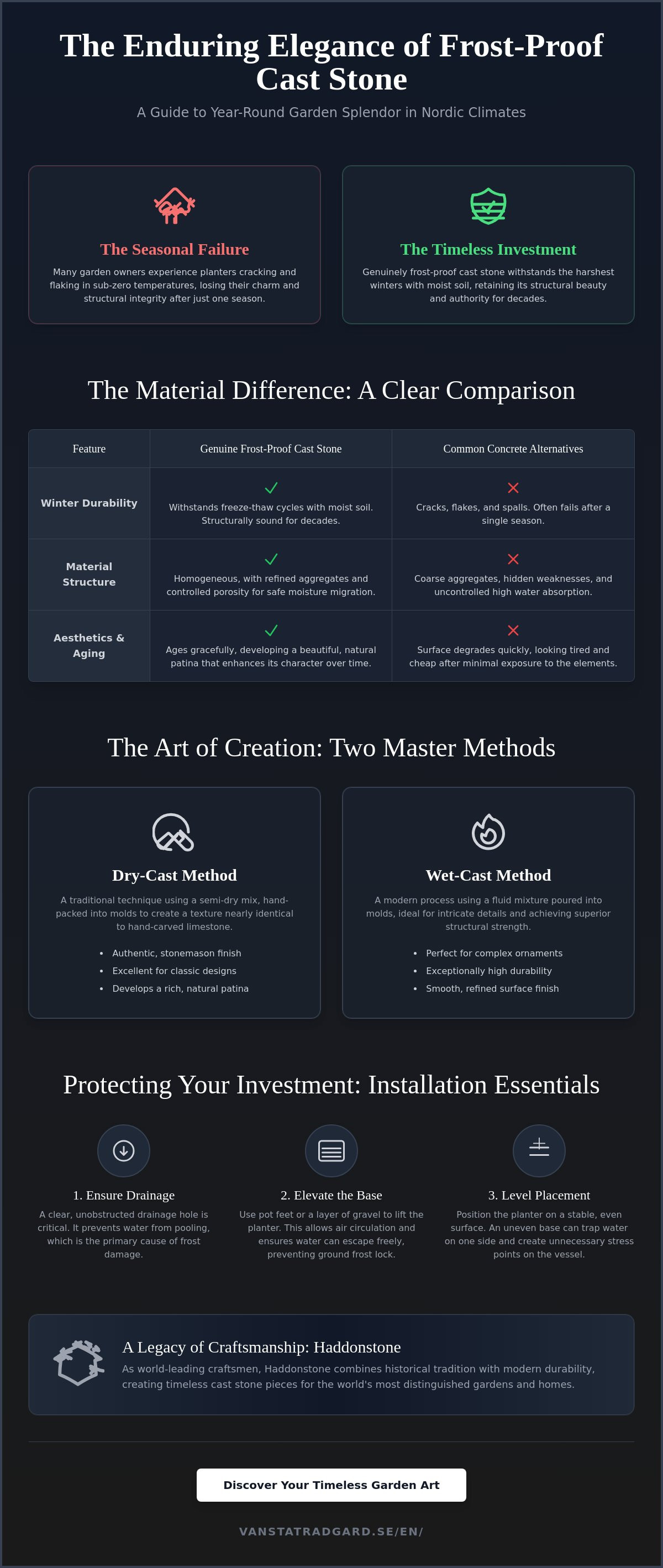
When we talk about frost-proof cast stone planters, we refer to objects that retain their structural integrity even during the most demanding Nordic winter months. Unlike simpler alternatives, often referred to as merely frost-tolerant, a genuinely frost-proof construction means that the vessel can remain outdoors with moist soil year-round. It's about the material's ability to handle capillary action. Controlled porosity allows moisture to expand and migrate through the material without causing the internal tension that leads to frost damage. This is a crucial difference between a pot looking good on the surface and it actually retaining its strength for decades.
To gain a deeper understanding of how to best care for your plants and vessels during the cold months, we recommend this guiding video:
Unique properties of cast stone
One of the primary advantages of high-quality cast stone is its ability to breathe. The material allows moisture to migrate through its structure without damaging the aesthetic surface, creating a natural balance that mimics living stone. Furthermore, the significant weight of cast stone provides unparalleled stability in the garden. In a time when weather changes are becoming increasingly unpredictable, it is reassuring to know that your architectural focal points stand firm even when autumn storms howl and the ground shifts.
Why cheap alternatives fail in the Swedish climate
Many garden owners are tempted by mass-produced concrete pots, but the difference in quality quickly becomes apparent when temperatures drop below freezing. Cheaper alternatives often suffer from uncontrolled high water absorption due to inferior binders and coarse aggregate. When the temperature drops, the water in the porous concrete expands, causing the surface layer to flake and the pot to lose its shape. Premium materials use specific recipes that minimize the risk of structural damage. While a standard pot often looks tired after a single season, frost-proof cast stone planters are an investment that only becomes more beautiful with age as the natural patina begins to emerge.
Material Science: Dry-cast vs. Wet-cast cast stone
To understand why some frost-proof cast stone planters preserve their beauty for generations while others crumble, one must look closer at the craftsmanship behind their manufacture. Dry-cast, or semi-dry casting, is a traditional method where the material has a consistency similar to moist sand. By hand-packing this mass into molds, a texture is created that is almost identical to naturally carved limestone. Wet-cast, on the other hand, uses a more fluid mixture that is poured into the molds. This method is ideal for objects with very intricate ornaments and rich details, while also resulting in very high structural strength that can withstand great stresses.
A critical aspect of production is the elimination of unwanted air pockets. When the material is compressed under high pressure, microscopic voids where water could otherwise accumulate, freeze, and thus expand, disappear. The choice of aggregate is equally crucial for the final result. Only crushed stone of the highest quality, with the correct fraction and hardness, ensures that the pot not only looks massive but actually possesses the internal strength to resist extreme temperature fluctuations. As stated in a Cast Stone Institute Technical Bulletin, the material's density and its controlled absorption capacity are key to long-term and reliable frost resistance.
The craftsmanship behind the casting
The craftsmanship behind casting requires both patience and precision. Each mold requires a careful hand to ensure the material is distributed correctly. By manually packing the material, layer by layer, the craftsman ensures that the structure is homogeneous and free from weak points that often arise in automated manufacturing. After the casting itself, a carefully monitored curing process follows, where moisture slowly leaves the stone. It is during these critical weeks that the material gains its final strength and chemical stability. This slow maturation is what ultimately distinguishes an architectural piece from a mass-produced item.
Aesthetics and patina over time
One of the most enchanting qualities of frost-proof cast stone planters is how they live with their surroundings. Unlike plastic or metal, which merely wear out, cast stone develops a beautiful patina that only deepens with age. Over time, sharp edges soften, and the surface comes alive through natural algae growth or lichen that adheres to the stone. This gives the garden a sense of history and permanence. A high-quality stone pot is not just a vessel for plants; it is an antique in the making that connects today's garden with future generations' memories. For those seeking this timeless aesthetic, Vansta Trädgård offers objects that embody precisely this artisanal perfection.
Technical guide for correct installation and drainage
Owning frost-proof cast stone planters provides technical security, but the material's durability is only half the equation. The single most important factor in preventing damage is uncompromising drainage. If water remains in the vessel and freezes, enormous expansion pressure is created that can challenge even the strongest constructions. Correct installation therefore always begins beneath the pot's bottom. By using pot feet or elegant plinths, the vessel is lifted from the ground. This creates a necessary air gap that prevents the drainage hole from freezing to the substrate, allowing excess water to drain freely even during fluctuating temperatures.
Inside the pot, a well-thought-out and methodical layering is required. A generous layer of coarse gravel or expanded clay pellets at the bottom acts as a reservoir for drainage. It is crucial to separate this layer from the potting soil with a good quality geotextile fabric. Without this barrier, soil particles and roots will eventually migrate down and clog the drainage holes. This creates a dangerous bathtub effect where water remains stagnant in the middle of winter. This technical precision is supported by industry standards, which can be read more about in a Cast Stone Institute Technical Bulletin on Freeze-Thaw Durability, emphasizing the importance of managing moisture migration to ensure the material's longevity in cold climates.
Step-by-step: Planting in large cast stone planters
When planting in large architectural vessels, you should avoid packing the soil too tightly at the bottom. An airy soil structure allows roots to breathe and significantly facilitates water drainage. Always place the pot on a stable and well-leveled surface, such as a paved area or compacted gravel. This prevents uneven loading and settling that, in the worst case, can create stress in the cast stone over time. Remember that a well-planned planting is the foundation for both the plant's well-being and the pot's long-term integrity.
Winter preparations for large vessels
Before winter, care is more about the plant's survival than the stone itself. Genuine frost-proof cast stone planters do not need external insulation for their own sake, but for sensitive plants, it may be wise to line the inside of the pot with insulating material already at planting. During winter thaws, you should regularly check that the drainage is working and that no ice is blocking the air gap underneath. A quick check after heavy snowfall ensures that your investment remains intact and visually appealing throughout the season.
Architectural design: Scale and placement in the garden
A well-designed garden is an extension of the home's architecture where every object plays a role in the overall composition. Choosing the right vessel is about more than personal taste; it's about understanding proportions and balance in relation to the house's scale. Frost-proof cast stone planters act as fixed anchors in the landscape and convey a sense of weight and permanence. Placing a stately urn at the end of a pathway or in a sightline from the living room window creates a natural focal point that guides the eye correctly. Symmetry is one of the most powerful tools in classical design. By placing urns in pairs to mark an entrance or a staircase, the transition between outdoors and indoors is emphasized with inherent authority. These elements work particularly well when they frame architect-designed greenhouses, where the delicate lightness of glass meets the massive calm of stone in a harmonious contrast.
Creating spatiality with large vessels
Many garden owners hesitate to use truly large vessels, but in an outdoor environment, it is almost always a mistake to choose objects that are too small. Daring to go up in scale creates an immediate sense of exclusivity and architectural awareness. A generous planter can serve as an effective room divider on an open terrace or in an orangery, helping to define different zones for rest and socializing. By combining the hard, defined surface of cast stone with soft and undulating plants, a dynamic is created that feels both ordered and alive. It is in this encounter between the constructed and the natural that garden architecture truly finds its soul.
Cast stone in combination with other materials
The timeless character and neutral color palette of cast stone make it an ideal partner for other high-quality materials. Imagine how a classic stone planter contrasts with the elegant and detailed finish of outdoor furniture from Oxleys; it's a combination that immediately brings to mind venerable British country estates. For those striving for a cohesive environment, the planters can advantageously be integrated with balustrades, columns, or fountains to create a rhythm in the garden space. This holistic architectural approach should extend all the way into our winter gardens, where the fixed forms continue to spread beauty regardless of whether the ground outside is covered in summer greenery or winter snow.
Explore our entire curated range of classic garden objects at vanstatradgard.se to find the details that elevate your outdoor environment to a new level of elegance.
Haddonstone: World-leading craftsmanship in cast stone
For over five decades, Haddonstone has been synonymous with excellence in outdoor architecture and classical garden art. Their journey began with a clear vision to recreate the stone sculptures of the English country estate tradition with a precision that nature itself rarely achieves. By developing a unique cast stone recipe, they have succeeded in creating a material that not only mimics the tactile surface of limestone but also possesses superior durability. Vansta Trädgård has chosen Haddonstone as its exclusive partner precisely because of this uncompromising artisanal integrity. In a world where mass production is often prioritized, these frost-proof cast stone planters stand as a counterpoint; they are objects created to endure and beautify our outdoor environments for generations.
Why Haddonstone is an investment
An investment in Haddonstone is about more than just aesthetics. Their materials undergo rigorous independent frost tests according to international standards, ensuring they withstand extreme freeze-thaw cycles without losing strength. The precision of their molds allows for a level of detail in ornamentation that often surpasses what is technically possible in natural stone, as natural cleavage planes and sedimentary veins can limit the craftsman. Furthermore, Haddonstone offers a security that is rare today through the possibility of ordering spare parts or complementing a collection with the exact same finish even after several decades. It is a circular philosophy based on quality rather than consumption. Choosing lifelong products is fundamentally one of the most sustainable choices a conscious garden owner can make.
Discover the collection at Vansta Trädgård
The breadth of the assortment ranges from the most magnificent classical urns with historical references to modern, minimalist vessels that harmonize with contemporary architecture. At Vansta Trädgård, we offer personal advice to help you navigate this rich heritage and find the objects that best enhance the character of your property. We understand that choosing the right model and scale is crucial for the final result, and we assist with our expertise in both design and the practical aspects of logistics. Handling heavy, architectural objects requires experience and the right equipment. We ensure that your chosen objects are placed in exactly the right spot with the utmost care. To truly understand the material's unique texture and weight, we invite you to our exhibition. There you can experience how light falls over the stone and imagine how these frost-proof cast stone planters will transform your garden into a place of timeless beauty.
Explore our curated range of Haddonstone planters
Realize your vision with architectural durability
By choosing frost-proof cast stone planters, you create an outdoor environment that not only survives winter's trials but actually grows in beauty with each passing year. We have seen how the combination of the right material choice, like Haddonstone's unique recipe, and a technically correct installation with a focus on drainage lays the foundation for a world-class garden. These objects serve as architectural focal points that give your property a timeless character and a sense of historical continuity.
As an authorized dealer of Haddonstone, we at Vansta Trädgård possess deep expertise in classical garden architecture. Our products are specifically tested for the extreme Nordic climate, giving you technical security in your investment for the future. Discover Haddonstone's exclusive garden art at Vansta Trädgård and let us help you create an outdoor space where quality always comes before quantity. Your garden deserves details that age with the same dignity as the rest of your home.
Frequently asked questions about frost-proof cast stone planters
What is the difference between frost-tolerant and frost-proof?
The difference lies in the material's ability to handle expansion pressure from ice. A frost-tolerant pot can often withstand cold but risks cracking if it contains moist soil that freezes; therefore, these are often recommended to be stored empty or under cover. Genuinely frost-proof cast stone planters, on the other hand, are designed to remain outdoors with moist soil year-round, provided that the drainage functions correctly.
Can I leave the soil in my cast stone planter during winter?
Yes, it is perfectly fine to leave the soil in the planter. The homogeneous structure and high density of cast stone mean it can withstand the pressure from frozen soil. However, it is absolutely crucial that you have a functioning drainage layer at the bottom so that water does not accumulate, as a solid block of ice that cannot expand upwards can damage even the strongest materials.
How heavy are cast stone planters and do they need a reinforced base?
Cast stone is a massive and heavy material; a medium-sized urn often weighs between 70 and 150 kg without soil. Due to this weight, a stable and well-leveled base of stone, concrete, or compacted gravel is required. An uneven base can lead to settling that creates unnecessary stress in the material, while a soft base can cause the pot to sink or tilt over time.
Do I need to treat the cast stone to keep it frost-proof?
No, high-quality cast stone does not need any chemical treatment or sealing to maintain its frost resistance. The material's resilience is created through the specific mixture of aggregate and the hard compression during manufacturing. Applying sealants can actually be negative as it can prevent the stone from breathing and naturally migrating moisture, which is part of its protective mechanism.
How do I clean my stone planters without damaging the patina?
Clean your planters gently with only lukewarm water and a soft natural brush. Absolutely avoid high-pressure washers and strong chemicals as these can etch the surface and remove the beautiful patina of moss and lichens that develops over time. For many, this aged character is a large part of the charm of owning objects made of genuine cast stone.
Which plants are best suited for overwintering in large stone planters?
Hardy woody plants such as boxwood, yew, and various forms of dwarf conifers are ideal for permanent planting. Robust perennials that can withstand frozen roots also work well. The thick walls of cast stone provide some protection against rapid temperature changes, but remember that the plant's own cold hardiness is always the governing factor for successful overwintering.
Why are drainage holes so important for frost resistance?
The drainage hole acts as a safety valve for your planter. Without a free outlet for excess water, a bathtub effect is created where water saturates the soil and then expands significantly when it freezes into ice. By keeping the drainage hole open, you eliminate the primary cause of vessels cracking during the winter months, regardless of the material's quality.
Can cast stone planters crack if it gets extremely cold?
The material itself tolerates extreme cold without problems, but cracks can occur if handling is incorrect. If drainage is blocked and water freezes inside the vessel, the expansion pressure can become too great. By using pot feet and ensuring correct layering of drainage material, you minimize the risk and can feel confident with your frost-proof cast stone planters even during the harshest winters.