

En hagebygning på 30 kvadratmeter er ikke bare en plass for dyrking; det er et arkitektonisk utsagn som foredler karakteren og sjelen til hele eiendommen. Når du begynner å utforske et arkitekttegnet drivhus ...
Arkitektdesignet drivhuspris: Invester i 30 kvm med arkitektonisk eleganse i 2026
27. mai 2026
En hagebygning på 30 kvadratmeter er ikke bare et sted for dyrking; det er et arkitektonisk uttrykk som foredler karakteren og sjelen til hele eiendommen. Når du begynner å utforske en pris på arkitekttegnet drivhus, du innser raskt at investeringen strekker seg langt utover enkle materialvalg. Det handler om å skape et tidløst sted for gjenoppretting der håndverk og estetikk møtes i en nesten poetisk harmoni med hagens naturlige elementer.
Vi forstår at veien til et spesialbygd orangeri kan føles komplisert, spesielt med frykten for skjulte kostnader eller usikkerhet om hvordan du best navigerer de siste juridiske endringene. Du ønsker et klart bilde av hva som kreves for å realisere visjonen din uten å bli sittende fast i byråkratiske hindringer. Denne veiledningen er laget for å gi deg full åpenhet om investeringsbehovene og de juridiske forholdene som gjelder i 2026.
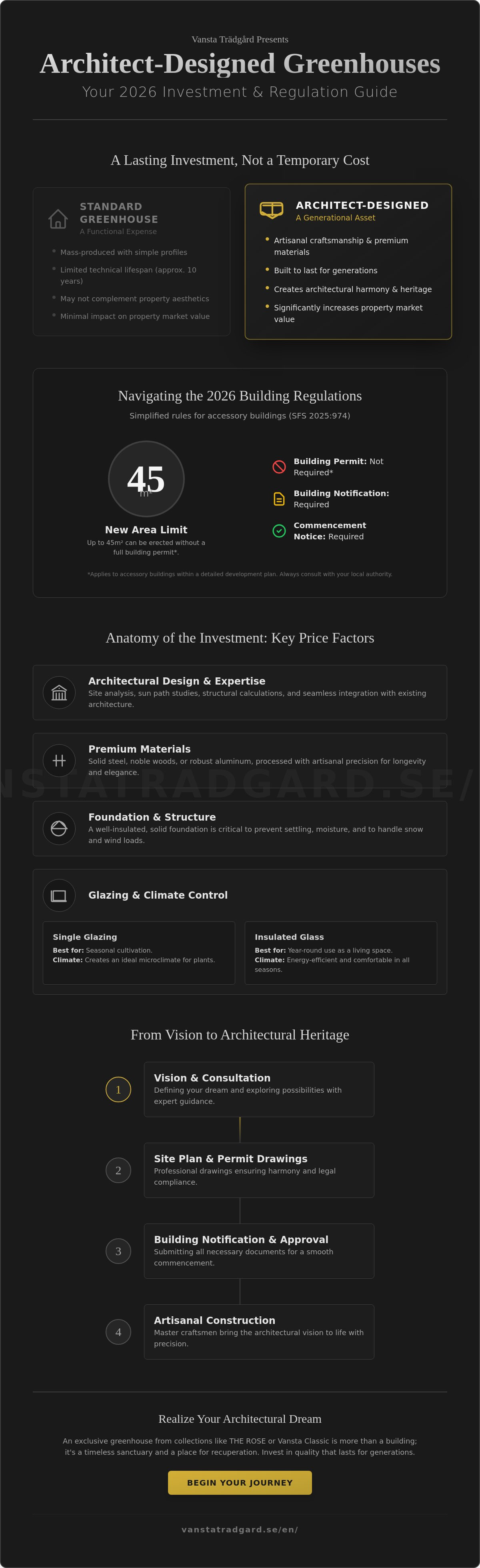
Vi lover å gi deg verktøyene som trengs for å forvandle hagedrømmen din til et arkitektonisk mesterverk. Ved å forklare de nye reglene for tilleggsbygg i henhold til SFS 2025:974, hvor opptil 45 kvadratmeter nå kan oppføres uten byggetillatelse innenfor en detaljert utviklingsplan, får du et sikkert grunnlag for din beslutning. Vi fordyper oss i hvordan juridisk presisjon og kompromissløs design samarbeider for å skape varig verdi for fremtiden.
Viktige konklusjoner
- Forstå hvordan pris på arkitekttegnet drivhus gjenspeiler en langsiktig eiendomsinvestering snarere enn en midlertidig kostnad ved å prioritere håndverksmessig kvalitet og tidløs design.
- Få klarhet i de nye byggeforskriftene for 2026, som tillater opptil 45 kvadratmeter areal som krever byggemelding, og lær å håndtere kravene til en kritisk igangsettingsmelding.
- Oppdag hvordan valget mellom enkeltglass for dyrking og isolerglass for helårsbruk påvirker både bygningens funksjonelle klima og dens arkitektoniske uttrykk.
- Lær hvorfor profesjonelle byggetillatelsestegninger og en gjennomtenkt tomteplan er avgjørende for at bygningen skal harmonere med eiendommens eksisterende arkitektur.
- Bli inspirert av hvordan eksklusive kolleksjoner som THE ROSE og Vansta Classic forvandler en funksjonell glassstruktur til en arkitektonisk arv og et sted for gjenoppretting.
Pris på arkitekttegnet drivhus: Hva koster en spesialdesignet drøm i 2026?
Å spørre om en pris på arkitekttegnet drivhus er litt som å spørre om verdien av et kunstverk basert på størrelsen på lerretet. For den kresne huseieren handler det ikke bare om kvadratmeter, men om hvordan en glassstruktur kan forbedre hele bomiljøet. Et spesialbygd prosjekt betyr en unik symbiose mellom lys, klimakontroll og en estetisk profil som taler samme språk som din hovedbolig. Det er en investering i livskvalitet som krever en dypere forståelse av både håndverk og arkitektonisk integritet.
Det er her forskjellen mellom et masseprodusert produkt og ekte håndverk blir tydelig.Standardløsninger med enkle profiler mangler ofte tyngden og sjelen som kreves for å virkelig integreres i et historisk miljø. I stedet jobber vi med materialer som massivt stål, edelt tre eller robust aluminium bearbeidet med håndverkspresisjon. Ved å investere i et arkitekttegnet drivhus skaper du et sted som ikke bare fungerer som en plantestøtte, men som en permanent forlengelse av hjemmet ditt, hvor form og funksjon danser i harmoni.
For å bedre forstå hvordan du velger riktig modell og hva som påvirker investeringen din, anbefaler vi denne veiledende videoen:
Investeringens anatomi: Design, materialer og ekspertise
En arkitekts primære oppgave er å tolke de unike forholdene på stedet. Dette inkluderer alt fra hvordan solstrålene faller i ulike årstider til hvordan bygningens proporsjoner møter de eksisterende hagens linjer. Den tekniske designen, som inkluderer strukturelle beregninger for snølast og vindtrykk, er en usynlig, men kritisk del av kostnaden. For prosjekter som faller inn under de nye forskriftene, er det lurt å konsultere Høstregler for drivhus for å sikre at din 30 kvadratmeter store drøm overholder gjeldende lovgivning uten unødvendig byråkrati. Et solid og godt isolert fundament er en annen faktor som ofte undervurderes, men som er avgjørende for å unngå setninger og fuktproblemer i fremtiden.
Langsiktig verdi og eiendomsmarkedsverdi
En eiendomsinvestering av dette kaliberet bør betraktes som en arkitektonisk arv. Der et enklere drivhus kan ha en teknisk levetid på et tiår før materialene brytes ned, er våre konstruksjoner bygget for å vare i generasjoner. Et godt designet orangeri øker ofte eiendommens markedsverdi betydelig mer enn den faktiske byggekostnaden. Det handler om å skape et unikt salgsargument; et atmosfærisk miljø som fremtidige kjøpere ser på som en uvurderlig ressurs for både estetikk og funksjon. Ved å inkludere parametere som minimalt vedlikehold og energieffektiv drift i beregningen, blir det tydelig at den første investeringen lønner seg gjennom både daglig glede og fremtidig økonomisk avkastning. Kvalitet er alltid den mest lønnsomme veien når man skaper noe varig.
Attefallregler for 30 kvm drivhus: Regler og rammeverk 2026
Å realisere et drivhus på 30 kvadratmeter er en sofistikert balansegang mellom estetisk visjon og juridisk presisjon. Selv om området faller innenfor de generøse rammene for tilleggsbygg, kreves det en metodisk tilnærming til regelverket for å sikre at investeringen din forblir en kilde til ren glede. pris på arkitekttegnet drivhus inkluderer ofte den uvurderlige sikkerheten som følger av at tegninger er presist tilpasset gjeldende krav til mønehøyde og areal, noe som minimerer risikoen for kostbare korreksjoner senere.
Fra og med de nye byggeforskriftene som trådte i kraft 1. desember 2025 (SFS 2025:974), har rammene for hva som kan oppføres uten tradisjonell byggetillatelse blitt endret til å være mer generøse. For et areal på 30 kvadratmeter faller bygningen inn under den totale