

Outdoor furniture can embody the expression of the Baroque without causing the patio to lose its distinct character. Grande outdoor furniture, inspired by the 18th-century Baroque period, raises questions about how histo…
Grande Outdoor Furniture with Baroque-Inspired Forms for the Patio
25. nov 2026
Outdoor furniture can embody the expression of the Baroque without causing the patio to lose its distinct character. Grande outdoor furniture, inspired by the 18th-century Baroque period, raises questions about how historic forms can find their place within a contemporary garden environment. The Baroque style emerged in Italy around 1600, and its design language provides a rich starting point for exploring the lines and ornamentation of furniture.
It is often the interplay between form and detail that makes a piece of furniture expressive and masterfully crafted. Here you will discover how Baroque materials, curves, and ornaments define Grande outdoor furniture and its seating, dining tables, and chairs, without letting the historical inspiration overwhelm the entire patio.
We take a closer look at how the different components of the furniture form a cohesive whole and how a classical design language can interact with the architecture of the home and the character of the garden. This makes it easier to envision the atmosphere the furniture can create, ranging from a serene seating area to a more formal setting for outdoor dining.
Key Takeaways
- Learn to recognize how materials and ornamentation shape the historical expression of the furniture.
- See how sweeping lines and ornaments can interact with garden architecture without dominating it.
- Gain perspective on how seating, dining tables, and chairs can create a cohesive setting for dining and relaxation.
- Discover which material and care choices are essential when outdoor furniture is exposed to shifting weather.
- Explore how classical furniture can become part of a greater harmony between patio, home, and garden.
Motifs, Materials, and Ornamentation
The design language of the Baroque provides a historical reference when observing the decorative expression of the Grande furniture. Evaluate motifs, materials, and surface finishes individually before assessing the overall piece.
Motifs and Ornamentation
Baroque furniture developed in Europe during the 17th and 18th centuries, with Italy as the birthplace of the style. During the reign of Louis XIV, French furniture evolved with a magnificent design language. When considering Grande, observe how any ornaments interact with the silhouette of the piece, rather than evaluating a single detail in isolation.
Compare, for instance, the chair's backrest, armrests, and legs with the table's edge and base. Recurring curves can create visual unity, whereas a single decorative detail carries greater visual weight. Baroque furniture was often embellished with carved forms and marquetry. These historical examples help you appreciate the richness of detail inherent to the style, but they do not define the specific materials or ornamentation of the Grande furniture.
Materials and Weather Resistance
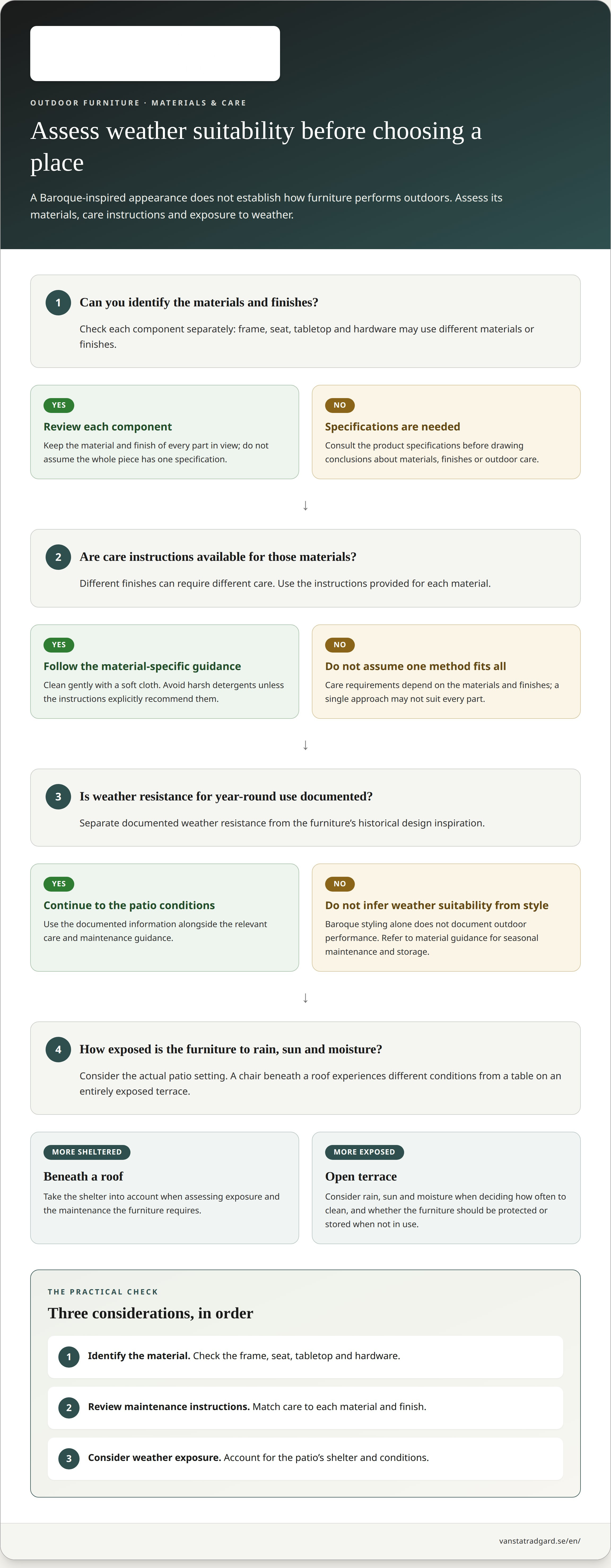
The choice of material affects both the character of the furniture and its maintenance outdoors. Review the specifications for each component: frame, seat, tabletop, and any hardware may feature different materials and finishes. Consider the degree of exposure to rain, sun, and moisture rather than drawing conclusions based solely on Baroque styling.
Exclusive Baroque pieces were historically crafted from wood, veneers, and inlays, yet historical craftsmanship does not dictate how modern outdoor furniture is constructed. For year-round use, it is necessary to distinguish between an aesthetic inspired by period pieces and documented weather resistance. The Swedish climate brings fluctuating conditions, making it essential to follow the material and care guidelines for seasonal storage and maintenance.
Clean Grande gently with a soft cloth and follow the care instructions provided for each material. Avoid harsh detergents unless explicitly recommended, as different finishes require tailored care.
For purchases in the US, warranty terms, delivery conditions, and return policies are outlined in the sales terms applicable to the order. These terms are separate from the historical design language and material description of the furniture.
Carry out a simple three-step evaluation: identify the material, review the maintenance instructions, and consider the weather exposure of your patio. A chair beneath a roof experiences different conditions than a dining table on an entirely exposed terrace. This influences how often the furniture requires cleaning and whether it should be protected or stored away when not in use.
Observe also how the surfaces of the furniture interact with their surroundings. A darker wood tone can accentuate stone paving and masonry, whereas lighter accents can provide a striking contrast against lush greenery. This represents an architectural design choice rather than a measure of durability. Therefore, weigh the overall visual impression alongside the documented maintenance needs of Grande furniture.
Baroque Curves, Ornaments, and Sculptures
In Baroque furniture, lines and details guide the eye across the form. An arched contour generates dynamic movement, while symmetrical ornaments lend structural poise to the composition. On a chair, trace the line running from the top rail of the backrest down through the armrests and legs. Notice how the transitions resolve: do the curves blend seamlessly, or do they establish clear contrasts? Such observations help you understand the design language without mistaking creative inspiration for a historical replica.
A Flemish tortoiseshell mirror from around 1680 demonstrates how ornamentation could frame an entire surface. The decorative motif functions as an integral part of the composition rather than a detached detail. The same principle applies when evaluating garden furniture: observe how an embellished rim, a shaped backrest, or a sculpted leg relates to the primary architectural lines. The sheer volume of details matters less than their placement and subtle dialogue.
Sculptural elements can grant furniture a distinct presence, especially when legs or armrests feature a pronounced profile. An Italian cabinet of curiosities from around 1635 illustrates how silhouette and decoration can work in harmony. This serves as a historical reference, not a description of Grande. When examining contemporary pieces, distinguish between Baroque visual references and the physical details present on the product.
Baroque ornaments can establish rhythm through repetition. On a table, the profile of the legs can visually anchor the top, while the contour of the chair back balances the seat. View the furniture from both the side and the front. A detail that seems prominent up close may appear restrained from a distance. Such comparisons reveal whether the ornamentation unifies the piece or competes with its practical function.
The surrounding environment influences how sculptural silhouettes are perceived. Against a minimalist facade, an undulating profile stands out with greater clarity, whereas plantings and natural stone can soften the impact of ornamentation. Consider the furniture against existing patio materials, such as timber decking, render, or stone paving. Select a placement where contours remain legible without allowing the decoration to overpower the entire garden room.
For a well-rounded assessment, examine three aspects: the outer silhouette of the furniture, the placement of ornaments, and how these details recur between seating and tables. Then, relate this impression to the architecture of your home. Those wishing to see how Baroque inspiration translates into outdoor living can study the design language of Grande furniture in its context, paying close attention to proportions and visible detailing.
Baroque Furniture Inspired by 18th-Century Style
The Baroque design aesthetic evolved across Europe during the 17th and 18th centuries. Originating in Italy, the style flourished from the 1600s through the early 1700s. Consequently, the movement spans several historical phases rather than adhering to a single static template. Modern furniture with Baroque inspiration can adopt proportions, curves, or ornamental reliefs without functioning as an exact reproduction of an antique. Grande outdoor furniture inspired by the 18th-century Baroque period can thus be understood as a contemporary interpretation of a historical design vocabulary.
During the Baroque era, chests of drawers, writing desks, and four-poster beds became more prevalent in private residences. Furniture assumed a larger role in everyday life, while its design served as an indicator of status and craftsmanship. A desk and a canopy bed fulfill distinct functions, yet both reveal how structural design shapes visual weight. The same perspective proves valuable when evaluating a seating group for your patio.
The prolonged evolution of the style is evident in dated artifacts from diverse regions. A Dutch late-Baroque longcase clock, dated to around 1740–1760, postdates the early Italian iterations, demonstrating that the aesthetic continued to adapt over time. For contemporary furniture, this implies that inspiration may draw upon various historical sub-periods rather than replicating one specific archetype.
When analyzing Baroque-inspired furniture, begin with the principal lines. Consider the proportion between legs, seat, and backrest on a chair, or between the tabletop and underframe. Then assess how decorative flourishes influence the whole. A bold profile can convey formal elegance, while subtle detailing allows the silhouette to carry the expression. Balance remains far more critical than the sheer volume of ornament.
Historical Baroque pieces can also provide direction when arranging modern outdoor furniture:
- Compare the chair's height and backline with the visual weight of the dining table.
- Observe whether recurring motifs create cohesion between seating and dining surfaces.
- Determine whether the historical character of the furniture complements the facade and patio materials.
The final consideration concerns how prominently the design language should feature within the garden landscape. Against a classical facade, an ornate piece can visually link with the architecture. In a more austere architectural setting, that same piece can serve as a deliberate focal point. When selecting Grande outdoor furniture inspired by the 18th-century Baroque period, base your choice on functional requirements, spatial proportions, and the historical elements you wish to highlight. In doing so, the inspiration becomes an organic element of the whole rather than a detached stylistic novelty.
The Baroque furniture style originated in Italy and flourished across Europe from the 17th century through the early 18th century. When selecting a modern interpretation, consider which aspects of the aesthetic you wish to emphasize. A gracefully curved contour may suffice to evoke the period, whereas multiple defined details will create a more pronounced presence. Determine whether the furniture should blend seamlessly among the patio's existing shapes or capture immediate attention. Consider also how it is experienced from various vantage points, not solely when seated at the table.
Allow function to carry equal weight with aesthetics. An expressive piece may demand more visual breathing room, whereas a restrained setting permits intricate forms to shine. Evaluate the furniture in relation to its intended setting and the elements already in place. If the setting begins to feel crowded, introduce calmer design elements nearby. If the presence feels too subdued, echo a shape or tonal finish in adjacent accents. This approach ensures your selection balances historical character with the tranquil ambiance you wish to cultivate outdoors.
Baroque-Style Seating, Dining Tables, and Chairs
Baroque furniture brings together commanding presence and everyday practicality. When designing an outdoor living area, start with the functional role of the seating and allow the dining table's form to establish continuity. Grande outdoor furniture inspired by the 18th-century Baroque period can be assessed through the lens of functionality, proportion, and contextual harmony.
Baroque-Style Seating
Chairs, armchairs, and benches provide distinct possibilities for relaxation and hospitality. In Baroque-inspired furniture arrangements, the contour of the backrest, the sweep of the legs, and the design of the armrests often define the visual identity. Compare the side profile with the front proportions of the seating. This will help you decide whether the sculptural form aligns with the remaining patio furniture.
Historic Baroque chairs and canopy beds demonstrate how purpose directly shapes architectural form. On the patio, consider instead how the seating arrangements will be utilized. An armchair can carve out a quiet reading retreat, while multiple chairs gathered around a table facilitate shared meals. Choose a configuration that accommodates both spatial dimensions and natural circulation patterns.
Dining Tables with Baroque Character
A dining table frequently serves as the visual centerpiece of an outdoor space. Observe the tabletop's geometry alongside the lines of the underframe, ensuring any ornamentation feels structurally anchored. While historical Baroque furnishings were often lavishly decorated, a contemporary outdoor space does not require an exact period recreation. A well-defined profile along the edge and base is often enough to impart a classical sensibility.
Arrange the chairs around the table and evaluate the grouping from multiple angles. Confirm that the backrest profiles do not compete with the table's perimeter and that the dimensions suit the entertaining space. For instance, an elongated rectangular table creates a different spatial dynamic than a compact, circular arrangement. Base your decision on proportion and the clearance required around the furniture.
To create a cohesive furniture suite, echo a specific design element, such as a curved contour or a sculpted leg profile. This repetition unifies chairs and tables without necessitating identical ornamentation on every piece. The history of Baroque furniture also demonstrates that various functional items—such as desks and credenzas—retained distinct forms suited to their purpose. On the patio, a consistent visual thread often proves far more successful than uniform ornamentation across every item.
Conclude by evaluating the furniture in relation to your home's exterior and hardscaping materials. A set with defined architectural lines stands out beautifully against minimalist stone paving, while timber decking and lush plantings can soften the composition. Let lifestyle dictate placement: position dining tables where al fresco meals are convenient, and arrange comfortable seating where conversation and leisure can flourish unhurried. In this way, Baroque inspiration assumes an elegant, purposeful role.
Is Grande Outdoor Furniture Weatherproof and Suitable for Year-Round Use?
Baroque styling alone provides no indication of how well furniture will withstand rain, frost, or intense sunlight. To evaluate Grande for year-round outdoor use, rely on the specific materials, surface treatments, and care guidelines provided for each component. A wooden chair and a metal-framed table will respond differently to moisture and temperature fluctuations, even when part of the same collection.
The Scandinavian climate introduces distinct challenges depending on the orientation of your patio. An open terrace exposes furniture to wind-driven rain far more than a sheltered veranda. Sun exposure dictates surface UV wear, while standing water can compromise joints and fasteners. Begin by differentiating between pieces positioned under shelter and those left fully exposed to the elements.
Next, inspect each element individually: frame, seat, tabletop, fittings, and cushions. Materiality and finishes dictate how every component should be cleaned, dried, and protected. A tabletop may require different seasonal care than metal fixings, while outdoor textiles must be maintained according to their specific fabric instructions. Rely on factual care advice rather than assumptions based on classical design.
Ahead of autumn and winter, minimize unnecessary environmental wear through a few dependable routines:
- Clear leaves and organic debris from seats and tabletops.
- Ensure damp surfaces dry completely before furniture is covered or stored.
- Store loose cushions in a dry, ventilated indoor environment when not in use.
- Position furniture where water cannot pool around feet, joints, or bases.
Winter protection is crucial when manufacturer instructions recommend safeguarding against frost and prolonged moisture. A well-ventilated, dry storage space is preferable to tight plastic tarpaulins that trap condensation. If furniture remains outside throughout the year, drainage and air circulation are paramount considerations for positioning. Take care never to drag heavy pieces across stone or timber, which can compromise protective coatings and structural joints.
Year-round enjoyment involves more than leaving furniture exposed outdoors. It requires matching placement, routine cleaning, and winter care to the specific materials and microclimate of your garden. Read about the design of Grande furniture and evaluate each piece with the same architectural rigor you apply to your home.
Vansta Trädgård
Vansta Trädgård is the natural partner when you wish to integrate outdoor furnishings harmoniously with the architecture of your residence and garden. For those envisioning an expansive, unified estate, Vansta Trädgård designs bespoke glasshouses and orangeries where siting, aesthetic refinement, and architectural dialogue take center stage. The curated range includes Vansta Orangerier, Vansta Classic orangeries, and greenhouses from THE ROSE greenhouse collection.
This architectural cohesion becomes especially vital when outdoor furniture is set to complement an elegant glazed structure rather than standing in isolation. Proportions, visual sightlines, and material authenticity define the overarching impression. Contact Vansta Trädgård to explore how a refined architectural whole can be tailored to your home and private landscape.
Shape the Patio Around Your Way of Living
The next step is to imagine how your patio will be used on a daily basis. Is it primarily intended for celebratory meals, peaceful solitary mornings, or lingering evening conversations? When you design around everyday living, it becomes intuitive to align furniture proportions with the residence, surrounding botanical layers, and natural movement outdoors.
Grande, drawing inspiration from the 18th-century Baroque era, can become an architectural anchor in your garden design. Let your decision begin with the complete spatial atmosphere you wish to curate rather than isolated accents. Consider how sightlines unfold from interior rooms and how inviting the patio feels in active use, not merely as a curated scene.
Take the next step by choosing to explore the Grande outdoor furniture and discover how its classical design language complements your estate. A truly inspired outdoor living space emerges when functional elegance and enduring architectural craft meet in perfect harmony.