

Hva om vinterens tyngste snøfall ikke var en trussel mot hagedrømmen din, men snarere den ultimate testen som beviser dens tidløse verdi? Mange hageentusiaster har en gnagende bekymring for at en elegant glassstruktur kan kollapse...
Drivhus som tåler tung snøbelastning: En guide til arkitektonisk holdbarhet 2026
24. jun 2026
Hva om vinterens kraftigste snøfall ikke var en trussel mot hagedrømmen din, men snarere den ultimate testen som beviser dens tidløse verdi? Mange hageentusiaster bærer på en gnagende bekymring for at en elegant glassstruktur kan kollapse når nordavinden feier inn og etterlate et massivt snøteppe. Denne usikkerheten fører ofte til smertefulle kompromisser, der praktiske, men uinspirerende plastmaterialer velges, noe som uunngåelig forringer følelsen av ekte håndverk. Det er imidlertid fullt mulig å realisere visjonen om et arkitekttegnet drivhus som tåler tunge snøbelastninger uten å miste den estetiske finessen som gjør bygningen til en vakker forlengelse av hjemmet ditt.
Vi forstår at sikkerhet og skjønnhet må gå hånd i hånd for å skape en varig investering som pryder sin plass året rundt. I denne guiden lærer du hvordan du kombinerer teknisk presisjon med klassisk design for å møte de mest krevende nordiske forholdene. Vi navigerer gjennom Boverkets nye byggeforskrifter, som trer i kraft i 2026, og viser deg hvordan du dimensjonerer konstruksjonen din i henhold til lokale snøsoner for minimalt vedlikehold og absolutt trygghet.
Viktige konklusjoner
- Forstå hvordan takets helling og profilens spesifikke geometri fungerer sammen for å avlaste snøtrykket på en naturlig måte og beskytte glassstrukturen.
- Lær hvorfor en drivhus som tåler store snøbelastninger krever tekniske beregninger basert på din lokale snøsone og Boligmyndighetenes nyeste forskrifter for 2026.
- Oppdag de arkitektoniske fordelene ved å bygge på en solid vegg, noe som forbedrer både bygningens stabilitet og dens evne til å regulere temperaturen.
- Få veiledning om hvordan du skal navigere byggetillatelsesprosessen for å sikre at drivhuset ditt er lovlig dimensjonert for ekstreme værforhold.
- Utforsk hvordan kolleksjoner som Vansta Classic og THE ROSE kombinerer britisk håndverk med styrken som kreves for et svensk vinterlandskap.
Hva betyr snøbelastning for et drivhus i nordisk klima?
Når vinteren kaster sitt stille teppe over hagen, forvandles landskapet til et poetisk bakteppe; men for en glassstruktur representerer snø en svært håndgripelig fysisk utfordring. Begrepet snølast beskriver den vertikale kraften som snø utøver på en overflate. For å forstå de tekniske kravene bak en slitesterk bygning, kan man spørre: Hva er snølast? I hovedsak handler det om å dimensjonere taket og dets støtteprofiler for å tåle både den statiske vekten av våt snø og de dynamiske kreftene som oppstår ved plutselig snøras. Mange enklere standarddrivhus svikter i Sverige nettopp fordi de spinkle aluminiumsprofilene deres mangler den vridningsstivheten som kreves når trykket er ujevnt fordelt.
En arkitekttegnet drivhus som tåler store snøbelastninger handler ikke bare om tykkere materialer, men om gjennomtenkt ingeniørkunst der alle vinkler jobber sammen for å spre energi. Det handler om å skape en balanse mellom vekt og eleganse.For å visualisere hvordan en robust konstruksjon kan utformes for å tåle ekstreme forhold, anbefaler vi å se følgende video:
Snøsoner i Sverige: Fra Skåne til Lappland
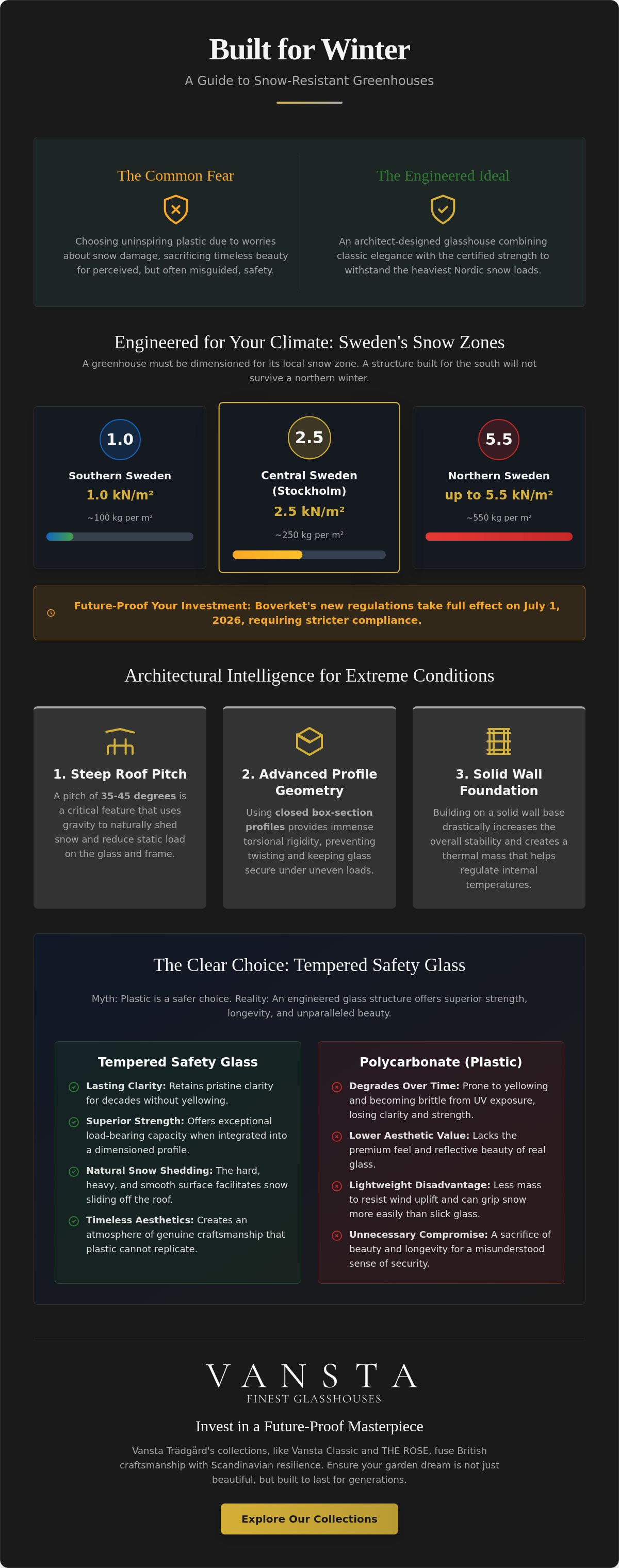
Sverige er geografisk delt inn i forskjellige snøsoner, noe som er helt avgjørende for planleggingen din. Kravene varierer dramatisk; fra 1,0 kN/m² i de sørligste delene til 5,5 kN/m² i de nordlige fjellområdene. Å bygge et drivhus i Stockholm, som ligger i sone 2.5, krever en konstruksjon som tåler omtrent 250 kg trykk per kvadratmeter. Med Boverkets nye byggeforskrifter som trer i kraft for fullt 1. juli 2026, blir det enda viktigere å sørge for at bygningen din er riktig dimensjonert. En konstruksjon tilpasset Skånes milde vintre vil uunngåelig kollapse under vekten av en Norrland-snøstorm. Presisjon i beregninger er derfor den eneste veien til langsiktig sikkerhet.
Sikkerhetsglass vs. polykarbonat: Estetikk møter styrke
Det er en utbredt myte om at plastmaterialer som polykarbonat ville være et krav for å oppnå høy snømotstand. Sannheten er at herdet sikkerhetsglass, når det integreres i en profesjonelt dimensjonert profil, gir en overlegen kombinasjon av styrke og estetikk. Glass beholder sin klarhet og glans år etter år, i motsetning til plast som ofte gulner og blir sprøtt over tid. drivhus som tåler store snøbelastninger drar nytte av glassets naturlige vekt og harde overflate, noe som gjør at snøen glir av. Dessuten skaper glass en atmosfære av tidløs eleganse som plast aldri kan gjenskape, noe som gjør det til det opplagte valget for de som ser drivhuset sitt som et varig kunstverk i hagen.
Arkitektoniske løsninger for ekstrem snømotstand
Opprette en drivhus som tåler store snøbelastninger handler om mer enn bare rå styrke; det handler om arkitektonisk intelligens. I en verden der estetikk ofte settes opp mot funksjon, velger vi å se dem som uatskillelige deler av en helhet. Ved å studere hvordan historiske drivhus i Nord-Europa har overlevd århundrer med harde vintre, har vi forbedret løsningene som lar en glassstruktur utstråle eleganse samtidig som den bærer en tung byrde. Takets geometri er den første forsvarslinjen her, der hver vinkel er nøye beregnet for å virke med naturens krefter snarere enn mot dem.
Innenfor de slanke profilene ligger sofistikert ingeniørkunst. Det er ikke mengden materiale som avgjør holdbarheten, men hvordan materialet er utformet og plassert. Ved å bruke profiler med spesifikk geometri, som lukkede boksprofiler i stedet for enkle T-profiler, oppnås torsjonsstivhet, som holder glasset på plass selv når vinden pisker og snøen ligger tungt. Dette lar oss opprettholde de tynne, klassiske linjene uten at det går på bekostning av sikkerheten.
Takhellingens betydning for naturlig snøavrenning
I områder med mye nedbør er en brattere takvinkel, ofte mellom 35 og 45 grader, ikke bare et estetisk valg inspirert av viktoriatiden. Det er en funksjonell nødvendighet. Denne vinkelen minimerer den horisontale overflaten der snø kan samle seg og lar tyngdekraften gjøre arbeidet som ellers ville kreve manuell måking. Den høye silhuetten gir også en romslighet og lysinnfall som forsterker hele vekstopplevelsen, noe som gjør bygningen til et arkitektonisk juvel som pryder hagen året rundt.
Materialvalg: Detaljer i kraftig aluminium og støpejern
Materialvalget er avgjørende for konstruksjonens levetid og dens evne til å bære vekt.Vi jobber utelukkende med pulverlakkert aluminium av høy kvalitet, som gir en vedlikeholdsfri overflate som tåler elementene i flere tiår. I motsetning til enklere konstruksjoner bruker løsningene våre skjulte interne forsterkninger for å håndtere vertikalt trykk.
- Forsterkede takstoler: Strategisk plasserte takstoler fordeler lasten jevnt over hele rammen og forhindrer punktbelastning på glasset.
- Integrerte takrennesystemer: De kraftige rennene fungerer som en integrert del av den bærende konstruksjonen og stabiliserer sideveggene.
- Geometrisk presisjon: Hver profil er utformet for å drenere vann og fuktighet, og forhindre isdannelse i skjøtene.
Ved å kombinere disse tekniske løsningene skapes et miljø der du kan nyte vinterens stillhet innenfra, uten å tvile på takets bæreevne. Det er i dette møtet mellom tradisjonelt håndverk og moderne konstruksjonsmekanikk at fremtidens klassikere blir født. Hvis du drømmer om et slikt sted for restitusjon, kan du utforske vårt. arkitekttegnede drivhus & orangerier som er skapt for å vare i generasjoner.
Drivhus på vegg: Den ultimate stabiliteten
En solid vegg er ikke bare en estetisk hyllest til klassiske orangerier; den danner grunnlaget for en struktur designet for å trosse tidens tann og vinterens tyngde. Når vi snakker om en drivhus som tåler store snøbelastninger, Vi fokuserer ofte på takets bæreevne, men den vertikale kraften fra hundrevis av kilo snø må overføres helt ned til bakken uten at rammen gir etter. Ved å la drivhuset hvile på en vegg, skapes en urokkelig base som eliminerer risikoen for at konstruksjonen beveger seg under betydelige temperatursvingninger eller ekstreme værhendelser. Dette gir en arkitektonisk sikkerhet som et frittstående drivhus med kun en sokkel i bakken sjelden kan matche.
I tillegg til strukturell styrke tilbyr muren uvurderlig termisk masse. Under vinterens bleke solstråler absorberer steinen eller mursteinen varme, som deretter sakte frigjøres i løpet av de kalde nettene. Dette skaper et mer stabilt mikroklima for middelhavsplantene dine og reduserer energibehovet til oppvarming. For de som ønsker en enda høyere grad av eksklusivitet, kan muren prydes med rekkverk og søyler i støpt stein. Disse detaljene, hentet fra gammel britisk tradisjon, fungerer både som dekorative kunstverk og som ekstra stabiliserende elementer i hagearkitekturen.
Fundamenter for tunge konstruksjoner
For å bære vekten av både en massiv vegg og den dimensjonerende snølasten kreves det et frostfritt fundament. I det svenske klimaet betyr dette at fundamentet må nå en dybde der bakken aldri fryser, noe som varierer avhengig av hvor du bor i landet. En enkel sokkel risikerer å heve seg på grunn av frost, noe som fører til spenninger i glasset og i verste fall sprekker. Vi veileder deg gjennom hele prosessen, fra de første tekniske byggetillatelsestegningene til det ferdige fundamentet, for å sikre at drivhuset ditt står like stødig om hundre år som det gjør i dag. Presisjon i forarbeidet er nøkkelen til en vedlikeholdsfri vinter.
Estetisk harmoni mellom vegg og glasshus
Materialvalget til veggen er avgjørende for å skape en visuell forbindelse til hovedbygningen og hagens overordnede karakter. Enten du velger en klassisk mursteinsbinding i rød tegl eller en pusset overflate i en dempet, tidløs fargetone, blir veggen bindeleddet som forankrer drivhuset i landskapet.EN drivhus på en vegg formidler en følelse av varighet og historie. Den forvandler bygningen fra et enkelt dyrkingsrom til et permanent orangeri der grensen mellom ute og inne viskes ut. Ved å integrere detaljer som matcher husets arkitektur, skapes en harmonisk helhet som øker eiendommens verdi og gir daglig livskvalitet gjennom alle årstider.
Planlegging og juridiske krav for holdbare drivhus
Beregning av snølast er ikke bare en teknisk formalitet; det er en lovpålagt garanti for din langsiktige sikkerhet. Når du søker om byggetillatelse for et større drivhus, krever kommunen en teknisk beskrivelse som beviser at bygningen kan oppfylle de spesifikke kravene i din geografiske sone. drivhus som tåler store snøbelastninger må dimensjoneres basert på eksakte matematiske modeller der profilenes bæreevne veies mot takets overflateareal og vinkel. Det er her forskjellen mellom et masseprodusert produkt og et teknisk konstruert bygg blir mest tydelig. Ved å investere i korrekt utført prosjektering fra starten av, reduserer du risikoen for fremtidige setninger og de kompliserte forsikringssakene som kan oppstå hvis en underdimensjonert konstruksjon kollapser i løpet av en ekstrem vinter.
Forskjellen mellom et Attefall-hus og en permanent byggetillatelsespliktig konstruksjon kommer ofte ned til størrelse, men også den tiltenkte bruken. For prosjekter som overstiger 30 kvadratmeter, eller de som plasseres nær tomtegrensen, kreves det full byggetillatelse der styrkekravene er strenge. Med Boverkets nye byggeforskrifter, som vil bli fullt implementert 1. juli 2026, blir dokumentasjon angående bæreevne og snølast enda mer sentralt. Å ha en ekspert ved din side som forstår disse forskriftene er avgjørende for at byggeprosessen skal gå knirkefritt og uten uventede hindringer.
Byggetillatelsestegninger og søknadsprosess
Den kommunale saksbehandleren fokuserer på å sikre at bygningen harmonerer med omgivelsene og oppfyller gjeldende sikkerhetskrav. En vanlig fallgruve er å undervurdere viktigheten av detaljerte seksjonstegninger som viser hvordan takstoler og bærende elementer er utformet. Vi bistår våre kunder gjennom hele denne reisen, fra de første estetiske skissene til ferdig tegninger for byggetillatelse. Dette sikrer ikke bare en godkjent igangsettingsvarsel, men gir deg også dyp trygghet for at hver arkitektoniske detalj er dimensjonert for det nordiske klimaet.
Hageplassering for minimal værpåvirkning
Hvor du velger å plassere drivhuset ditt påvirker direkte hvordan snøen samler seg på taket. Å plassere et drivhus for nær takskjegget på hovedhuset kan skape en farlig snøfelle der store mengder snø risikerer å falle ned og forårsake punktlaster som få konstruksjoner er bygget for å håndtere. Vindretning spiller også en avgjørende rolle, ettersom snøfonner ofte dannes på lesiden av bygninger. Ved å studere eiendommens mikroklima nøye kan vi optimalisere plasseringen slik at vintersolen fanges maksimalt opp, samtidig som risikoen for tunge og ujevne snøansamlinger minimeres. Hvis du vil sikre at hagedrømmen din hviler på et stabilt juridisk og teknisk grunnlag, kan vi hjelpe deg med profesjonelle løsninger. tegninger og søknad om byggetillatelse for ditt fremtidige orangeri.
Invester i fremtiden med Vansta Trädgårds eksklusive kolleksjoner
Å velge en struktur som kombinerer teknisk perfeksjon med et sofistikert designspråk er å gi eiendommen din en gave som varer i generasjoner. Vi ser en drivhus som tåler store snøbelastninger ikke bare som en praktisk nødvendighet, men som en integrert del av hjemmet og et sted hvor selve arkitekturen blir en kilde til daglig inspirasjon. Hvert prosjekt vi påtar oss begynner med en dyp forståelse av både stedets unike forhold og dine personlige drømmer. Dette resulterer i en harmonisk balanse mellom vill natur og godt planlagt håndverk, hvor hver detalj tjener både skjønnheten og holdbarheten i det nordiske klimaet.
En arkitekttegnet løsning fra oss er en verdibevarende investering for eiendommen din. Ved å kombinere historisk håndverk med moderne ingeniørkunst, skaper vi miljøer som ikke bare oppfyller dagens krav, men som blir vakrere for hvert år som går. Vi veileder deg gjennom hele prosessen, fra de første visjonene og tekniske beregningene til øyeblikket den siste glassruten er installert i hagen din.
Vansta Classic: Når bare det beste er godt nok
Våre Vansta Classic-oransjerier representerer kulminasjonen av vår ekspertise innen utendørsarkitektur. Her møtes rå strukturell styrke og delikat eleganse i en symbiose som er unik for hver kunde. Ved å tilby fullstendig skreddersydde løsninger arkitekttegnede drivhus, Vi kan sørge for at bygningen ikke bare harmonerer med husets stil, men også er dimensjonert for de mest krevende snøforholdene i nord. Gjennom årene har vi realisert drømmer i miljøer der vinteren er på sitt mest nådeløse; hver gang har våre konstruksjoner bevist sin verdi ved å stå uberørt og stolt under tette snødekker.
Innenfor vår ekspertise tilbyr vi også drivhuskolleksjonen THE ROSE. Denne kolleksjonen kombinerer enestående fleksibilitet med en dyp britisk håndverkstradisjon, noe som gjør det mulig å skape et vekstmiljø som føles både personlig og tidløst. Det er en hyllest til klassisk hagekunst, optimalisert for å møte fremtidens krav til stabilitet og estetikk uten å gå på kompromiss med arkitektoniske detaljer.
Livskvalitet året rundt i en vinterhage
For de som ønsker å fullstendig viske ut skillet mellom årstidene, en fullstendig isolert vinterhage er det ultimate valget. I motsetning til et sesongbasert drivhus tilbyr en vinterhage et miljø hvor du kan drikke morgenkaffen din omgitt av snødekte grantrær uten å føle den minste kulde. Det er et sted for restitusjon som krever eksepsjonell bæreevne, spesielt når store glasspartier møter vinterens vekt. Atmosfæren under glasstaket på en stjerneklar vinternatt er nesten poetisk og skaper en livskvalitet som strekker seg langt utover den vanlige vekstsesongen.
Vi inviterer deg til en verden der kvalitet alltid kommer foran kvantitet. Gjennom personlig rådgivning og nøye prosjektplanlegging sørger vi for at investeringen din blir like storslått som du forestilte deg. Bestill en konsultasjon med oss for å starte reisen mot et slitesterkt drivhus som trosser elementene med eleganse og stolthet.
Realiser vinterdrømmen din med teknisk presisjon og tidløs estetikk
Opprette en drivhus som tåler store snøbelastninger til syvende og sist betyr det å gi rom for både trygghet og inspirasjon gjennom alle årets måneder.Vi har fremhevet viktigheten av å kombinere en bratt takvinkel med et solid murfundament, og hvordan de nye byggeforskriftene for 2026 stiller høyere krav til teknisk dokumentasjon. Ved å navigere disse utfordringene med ekspertise, omdannes tekniske krav til arkitektoniske muligheter som øker eiendomsverdien og din egen livskvalitet.
Ta det første skrittet mot din egen glasskledde oase og oppdag våre arkitekttegnede drivhus og orangerier på Vansta Trädgård. La vinterens stillhet bli en tid for restitusjon, beskyttet av en struktur bygget for å vare i generasjoner.
Ofte stilte spørsmål om drivhus og snølast
Hvor mye snø tåler et drivhus fra Vansta Trädgård?
Våre konstruksjoner er alltid dimensjonert i henhold til den spesifikke geografiske plasseringen og dens unike snøsone, noe som betyr at de kan håndtere alt fra 1,0 til 5,5 kN/m². drivhus som tåler store snøbelastninger fra oss gjennomgår strenge tekniske beregninger for å sikre at takstolene og profilene bærer den nødvendige vekten i henhold til svenske byggeforskrifter. Dette gir deg en sikkerhet som strekker seg langt utover begrensningene til standardmodeller og garanterer en bærekraftig investering for fremtiden.
Må jeg måke taket på drivhuset mitt om vinteren?
Med en riktig utformet takvinkel vil snøen vanligvis glir av naturlig, noe som minimerer behovet for manuell måking under normale vinterforhold. Vi anbefaler imidlertid at du holder øye med snøen under ekstreme værhendelser eller hvis snøen pakker seg ujevnt på grunn av sterk vind. En bratt takvinkel på 35 til 45 grader fungerer som din primære forsikring mot at tunge snødekker blir liggende og belaster konstruksjonen i lengre perioder.
Er herdet glass bedre enn flerveggs polykarbonat for snølast?
Herdet sikkerhetsglass er det opplagte valget for de som prioriterer både estetikk og strukturell integritet fremfor enkle plastmaterialer. Den harde og glatte overflaten på glasset gjør at snøen glir av betydelig lettere enn på flervegget polykarbonat, som ofte har en grovere tekstur der is kan feste seg. Når glasset er riktig dimensjonert i en robust profil, tilbyr det overlegen styrke og en levetid som strekker seg over generasjoner uten å gulne eller svekkes.
Hvilken takvinkel er best for at snøen skal kunne rase av?
En takvinkel på mellom 35 og 45 grader anses som optimal for at snøen skal kunne skli av ved hjelp av tyngdekraften. Denne vinkelen er ikke bare funksjonell, men gir også den klassiske viktorianske silhuetten som kjennetegner våre mest eksklusive orangerier. Ved å velge en høy taklinje reduserer du den horisontale overflaten der snø kan samle seg, noe som beskytter konstruksjonen i perioder med kraftig nedbør og skaper en vakker romslighet innvendig.
Trenger jeg byggetillatelse for et drivhus designet for tunge snølaster?
Ja, i de fleste tilfeller kreves det byggetillatelse eller formell byggemelding for permanente drivhus, spesielt når tekniske beregninger for snølast skal gjennomgås av kommunen. Myndighetene ønsker å sikre at bygningen er trygg for formålet og at den overholder de nyeste sikkerhetsforskriftene fra Boligmyndighetene. Vi bistår med komplette byggetillatelsestegninger for å forenkle denne prosessen og garantere at drømmen din hviler på et juridisk og teknisk stabilt grunnlag.
Hva er en snøsone, og hvordan vet jeg hvilken jeg tilhører?
En snøsone er et geografisk område definert av Boverket som angir hvor mye snølast bakken forventes å bære over en 50-årsperiode. Verdiene måles i kN/m² og varierer mye i Sverige, fra 1,0 i sør til 5,5 i de nordlige fjellområdene. Du kan finne din spesifikke sone via interaktive kart fra Boverket eller SMHI. Å kjenne sonen din er det første steget i vår felles prosjektplanlegging for en drivhus som tåler store snøbelastninger.
Kan jeg installere en ovn i et drivhus som tåler mye snø?
Det er fullt mulig å installere en ovn i våre forsterkede konstruksjoner, som forvandler bygningen til et koselig orangeri året rundt. En ovn tilfører ikke bare atmosfære, men bidrar også til å holde glasset varmt, noe som letter snøsmelting og at det glir av taket. Vi sørger for at røykrøret integreres arkitektonisk riktig uten å påvirke takets bæreevne eller strukturelle tetthet.
Hvordan påvirker vind snøbelastningen på taket?
Vind påvirker snølasten ved å lage snøfonner der snøen pakker seg tettere og tyngre på visse deler av taket, ofte på lesiden av bygningen. Dette kalles ujevn belastning og er en av de vanligste årsakene til at enklere drivhus kollapser under uvær. Våre tekniske beregninger tar alltid hensyn til vindens påvirkning for å sikre at rammen er vridningsstiv nok til å håndtere disse asymmetriske kreftene uten at glasset utsettes for belastning.