

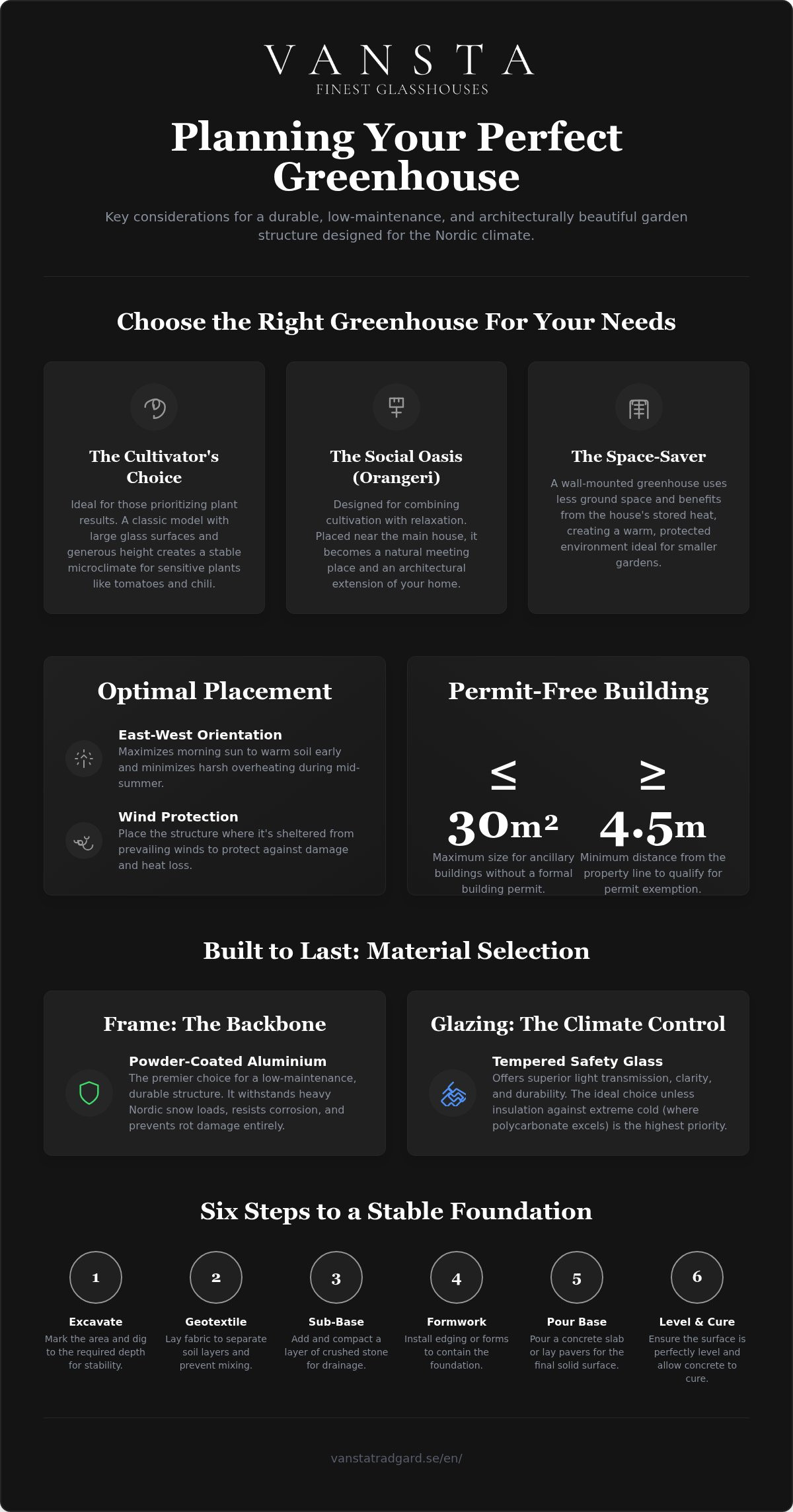
TL;DR: Place the greenhouse in an east-west direction for maximum morning sun and choose a stable concrete foundation with an aluminum frame to withstand Nordic snow loads and minimize maintenance.
30 square meters is th…
Planning a Greenhouse in the Garden: A Guide from Building Permits to Placement
7. sep 2026
TL;DR: Place the greenhouse in an east-west direction for maximum morning sun and choose a stable concrete foundation with an aluminum frame to withstand Nordic snow loads and minimize maintenance.
- 30 square meters is the limit for permit-free ancillary buildings, provided the placement is 4.5 meters from the property line.
- Glass provides the best light transmission and durability, unless insulation against cold is prioritized higher.
- Choose powder-coated aluminium and tempered safety glass for a low-maintenance construction that can withstand strong winds.
- Six steps for ground work, including excavation and base layer, ensure stability without future rot damage. Planning a greenhouse requires a balance between sun hours, rules for a permitted area where ancillary buildings up to a certain size can be erected without a formal building permit, and a stable foundation. Through proper ground work and material selection, you create an energy-efficient environment that significantly extends the growing season. The questions that guide the entire project are the same from the first sketch to the last screw: how much sun does the location get, does the structure fit within your permitted area where ancillary buildings up to a certain size can be erected without a formal building permit, and what foundation will support the frame when the snow is heavy?
Choose the Right Greenhouse for Your Three Garden Needs
Three typical locations guide the choice early on. If you primarily grow tomatoes and chili: choose a classic model with a large glass surface and generous room height, as the height provides a more stable microclimate and better plant results. If you want to have coffee and sit indoors among the greenery: aim for a greenhouse for coffee and socializing (orangeri) near the house. If you have limited space: a greenhouse on a wall (wall greenhouse) takes up less ground and functions as a heat-storing volume against the facade.
Your choice depends on whether you prioritize cultivation, relaxation, or a combination. Among customers, we see that growers prioritize height for greater volume. The right room height provides a more stable microclimate and clearer plant results.
We offer customized options and flexible shipping solutions for various projects. Explore EXCLUSIVE GREENHOUSES ORANGERIES CONSERVATORIES Vansta to find the right structure. The models open up new possibilities in the garden, and the construction becomes a natural meeting place throughout the seasons.
Place the Greenhouse for Morning Sun and Wind Protection
Place your greenhouse where it receives ample morning sun and shelter from prevailing winds. Sunlight warms the soil early, giving plants a strong start.
Placement significantly impacts the building's lifespan and microclimate. According to the English Wikipedia article on Botanisk Have from 2024, historical glass structures have long been strategically placed to achieve optimal growing conditions. If you dream of a greenhouse for coffee and socializing, you should integrate it close to the residential house, so that the volume forms an aesthetic whole. Some prefer a greenhouse on a wall to utilize the house's stored heat.
When planning, you must check the structure's ridge height. It is easy to exceed permitted dimensions, which requires architectural drawings prepared to obtain building permits from authorities before the project can be implemented. Ensure you have a good overview of the entire property. We collaborate with stable suppliers who offer flexible shipping solutions so that logistics do not halt construction. Invest in glass that does not break easily (tempered safety glass) for long durability.
Explore Exclusive Greenhouses | Highest Quality | Architect-Designed for a model that suits your garden architecture.
Tip: Place the greenhouse in an east-west direction to maximize early spring sunlight and minimize overheating during mid-summer.
A commenter in the forum.odla.nu thread "A greenhouse can be so beautiful, Garden Forum":
"I would gladly be a co-owner of this English company, but unfortunately, reality is different. I'll have to settle for green fingers and a flourishing garden." (source)
The comment reflects the passion many garden enthusiasts feel for timeless glass structures and flourishing greenery. The right placement on the property determines whether the cultivation dream lasts, regardless of the garden's size.
Combine Cultivation and Socializing in the Same Space
A combined greenhouse offers the benefit of both harvest and company. Pure cultivation requires functional space planning, but with the right accessories, a balanced meeting place is created where vegetables thrive while the room functions as a social oasis.
What few consider: with well-thought-out solutions, you don't have to choose one over the other. A generous overall environment provides space for both tomatoes and a dining table. Aluminum frames with powder-coated aluminium also provide low-maintenance protection that prevents rot damage.
If you want to realize a unique dream, Architect-designed greenhouses or customized orangeries, VANSTA are available to create greenhouses for coffee and socializing. Choose durable materials for a lasting investment.
A commenter in the forum.odla.nu thread "A greenhouse can be so beautiful, Garden Forum":
"Excuse me, but there's a somewhat paranoid attitude towards my post here. I have nothing to do with Vansta!" (source)
The reaction shows how charged the choice of supplier can be among growers. By focusing on material selection and function, you will find the right structure regardless of who builds it.
Glass or Polycarbonate: What the Nordic Climate Requires
Glass provides great light transmission while plastic sheets (polycarbonate) effectively insulate against Nordic cold.
In the workshop, we see that the choice of surface material controls the entire growing climate. English greenhouses in aluminium with glass that does not break easily provide a timeless aesthetic finish that lasts for generations. The construction anchors the room in the outdoor environment and creates a protected outdoor environment for sensitive plants. Standard glass, however, lets in mid-summer sun quickly without attenuation. Plastic sheets spread light more softly than pure glass and act as a warming blanket during cold spring nights.
Plastic sheets suit those who prioritize insulation over view. Glass suits those who seek long durability and the timelessness of classic architecture.
Permit-Free Zone: When You Don't Need a Permit and When Neighbors Are Required
If you are planning a freestanding greenhouse for coffee and socializing under 30 square meters, a building permit is usually not required.
In our workshop, we see how important accurate architectural drawings prepared to obtain building permits from authorities are when dimensions are exceeded. The right documentation prevents prolonged applications and saves valuable time.
You have a permitted area where ancillary buildings up to a certain size can be erected without a formal building permit for smaller sheds and "attefallshus" (specific Swedish type of permit-free ancillary building). However, placement requires sensitivity to the property. If a greenhouse on a wall is built closer than 4.5 meters to the property line, neighbors' consent is needed.
Local regulations vary significantly. According to the Eures portal 2026, regional directives often affect your building plans.
Adapt your construction to local snow zones. Higher snow loads place demands on window frames and roofs. Strong solutions with classic dwarf walls provide durable stability. Choose a classic model for timeless charm, or a modern variant if the home is minimalist.
Foundation and Materials: What Drives Your Budget
The choice of foundation and frame determines your total budget when you want to plan a greenhouse in the garden. Different solutions offer varied durability in our outdoor environment. You can request a quote for exact costs.
The choice of panel affects future maintenance quite quickly. Here is a comparison of the benefits of different choices.
| Foundation and Frame | Material Choice | Advantages |
|---|---|---|
| Cast slab | Painted aluminum (powder-coated aluminium) | High stability and long durability |
| Plinth | Glass that does not break easily | Safe protection for outdoor environments |
| Concrete | Plastic sheets | Good insulation for plants |
Painted aluminum requires minimal maintenance. Glass that does not break easily provides strong light transmission and enhances the feel of the room. The right combination determines how long the investment lasts.
Six Steps for a Stable Foundation Without Rot Damage
Carefully executed ground work guarantees a stable foundation and prevents future rot damage to your structure. To avoid a pile of poor fixtures and broken parts, proper preparation is required. A stable foundation functions just like a house's stone plinth.
- Excavate: Remove the topsoil.
- Lay base layer: Fill with crushed material.
- Compact the surface: Pack the gravel thoroughly.
- Cast the foundation: Create a durable concrete plinth.
- Ensure drainage: Lead away all water.
The work creates a holistic environment with climatic advantages for your plants and makes it easier to realize a well-maintained garden. With beautiful reddish-brown details, generous spaces are created, and durable materials support the construction over time.
If the greenhouse is to function as an orangeri for coffee and social moments, adequate insulation is required. Well-thought-out solutions provide a safe and functional environment for many years.
When the Standard Model Cannot Handle Snow and Wind
Simpler greenhouse models often fail when Swedish snow loads and strong autumn winds exceed the construction's bearing capacity.
In our consulting, we see how cheap profiles buckle under wet snow: the manufacturer's dimensioning is insufficient for tough local conditions.
Thin plastic sheets and weak frames act like a sail in a storm. Choosing a greenhouse on a low wall (växthus på mur) with a frame of painted aluminum instead provides unyielding stability, as heavy buildings stand firm when the load increases.
If the house has a high ridge height, robust fixtures are required. Standard models then appear visually too small against the facade. If you are considering a larger model, architectural drawings prepared to obtain building permits from authorities are needed before assembly.
Invest in durable quality. A well-considered investment helps you withstand the stresses of the weather, and a clear building permit application secures the project before the first delivery.
Ventilation, Electricity, and Water: Plan the Technology in the Plinth
Automatic ventilation systems create a stable microclimate and prevent harmful overheating during warm summer days. For sensitive plants like orchids, precise control electronics are required. Correct electrical installation also enables efficient supplementary heating.
Smart water solutions facilitate the daily care of your flourishing oasis. Avoid thermal bridges during cable and pipe routing to maintain the frame's insulating capacity: therefore, plan all technical penetrations in the plinth early in the process.
When choosing a heating system, the building's responsiveness and snow zones affect the choice of equipment, especially in tougher climate zones. Always check if technical installations affect your applications with the municipality before work begins.
If you are considering solar panels to offset the energy costs of heating and lighting your greenhouse, check out Zonnepanelen Brabant B.V. for professional advice on solar installations and equipment longevity.
Frequently Asked Questions
Where is the best place to put a greenhouse on the property?
Choose a spot with good drainage and sufficient space around the structure. Feel free to integrate the volume with other garden environments so that the plants get the conditions they need.
In which direction should a greenhouse face?
An east-west orientation provides ample sunlight throughout the day. This orientation is suitable for early cultivation in spring, as the light is then evenly distributed over the plants.
Do you have to cast a foundation for a greenhouse?
A stable concrete foundation provides high durability for heavy glass constructions. You can also choose a greenhouse on a low wall as a foundation, which protects against ground frost and keeps the structure steady.
Should I place my greenhouse in sun or shade?
Place the building in full sun if you primarily plan to cultivate heat-loving crops. If you are looking for a place for coffee breaks and socializing in the form of an orangeri, a little shade can create a cooler environment, for example, from trees.
Greenhouse for cultivation or socializing?
A pure cultivation greenhouse requires more direct sunlight and efficient ventilation. If you are planning a greenhouse in the garden for relaxation, a larger area for furniture is needed. The functions can be combined in the same volume.
Take the First Step Towards Your Garden Dream
Proper planning transforms your garden into a timeless oasis, with the same balance between sun hours, a permitted area where ancillary buildings up to a certain size can be erected without a formal building permit, and a stable foundation that began this guide. In 2026, Vansta Trädgård will help you plan a greenhouse in the garden with a focus on craftsmanship and durability. Our advisors will support you throughout the entire process to create a customized greenhouse on a low wall or a greenhouse for coffee and socializing.
Adapting the building to the house's architecture requires precision and pays off in both appearance and function. We assist with architectural drawings prepared to obtain building permits from authorities so that the project harmonizes with your property.
Contact us for a personal consultation about your future garden.