

Can an urn transform how an entire garden is perceived? The right choice of Haddonstone planters can serve as an architectural anchor for an outdoor room, whereas a piece with ill-fitting proportions can easily feel fore…
Haddonstone Planters: Choosing Classical Garden Urns
30/09/2026
Can an urn transform how an entire garden is perceived? The right choice of Haddonstone planters can serve as an architectural anchor for an outdoor room, whereas a piece with ill-fitting proportions can easily feel foreign beside the house or on the terrace. Therefore, evaluate both shape and scale against the setting where the urn will stand, and consider how the classical expression of cast stone interacts with the surrounding planting.
A Haddonstone garden urn is far more than a planting vessel. Positioned with intention, it can frame an entrance, terminate a sightline, or draw the eye across a patio. Before making a selection, take into account the scale of the site, the architecture of the residence, and how the urn will be planted and cared for throughout the year.
Here you will find practical approaches to assessing proportions and aesthetic character, selecting plantings, and managing drainage and seasonal care ahead of winter. You will also discover how deliberate placement can unify architecture, greenery, and outdoor living spaces so that the urn feels like an integral element of the overall composition.
Key Takeaways
- Compare the urn's profile and scale with the facade, staircase, or terrace before committing to a location.
- Discover how Haddonstone planters can draw the eye and impart a distinct architectural character to an outdoor space.
- Select plantings that complement the urn's proportions and its specific garden environment.
- Inspect drainage channels and observe winter care guidelines, as freezing water can cause destructive frost damage.
- Verify dimensions, model details, and frost-related manufacturer advice for the chosen urn prior to purchase and planting.
What Characterizes Haddonstone Planters in the Garden?
A garden urn serves as both a planting vessel and a sculpted architectural element within the landscape. A standard container often functions merely as a temporary home for foliage; an urn, by contrast, possesses a defined silhouette and decorative presence even when left unplanted. Haddonstone planters are cast stone garden urns defined by a classical design vocabulary, where material substance and form elevate the overall aesthetic of a property.
A cast stone garden urn is a sculpted vessel for plants whose stone-like character and deliberate craftsmanship provide a visual focal point for the garden. The distinction between Haddonstone planters and ordinary plant pots extends beyond superficial ornament. An urn can frame an entryway or define the transition between distinct garden rooms. For more on the material's composition and architectural heritage, explore this overview of cast stone.
What is a cast stone garden urn?
Haddonstone garden ornament is renowned for its classical lineage and cast stone craftsmanship. An urn's profile, rim molding, and ornamental relief define its aesthetic character, while remaining fully functional for planting. Before selecting a piece, confirm the chosen model's dimensions, weight, and specification to ensure it harmonizes with the intended setting and can be positioned safely.
How does an urn transform the experience of the garden?
At an entryway, an urn can articulate the threshold between residence and landscape. On a terrace, it can anchor a seating area, while along a vista, it directs the gaze through the garden axis. Symmetrically flanking a grand flight of steps with two urns creates a formal, balanced presence; a solitary urn nestled within perennial borders introduces a softer, more romantic composition.
Envision an urn placed at the terminus of a gravel path: it becomes an eye-catching focal point, with lush foliage providing dynamic texture and movement. When selecting Haddonstone planters, first determine the functional role the urn will play, then choose the appropriate profile, position, and companion plantings accordingly.
The Expression, Craftsmanship, and Material Choice of Cast Stone
Cast stone combines the tactile, authentic surface of natural quarried stone with the ability to render refined moldings and intricate decorative details. On an urn, the physical and visual weight of the material conveys permanence, though its perceived presence depends heavily on proportion and context. Haddonstone pieces carry an inherent historical sensibility, enriching both heritage settings and modern schemes without requiring surrounding elements to replicate identical historical details.
Materiality, silhouette, and craftsmanship together determine whether an urn appears as a freestanding decorative object or as an organic extension of the estate's architecture. It is therefore essential to evaluate both surface texture and contour from close range as well as from key vantage points across the grounds.
How do you read form, surface, and ornamentation?
Begin by studying the profile. Observe how the bowl tapers or expands, how the rim terminates the rim opening, and how the socle or plinth meets the ground. These transitions dictate whether the piece feels light, restrained, or monumental. An ornamental relief lends depth and shadow lines that shift throughout the day with the changing light. Up close, fine craftsmanship commands attention; from afar, the outline dominates. Review multi-angle product photography alongside documented dimensions before finalizing a choice.
A richly embellished urn draws focus to its decorative motifs and is ideally placed as a standalone feature. A cleaner, more restrained model yields an understated presence, allowing surrounding architecture or architectural plants to take center stage. The consideration is never whether ornament is superior, but rather what specific role the piece is designed to fulfill within the overall setting.
When does classical cast stone suit a modern garden?
Classical forms can establish a striking, intentional dialogue in contemporary environments characterized by crisp linear paving, smooth rendered walls, or minimalist materials. An urn with an elegant profile acts as a sculptural counterpoint, softening strict rectilinear geometry. Paired with restrained, architectural planting, the cast stone vessel itself takes prominence; with cascading foliage, it creates an intriguing contrast between crisp foliage and sculpted relief.
Base your decision on the building's facade, portico, and existing garden architecture rather than evaluating the urn in isolation. Historical context often provides valuable perspective. This overview of the history of landscape design illustrates how sculpted ornaments have anchored outdoor settings across centuries. To compare classical forms and finishes, explore Haddonstone planters at Vansta Trädgård, verifying specifications and technical parameters to match your project.
Choose a Haddonstone Planter by Location, Scale, and Plant
An urn that appears perfectly proportioned in a catalog photograph can read entirely differently against an expansive two-story facade or on an intimate courtyard terrace. Always begin with the site. Measure the footprint, note surrounding architectural features, and study sightlines from multiple perspectives. Compare the vessel's height and diameter against nearby stairs, retaining walls, and usable terrace area. Always verify the physical dimensions of the specific model prior to ordering.
What size planter fits the space?
Mark the intended footprint on the ground using a tape measure or a cardboard cutout of the base. Inspect the outline both up close and from primary viewpoints. A tall urn commands significant visual weight against a low retaining wall compared to a grand brick facade. A broad bowl requires adequate breathing room around its perimeter. Be sure to check both dimensions and net weight for the specific model.
| Location | Desired Expression | Proportion to Consider | Planting Idea |
|---|---|---|---|
| Entrance or staircase | Welcoming and structured | Urns scaled in balance with the doorway and stair width | Lush seasonal blooms that introduce vibrant color and vitality |
| Terrace | Anchored, tranquil lounge setting | A well-defined urn that does not impede footpaths or furniture layouts | Low groundcover that leaves the rim and ornamental relief exposed |
| Terminus of a sightline | Distinct visual anchor | A height and silhouette that remain clearly legible from afar | Architectural plants with a bold, structured silhouette |
| Beside facade or stone wall | Bridge between architecture and landscape | Scale harmonized with adjoining masonry and window heights | Plantings selected according to site exposure and maintenance needs |
Which plants suit a classical urn?
Your planting choice can either accentuate or soften the vessel's form. Generous seasonal blooms create an exuberant, dynamic statement. Compact, evergreen groundcovers keep the focus squarely on the stone craftsmanship, while architectural boxwood or topiary reinforces formal lines. Base your choice on local light conditions, microclimate, and the level of care you can maintain. Every setting presents unique conditions that influence plant health.
Consider also whether the urn will stand alone or as a symmetrical pair. A single statement piece can serve as a powerful architectural anchor, ideal for concluding a garden axis. A matching pair frames an entrance or stone steps with timeless symmetry, though it demands sufficient space and balanced placement. Let the home's architecture and the garden's layout guide your choice. For inspiration on pairing architectural accents, read about how Haddonstone fountains serve as garden centerpieces.
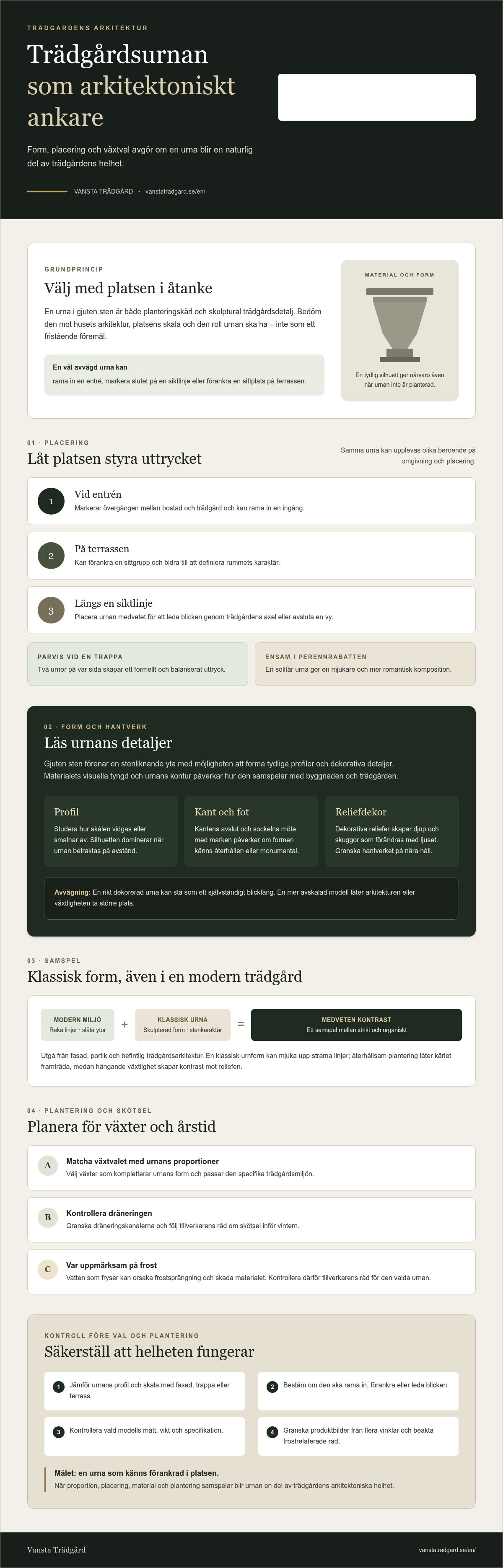
Care, Drainage, and Frost for Planters in a Swedish Climate
The repeated freeze-thaw cycles characteristic of the Nordic climate make thoughtful water management essential before planting even begins. Trapped water poses a risk both inside the planter and directly beneath its base. Always adhere to the manufacturer's specific instructions for the model rather than assuming all stone vessels are treated identically.
How do you reduce the risk of standing water?
Ensure that excess water can freely escape through the drainage hole and disperse away from the vessel's foundation. Follow the manufacturer's guidelines regarding drainage materials and substrate layers, ensuring that the drainage outlet never becomes blocked by soil or compacted roots. Never modify the core structure or add internal materials in a manner that contradicts the maker's recommendations. Establish proper drainage before adding compost, when the vessel interior is fully accessible.
What should be checked ahead of winter?
Frost damage or frost shattering occurs when moisture penetrates a porous material, freezes, and expands, creating internal pressure that can result in spalling or structural cracks. While this represents a general physical risk across all exterior stonework, actual performance depends on product design and maintenance. Frost resistance must always be verified for the specific planter model and should never be assumed solely on the basis of cast stone material composition.
Review Haddonstone's current care guidance for your selected piece and confirm any winterization protocols. Whether a vessel must be emptied of soil, shielded with a breathable cover, or moved to a sheltered space depends on the model's profile and the exposure of the site. Verify that meltwater does not pool beneath the plinth. Consult your distributor for clarification on specific model requirements.
- Before placement: verify that the sub-base is level and that runoff water drains away freely.
- Before planting: review the manufacturer's directions regarding drainage material and internal liners.
- During the growing season: ensure that drainage openings remain unobstructed.
- Ahead of winter: observe model-specific guidelines regarding moisture mitigation, protective covers, or relocation.
With informed maintenance, integrating an urn into your landscape becomes straightforward without overlooking practical climatic realities. For detailed advice on available models and seasonal care, you can review Haddonstone planters at Vansta Trädgård.
How Vansta Trädgård Creates a Cohesive Whole with Haddonstone Planters
A thoughtfully selected urn is an integral note in a broader architectural composition. Begin by evaluating the site, confirming physical dimensions, and harmonizing the design style with the architecture of the house. Next, select appropriate plantings and clarify the maintenance guidelines specific to the chosen piece. This structured approach reconciles aesthetic aspirations with functional durability.
Vansta Trädgård supplies Haddonstone planters alongside an exquisite selection of cast stone garden ornaments. The company specializes in product consultation, design integration, and procurement rather than routine grounds maintenance or landscaping construction. Consequently, homeowners and designers should plan the final installation carefully and review technical specifications before purchase.
How does the urn interact with the house and garden space?
Observe how the urn relates to the exterior cladding, entrance portico, and hardscaping. The classical character of cast stone pairs naturally with historic masonry and heritage timber, yet it can also form a deliberate, refined counterpoint to minimalist modern architecture. An urn placed at the threshold between an outdoor terrace and lush planting beds anchors the transition without overwhelming the setting.
Examine the overall composition from key vantage points: from inside principal living rooms, from the entrance gates, and from garden seating areas. If the urn is part of a larger landscaping scheme, consider how it harmonizes with other stone elements. Explore Haddonstone garden fountains to discover how architectural stone accents can be coordinated across an estate, or draw inspiration from greenhouse design to achieve total architectural harmony between home and garden.
What should you ask prior to purchasing?
Gather the essential details that influence both visual placement and practical handling:
- Which specific models are currently available, and what are their exact dimensions and dry weights?
- What is the design of the base and drainage hole, and are there particular installation or planting requirements?
- What care recommendations apply to this model, particularly regarding Nordic winter conditions?
Because shapes, dimensions, and production lead times vary, confirm all details for your chosen urn early in the planning process. When you are ready to take the next step, explore Haddonstone planters at Vansta Trädgård and reach out with your project specifications. Begin with the proportions of the site, and let the craftsmanship of cast stone, balanced planting, and architectural context create a cohesive vision.
Let the Urn Become Part of the Garden's Cohesive Whole
An exceptional garden urn fulfills a far greater purpose than serving as a container for flora. When its scale aligns with the facade, staircase, or stone terrace, it acts as an enduring architectural anchor for the outdoor room. Begin by analyzing the proportions of the site, then allow the urn's craftsmanship and seasonal plantings to complement the architectural soul of your home.
The tactile finish and ornamental relief of cast stone influence how the urn is appreciated both from an intimate perspective and from distant vistas. Always maintain proper drainage and adhere to model-specific maintenance instructions, especially ahead of freezing winter months. Confirm frost-resistance protocols for your specific piece rather than relying on generalized assumptions.
Vansta Trädgård provides Haddonstone planters as an integral element of its bespoke garden collection, offering specialist consultation and project coordination for high-end properties. Discover the collection to identify the piece suited to your residence, or contact the team with product inquiries: Explore Haddonstone planters at Vansta Trädgård.
Through deliberate placement, superior materials, and diligent seasonal care, your urn will form an enduring, natural extension of the landscape for decades to come.
Frequently Asked Questions About Haddonstone Planters
What are Haddonstone planters?
Haddonstone planters are premium cast stone garden urns and containers manufactured by Haddonstone and represented by Vansta Trädgård. They are part of an exclusive garden ornament portfolio celebrated for classical proportions and authentic stonework craftsmanship. As specifications and features vary by model, always review the specific product dimensions, material finish, and care requirements before making a selection.
Are Haddonstone planters frost-resistant?
Frost resistance should never be assumed purely from the material category. When water collects inside or around a vessel and freezes, the expansion can cause severe frost damage; however, internal construction and winterization requirements vary across models. Always confirm the specific guidelines for your selected model and follow the manufacturer's advice on drainage and winter care to protect the stone under local climate conditions.
How do I choose the right size for a garden urn?
Measure the intended location and compare the urn's height and width against surrounding architectural elements such as porticos, stairs, stone facades, or terraces. Larger courtyards accommodate designs with greater visual weight, whereas smaller settings benefit from more delicate proportions. Always verify physical dimensions and weights prior to ordering, and consider both root room and how the planted vessel will read from main sightlines.
Can you plant directly into a Haddonstone planter?
Direct planting depends on the specific model's interior profile and manufacturer instructions. Check that the planter features an unobstructed drainage hole and follow recommended layering steps before adding growing medium. Select plants that align with site exposure and your maintenance routine. If guidance is not detailed in the product specifications, consult Vansta Trädgård for expert advice on your chosen piece.
How do you care for cast stone planters?
Always adhere to the manufacturer's maintenance instructions for the specific piece. Maintain clear drainage channels and avoid harsh chemical cleaners or unapproved surface treatments that could compromise the stone's patina. Implement proper winterization procedures to prevent standing water and mitigate the risk of frost damage. Contact your distributor for model-specific care advice if necessary.
Do classical Haddonstone urns suit a modern garden?
Yes, a classical cast stone urn can create a striking, intentional counterpoint within contemporary garden design. Establish visual harmony by ensuring the urn's proportions and placement relate directly to the lines of the house and surrounding materials. Restrained planting highlights the vessel's sculpted contours, while softer greenery yields a balanced contrast. Always assess the relationship from key perspectives around the property.
What should I check before purchasing a Haddonstone planter?
Compare your site measurements with the urn's external dimensions and confirm total weight, finish options, and current lead times with the distributor. Inquire about drainage configuration, planting methods, and specific seasonal care recommendations. Never rely on generic assumptions regarding frost performance or material behavior; let the manufacturer's verified technical documentation guide your decision.