

When you want to combine Haddonstone with an orangerie, the total investment is mainly driven by windows in tempered safety glass, optional extras like an outdoor shower, and the choice of frame and the extent of the sto…
Combine Haddonstone with an Orangerie: Price and Material Choices 2026
16 сент. 2026 г.
When you want to combine Haddonstone with an orangerie, the total investment is mainly driven by windows in tempered safety glass, optional extras like an outdoor shower, and the choice of frame and the extent of the stone wall. Vansta Trädgård provides exact prices via quotation after project planning, while the market generally shows great variation depending on material choices.
Key Takeaways: You integrate Haddonstone into an orangerie by using cast stone as a heat-storing plinth or wall, which provides the glass structure with visual stability and frost-resistant architectural weight.
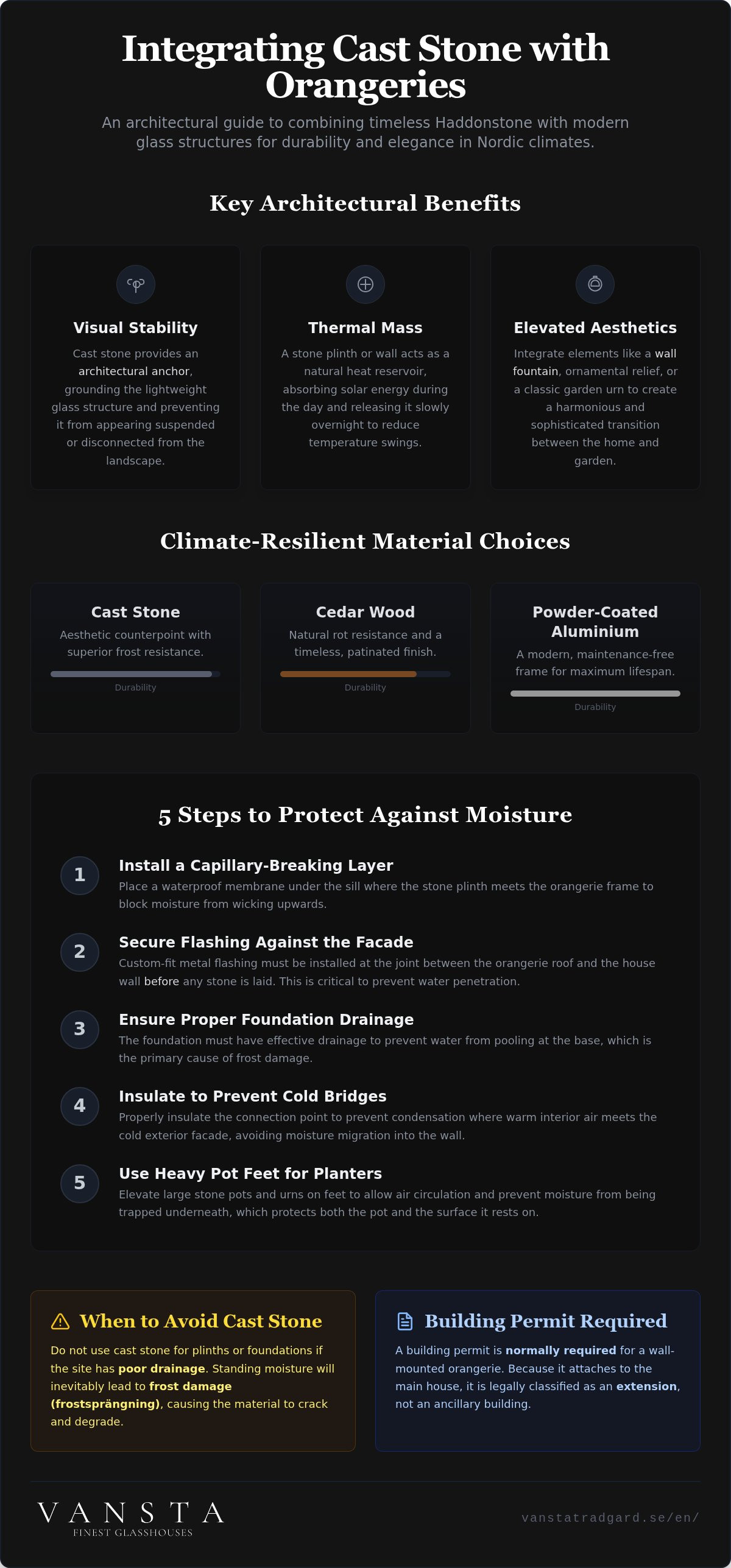
- Five steps are required for moisture protection, including a capillary-breaking layer under the sill and flashing against the facade.
- Avoid the material if the foundation lacks drainage, as standing moisture causes cracks due to frost damage.
- Choose cast stone for plinths and ornamental relief combined with aluminium profiles for a maintenance-free result.
- A building permit is normally required for wall-mounted orangeries as they are legally classified as an extension.
Cast Stone Providing Weight and Heat Storage to the Glasshouse
Before deciding on placement, it pays to assess the actual situation your plot and facade present. Here are three common scenarios, with recommendations drawn from the same material choices as the rest of the article:
- The glass feels suspended above the ground. Place heavy stone elements directly against the glass structure so that the surfaces gain visual stability and do not appear isolated from the ground.
- You want heat storage in the foundation. Build the orangerie with an integrated plinth or construct the greenhouse on a wall: the plinth frames the plants, and the wall stores heat.
- The outdoor environment lacks character. Combine a wall fountain and ornamental relief with a classic garden urn at the entrance: the weight and durability of cast stone provide a timeless feel in the Nordic climate.
Cast stone creates an elegant balance against a modern glasshouse. In customer projects, it is clear that heavy stone elements against the glass structure provide precisely the stability that glass surfaces otherwise lack. An integrated plinth frames the plantings, while a greenhouse on a wall (architectural anchor) provides a foundation that stores heat.
A thoughtful comparison shows that cast stone resists frost damage better than temporary decoration. The material's weight and quality create a harmonious space. Create a unique environment by combining greenhouses and orangeries from Vansta with timeless stone architecture.
Orangerie Against a Wall: Heat, Surface, and Classic Transition
A wall-mounted orangerie utilizes the house's existing facade and provides you with a stable, energy-efficient, and aesthetically pleasing outdoor environment without consuming unnecessary ground space.
In practical work, it is evident how the house wall functions as a natural heat reservoir. This thermal mass stores the day's sunshine and reduces temperature variations during cold, frosty nights. Historically, the orangerie has been an exclusive building for overwintering citrus trees. By choosing a greenhouse anchored on a wall, you physically anchor the structure in the ground and achieve a classic, seamless transition between dwelling and garden.
Heavy pot feet under generously designed stone pots protect against moisture and frost damage. The right material choices realize the dream of a sustainable outdoor room. Those who prefer architectural symmetry often choose a wall connection precisely for the harmonious entirety between stone and glass, a solution suitable for the Nordic climate and based on craftsmanship rather than temporary decoration.
If you understand the advantages of a wall-connected model, the next step is to choose the right craft elements for your facade.
A user in the discussion "A greenhouse can be so beautiful, Garden Forum" on forum.odla.nu noted:
"It would have been fantastic to own a share in that British company, but unfortunately, that's not the reality. I'll have to settle for green fingers and a flourishing garden." (source)
The text reflects how a wall-mounted orangerie, with the right material choices and proven building tradition, creates a sustainable architectural whole, in line with the appreciation for British craftsmanship and a flourishing garden environment.
Flashing and Waterproofing to Stop Moisture at the Joint
You avoid moisture through correctly installed flashing that breaks capillary action and insulates the structure from the existing facade.
When an orangerie is built against a property, a structural challenge arises. Incorrect insulation creates a cold bridge where warm room air meets cold facade surfaces, and harmful moisture can then migrate into the wall. A tight connection acts as the house's invisible shield: without it, rainwater risks penetrating over furniture and turning well-thought-out choices into disappointment.
With proper planning, you get a refined result that can withstand the Swedish climate for decades. Custom-made orangeries against an existing facade are adapted to the house's specific conditions, so that the joint between glass and wall becomes a safe place rather than a risk zone.
Tip: Always secure the flashing connection to the existing facade with custom sheet metal before the stone is installed to completely avoid future capillary action.
Cast Stone, Cedar Wood, and Aluminium That Withstand Nordic Climate
The choice of frame and details determines the building's character far more than a single surface. Haddonstone's patinated cast stone acts as an aesthetic counterpoint to more modern profiles and withstands frost damage in the Nordic climate. Cedar wood provides a lasting feel with its aging grey hue, while powder-coated aluminium offers a maintenance-free alternative that extends the structure's lifespan.
If you are planning a greenhouse on a wall, the plinth provides the balance that a freestanding building would otherwise have to derive solely from its frame. Create a cohesive style through freestanding orangeries in matching materials, where stone, wood, and metal interact with the garden. Wood suits those seeking patina; aluminium is suitable when you want to minimize maintenance.
| Material | Primary Advantages | Area of Use |
|---|---|---|
| Cast Stone | Durable with beautiful patina | Plinths and ornamental relief |
| Cedar Wood | Naturally rot-resistant | Frame and details |
| Aluminium | Maintenance-free protection | Profiles and roof |
When You Should Refrain from Using Haddonstone in the Orangerie
Wet-cast stone is not suitable for all outdoor environments. Misplaced stone objects quickly become indistinct, especially where moisture is stagnant.
If the foundation lacks drainage, the material risks cracks due to frost damage: in such cases, it is better to refrain than to force heavy elements. Never place heavy vessels directly on delicate wooden floors without pot feet. A generously designed garden urn requires stable bases. Temporary decoration has no place when building an orangerie; durable solutions protect both the structure and the overall impression.
In the thread "Garden General" on byggahus.se, a member wrote:
"But after my conflict with Markslöjd, they actually sent me several replacement products. I also collected a pile of faulty luminaires this spring."
The example shows how incorrect components create frustration when installing garden structures and underscores the value of proven craftsmanship and durable materials.
Five Steps to Protect the Greenhouse on a Wall from Moisture
You protect the wall with a correctly installed capillary-breaking layer under the sill. The wall acts as weather protection, much like a pair of leather boots against wet moss, and proper moisture protection is therefore a good investment for a masonry foundation.
- Install a capillary-breaking layer on the top of the wall before the sill is placed.
- Check the ridge height against the approved architectural drawings that have been prepared.
- Fasten the frame to the wall with acid-resistant fixings adapted for the stone.
- Apply silicone along all connection surfaces to prevent moisture migration.
- Inspect the drainage so that water is permanently led away.
The stone requires careful shipping solutions from reliable suppliers so that it arrives without cracks. A greenhouse on a wall gains stately character only when the work is carried out methodically: create a clear overview before assembly begins, and the orangerie will withstand moisture for decades.
Building Permit Often Required for Orangerie Against House Wall
Yes, building an orangerie directly against the facade normally requires an approved building permit as it is considered an extension.
When such a building permit application is planned, the existing ridge height of the house is reviewed. This is a necessary check for correct adaptation. The building sometimes exceeds permitted dimensions in the urban plan; in such cases, an adapted construction that meets both aesthetic and legal requirements is needed.
A wall-mounted greenhouse on a wall forms a harmonious whole and saves ground space, while also providing support for delicate plants. Questions about exemption from building permits are sometimes met with suspicion in forums: a clear overview of the steps creates security during the process. Contact your municipality early; it saves valuable time.
What Drives the Price for Haddonstone and Orangerie
The groundwork and the adaptation of profiles determine the final price when you build an orangerie. The nature of the ground and the height of the wall set the framework for the project.
From the workshop engineer's perspective, custom-sized glass requires exact tolerances against the cast stone. A millimeter error in the wall's crown propagates directly up into the aluminium profiles. The price structure is therefore strongly affected by how much ground preparation is required before stone and glass are installed.
The cost is influenced by whether you choose windows in tempered safety glass and aluminium profiles finished with powder coating. A masonry foundation creates a stable base that protects against frost damage and provides thermal mass, which retains heat during cool evenings. Integrating a greenhouse on a wall requires precise architectural drawings for correct dimensioning.
Haddonstone's classic cast stone and its ornamental relief become a timeless feature in the garden. Generous, weather-resistant outdoor furniture creates space for intimate conversations, but it is the craftsmanship precision in the joint between stone and glass that costs more initially and provides a maintenance-free greenhouse that withstands the Swedish climate for decades.
To deepen your planning budget: request a personal quotation based on your specific measurements.
Details and inquiry: Vansta Trädgård.
Frequently Asked Questions
What color choices are available for the products?
The cast stone is delivered in classic standard tones such as Bath, Portland, and Terracotta. The Vansta Classic aluminium profile can be powder-coated in any color for adaptation to the facade and stone.
How do I protect the joint between the orangerie and the house from moisture?
A correctly installed flashing breaks capillary action and insulates the structure from the existing facade. Supplement with a capillary-breaking layer under the sill, silicone along all connection surfaces, and functional drainage away from the wall.
What does it cost to combine Haddonstone with an orangerie?
The final price is determined by groundwork, the height of the wall, the nature of the ground, custom-sized tempered safety glass, and the choice of frame, for example, in powder-coated aluminium. The exact amount will be provided via a quotation after project planning.
What materials work well with Haddonstone in the orangerie?
Cast stone is suitable for plinths and ornamental relief, cedar wood for frames and details with a natural patina, and aluminium for maintenance-free profiles and roofs. The combination provides thermal mass in the foundation and a frame that withstands the Nordic climate.
Do I need a building permit to build an orangerie against a wall?
It depends entirely on the size of the structure, the distance to the property boundary, and local zoning regulations. Smaller projects may fall within a permitted area for ancillary buildings without a formal building permit. Before applying, you should prepare professional architectural drawings.
Realize Your Dream in 2026
The same questions that govern the initial investment – glass, frame, the extent of the stone wall, moisture protection, and building permits – also determine whether the result will be lasting. Combining Haddonstone with an orangerie creates a harmonious balance between classic stone art and light architecture when these choices are made in the correct order.
The experts at Vansta Trädgård will guide you through every step towards a custom-made greenhouse on a wall. Let your garden feature timeless details and genuine craftsmanship: find inspiration in the webshop, or contact us for personal advice regarding your project.