

A garden often gains its most distinct character through its details. Cast stone garden art can lend it a personal, classical expression. A statue, garden urn, or fountain contributes form and weight, harmonizing with gr…
Cast Stone Garden Art for a Personal Expression
2 nov. 2026
A garden often gains its most distinct character through its details. Cast stone garden art can lend it a personal, classical expression. A statue, garden urn, or fountain contributes form and weight, harmonizing with greenery, paving, and the architecture of the home. The goal is not to fill the garden with objects, but to select a detail that feels natural within the composition as a whole.
It is easy to focus primarily on the motif at first, yet placement, proportions, and surrounding planting also shape how the artwork is experienced. Here, you will gain an overview of what cast stone brings to an outdoor space, how different forms can define the garden, and what is essential to consider during your selection. Discover how classical forms can interact with the structure of your garden, from a garden urn tucked into a lush corner to a fountain serving as the focal point of an outdoor room.
Key takeaways
- Select a statue, garden urn, or fountain based on the character of the garden and the intended role of the feature.
- Evaluate form and scale in relation to the house architecture, pathways, and plantings to achieve a balanced whole.
- Position the artwork where it has room to command attention, while allowing surrounding greenery and materials to frame it.
- Consider how the classical expression of cast stone interacts with garden structure and the shifting seasons.
- When garden features are designed to harmonize with a greenhouse or orangery, architectural cohesion becomes an essential part of the planning.
Cast stone garden art
A statue, garden urn, or fountain can establish a distinct focal point without disrupting the fundamental layout of the garden. The sculpted surface of cast stone adds an architectural expression that dialogues with pathways, stone walls, and plantings. Consequently, cast stone garden art is equally suited to classical settings and to providing a traditional counterpoint to modern lines. The selection succeeds when the object's function and placement are considered from the very beginning.
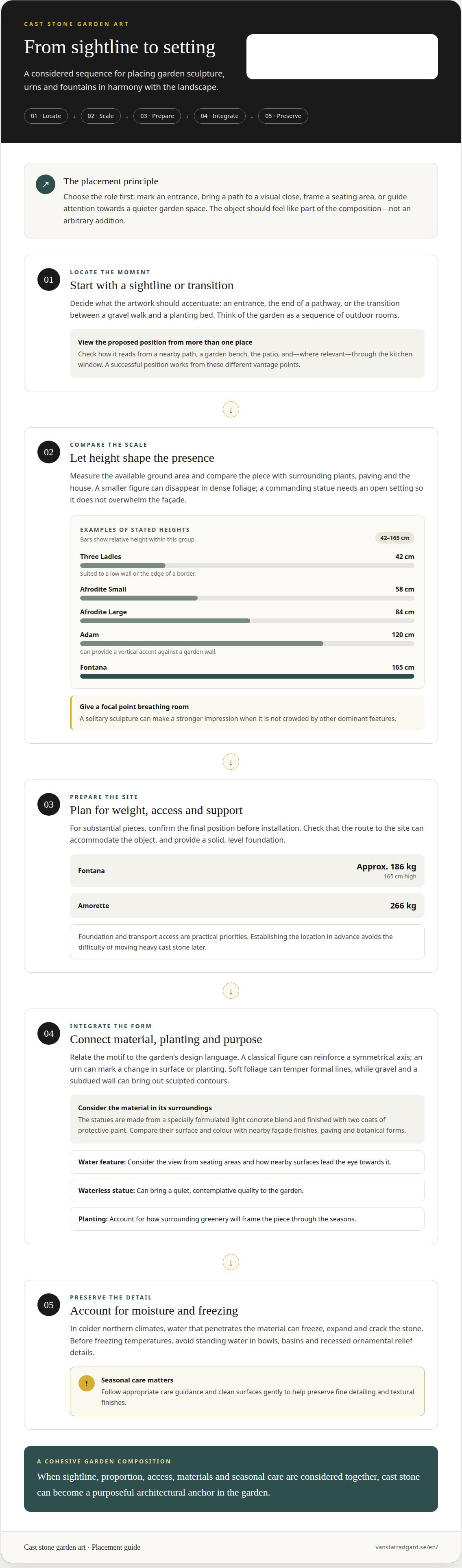
View the garden as a sequence of outdoor rooms and sightlines. A sculpture at the entrance greets visitors at close range, while a statue placed at the terminus of a path can serve as a defining visual culmination. Observe the proposed location from multiple vantage points, such as through the kitchen window or from the patio. If the piece functions harmoniously from these perspectives, it serves as a natural architectural anchor rather than an arbitrary addition.
Scale influences expression just as much as the motif. Afrodite Small stands 58 centimetres high, whereas Afrodite Large measures 84 centimetres. Three Ladies is 42 centimetres high, making it well-suited to the top of a low wall or the edge of a border. Compare the height with surrounding plants and hardscaping. A modest figure can easily become obscured by dense foliage, while a commanding statue requires an open setting where it will not overwhelm the building facade.
Larger works demand careful attention to ground preparation and site accessibility. Fontana stands 165 centimetres high and weighs approximately 186 kilograms. Amorette weighs 266 kilograms, rendering installation a practical priority from the early planning stages. Choose a solid, level foundation and ensure that access routes can accommodate the weight and dimensions. Designating the final location in advance eliminates the challenge of moving heavy cast stone later.
The motif should also engage in dialogue with the design language of the garden. A classical figure can reinforce a symmetrical axis, while a garden urn can articulate the transition between a gravel walkway and a planting bed. Adam, measuring 120 centimetres in height, can act as a striking vertical accent set against a garden wall. It is rarely necessary to repeat the same motif throughout the grounds; a solitary sculpture often commands far greater presence when granted ample visual breathing room.
Water introduces acoustic nuance and gentle movement, transforming the experience of garden art. A fountain can serve as an inviting gathering point within a courtyard, whereas a waterless statue often imparts a quiet, contemplative atmosphere. Carefully consider where a water feature should be situated, how it appears from seating areas, and how adjacent surfaces lead the eye toward it. Through thoughtful placement, a fountain becomes an integral element of the garden's architectural composition rather than a standalone object.
Consider these practical steps when determining placement and scale:
- First, identify which sightline or transition the artwork will accentuate, such as an entranceway or the terminus of a pathway.
- Measure the available ground area and compare it with the height and width of the piece.
- Assess the foundation requirements and transport route, especially for substantial works such as Fontana or Amorette.
- Evaluate how surrounding plantings will frame the piece throughout the various seasons.
In colder northern climates, appropriate placement and seasonal maintenance are vital for exterior ornaments. Moisture penetrating the material and freezing can cause frost damage, expanding inside and cracking the stone. Avoid leaving standing water in bowls, basins, or recessed ornamental relief details ahead of freezing temperatures. Observe proper care guidelines and clean surfaces gently to preserve fine detailing and textural finishes.
Patina and ornamental relief also define how cast stone interacts with greenery. Soft foliage can temper the formality of a classical figure, while clean gravel lines accentuate its contours. Base your selection on more than historical provenance or individual size; evaluate the artwork in direct relation to facade finishes, ground paving, and botanical forms. In doing so, it becomes an enduring facet of the garden's architecture with clear purpose and aesthetic coherence.
Surface texture and colour also affect how an artwork integrates with its environment. The statues are crafted from a specially formulated light concrete blend and finished with two coats of protective paint. Consider the piece against its backdrop, taking into account surrounding shades and textures. A subdued architectural wall highlights sculpted contours, while lush planting creates a softer transition. Clarify the intended function: marking a threshold, framing a seating alcove, or drawing the eye toward a secluded garden quarter.
Budgetary considerations naturally play a role. Compare options with both placement and proportion in mind, ensuring the piece fits harmoniously and fulfills your intended design purpose.
Once the position is established, assess how the piece is perceived from nearby pathways and garden benches. Preserve open space around it and avoid competing with other dominant focal points. For a fountain, consider how the water element dialogues with adjacent structural forms. In this manner, your garden art becomes an enduring, deliberate element of the landscape.
Vansta Trädgård: Vansta Orangeries
Vansta Trädgård offers Vansta Orangeries for those seeking to unite botanical cultivation and refined living within garden architecture. When designing an orangery or bespoke greenhouse, proportions, materials, and placement can seamlessly mirror the aesthetic of the surrounding grounds. Cast stone accents contribute timeless architectural substance. The portfolio also includes Vansta Classic orangeries, custom glasshouses, and THE ROSE greenhouse collection.
For comprehensive landscape transformations, architect-designed greenhouses and orangeries create an elegant synergy between residence and garden. Tailor your choice to the intended lifestyle and the architectural heritage of your home. Discover Vansta Trädgård's bespoke greenhouses and orangeries at vanstatradgard.se.
Let the garden's next step take shape
A refined garden evolves through decisions that preserve the harmony of the whole. Before introducing your next feature, reflect on the ambience you wish to create: tranquility, classical formality, or a seamless transition between interior and exterior spaces. This vision will guide whether a sculptural element stands alone, complements an outbuilding, or nestles within lush plantings. Cast stone garden art thus becomes part of a cohesive design vision, rather than a mere decorative addition.
If your plans also encompass an orangery or greenhouse, refining the dialogue between architectural framework, materials, and garden features is a worthwhile endeavor. Vansta Trädgård is your trusted partner when planning a harmonious landscape. Contact Vansta Trädgård to take the next step in shaping the character of your garden and creating an enduring, bespoke outdoor living space.