

Can an extension truly feel as if it has always belonged to your property, or does it risk appearing as a foreign object that breaks the architectural soul of the house? Investing in professional architectural assistance…
Architectural Assistance for Building an Orangery: A Guide to Architectural Excellence 2026
1 Ιούν 2026
Can an extension truly feel as if it has always belonged to your property, or does it risk appearing as a foreign object that breaks the architectural soul of the house? Investing in professional architectural assistance to build an orangery is about significantly more than just technical drawings; it's an assurance that your dream transforms into a timeless and aesthetically harmonious extension of your home. With the new regulations in the Planning and Building Act, which became fully effective in 2026, the freedom to create significant ancillary buildings has increased, but the demands for craftsmanship quality and technical precision are simultaneously more extensive than ever before.
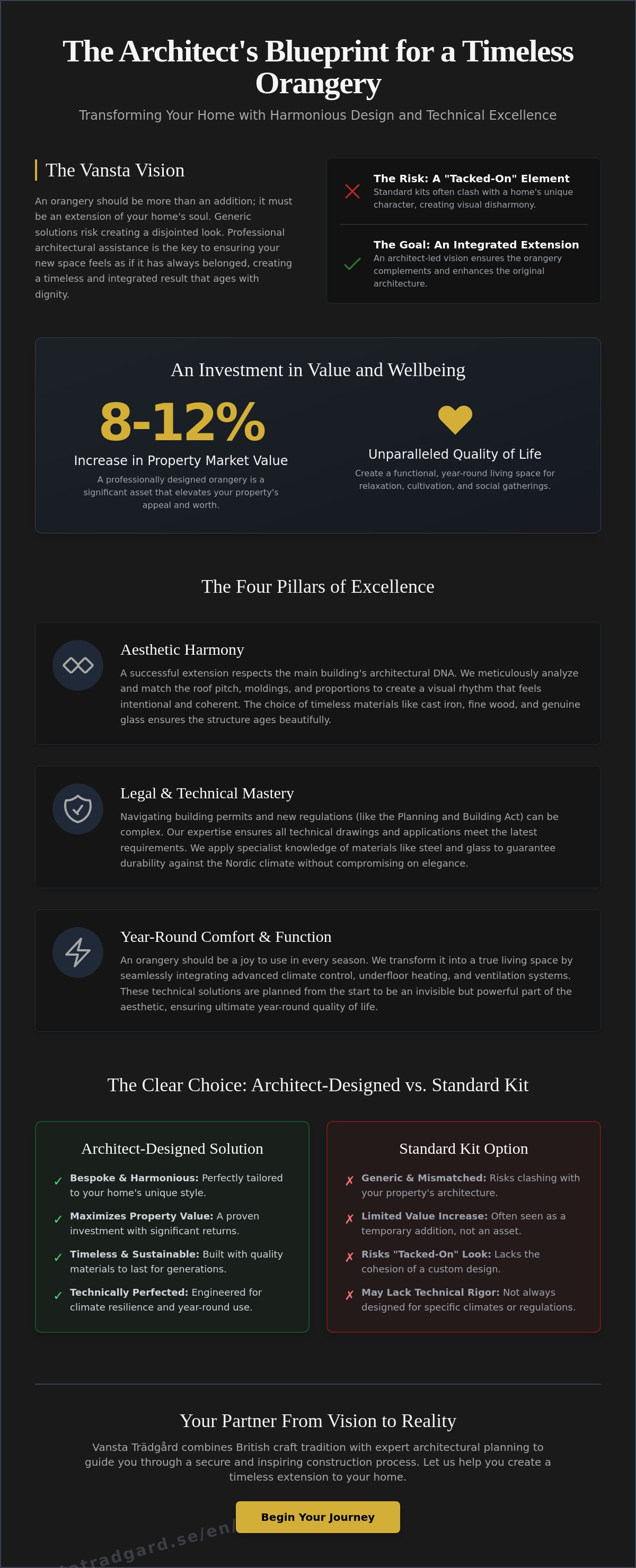
We share your view that an orangery should be a place for deep recuperation, not a source of worry about future moisture problems or legal obstacles. This guide shows how the right architectural expertise navigates through the new regulations for areas up to 50 square meters and transforms technical requirements into poetry in glass and stone. You will discover how a well-planned investment not only creates outstanding quality of life but can also raise your villa's market value by between 8 and 12 percent. We explore the path towards a technically perfected room where 2026's warm color palette meets classic craft traditions in perfect symbiosis.
Key Takeaways
- Learn how to create an aesthetic symbiosis between your home and your new extension by choosing timeless materials such as cast iron and genuine glass.
- Gain insight into how professional architectural assistance for building an orangery ensures that technical drawings and building permit applications meet the latest requirements of the Planning and Building Act.
- Discover how advanced climate control, underfloor heating, and ventilation transform your orangery into a functional living space for year-round quality of life.
- Understand the importance of choosing architect-designed solutions over standard options to maximize the property's market value and aesthetic sustainability.
- Explore the journey from vision to reality where British craft tradition meets expertise in building permit drawings for a secure and inspiring construction process.
Architectural Assistance for Orangery Construction: More than just a drawing
Realizing the dream of a glasshouse requires more than just a desire to build; it demands a deep understanding of how light, form, and function interact. Professional architectural assistance for building an orangery is fundamentally an investment in your property's future soul. A drawing in itself is merely a technical document, but an architectural vision ensures that the extension does not become a foreign object, but an integrated part of the home that ages with dignity. It's about creating lasting value where every detail, from the profiling of the eaves to the choice of fittings, contributes to an overall experience of timeless elegance.
Many are tempted by simple standard solutions, but these often fall short when contrasted with a house of historical character or specific proportions. Without expertise, the orangery risks feeling like a tacked-on element rather than a natural extension. If we study the rich history of the orangery, it becomes clear that these structures have always been intended as architectural jewels. They require a partner who possesses specific expertise in glass constructions to balance the delicate aesthetics with modern engineering.
To visualize the journey from idea to reality, you can watch this video that highlights the complexity of creating a sustainable glasshouse:
The Vision as the Foundation for the Project
A skilled architect never starts with the walls, but with the surroundings. By analyzing how the sun's rays move across your plot during different seasons, the architect can position the glass sections to capture the most flattering light. Is the goal a place for contemplative cultivation or a social hub for late dinners? By defining the needs early, a seamless transition is created between the cozy indoor environment and the freedom of the garden, where the house's proportions are respected and enhanced.
From First Sketch to Technical Precision
The path from a dreamy sketch to a technically perfected construction is filled with crucial decisions. Material choices such as steel and glass require specialist knowledge to withstand the Nordic climate without compromising elegance. Planning for winter gardens already in the sketching phase ensures that technical solutions for insulation and heating become an invisible but powerful part of the aesthetics. It is this precision that distinguishes a simple greenhouse from an architectural masterpiece.
Aesthetic harmony: Matching the orangery with the house's soul
A successful extension is about understanding and respecting the main building's architectural DNA. When hiring professional architectural assistance to build an orangery, the first task is to identify the proportions and lines that give the house its unique character. The roof pitch is often the most critical factor; it should neither dominate nor feel undersized, but rather reflect existing roof slopes to create a visual rhythm. By carefully matching the profiling of ridge beams and moldings with the house's carpentry details or clean lines, a coherence is achieved that feels planned rather than added.
Material choices are crucial for how the building is perceived once the initial novelty has worn off. We advocate for materials that age with a beautiful patina and possess an inherent honesty. Cast iron, fine wood, and genuine glass are not only durable choices from a technical perspective; they are carriers of a craft tradition that lends weight and authority to the construction. In 2026, we see a clear movement towards warmer and more saturated colors. Brown has taken the place of the new beige, and together with tones of olive green and honey, a sophisticated palette is created that softens the transition between architecture and nature.
Details such as masonry and plinths serve as the building's anchor in the ground. By using handmade bricks or natural stone that harmonize with the house's foundation, a sense of permanence is created. It is in these encounters between glass, metal, and stone that the orangery's true elegance emerges, as a value-preserving investment for the future.
British Tradition Meets Nordic Functionalism
The classic English style, with its proud proportions and decorative details, often forms the basis of our design philosophy. In the Nordic climate, however, a careful adaptation is required where aesthetics meet demands for insulation and snow loads. Many of our customers draw inspiration from architect-designed greenhouses to find the right balance between Victorian ornamentation and modern, clean lines that suit a contemporary lifestyle.
Integration with Garden Architecture
An orangery should be regarded as the heart of a larger garden plan. By creating sightlines that lead the eye towards strategically placed Haddonstone fountains or statues, the building is integrated into the outdoor environment in a natural way. The placement is about maximizing light intake during the dark winter months without compromising the house's private sphere or privacy. For those who dream of a harmonious overall solution, Vansta Orangeries can help realize a vision where every detail works together to enhance the quality of life.
Building permits and technical drawings: Navigating the process with expertise
Navigating the legal labyrinths of the Planning and Building Act (PBL) can feel like a challenge that distracts from the creative process. Since the new regulations came into force on December 1, 2025, the landscape for extensions has changed significantly. The terms "friggebod" (shed) and "attefallshus" (small ancillary dwelling unit) have been replaced by the term "ancillary building," which offers new opportunities but also places higher demands on technical precision. By engaging professional architectural assistance to build an orangery, you ensure that the project rests on a secure legal foundation from day one. It's not just about getting approval, but about creating a structure that meets all safety requirements and technical standards required in 2026.
For projects within a detailed development plan area, an ancillary building of up to 30 square meters is now permitted without a traditional building permit, provided that the total area of all ancillary buildings on the plot does not exceed 45 square meters. Outside a detailed development plan, the allowance is even more generous, with up to 50 square meters. Despite these simplifications, a technical notification is often still required, especially if you plan to install water, sewage, or a fireplace in your orangery. An architect here acts as your guide, ensuring that the placement respects the critical boundary of 4.5 meters to the neighbor, or handles the legal documents if a closer construction would require neighbor consent.
The Critical Drawings for Application
An application lacking professional sharpness often leads to time-consuming supplementary requests and unnecessary waiting. The building committee requires exact facade drawings, section drawings, and a site plan showing the building's precise position on the property. When the drawings maintain a high architectural standard and show detailed sections of the construction, it signals that the entire project is permeated by quality. This creates confidence among the case officers and facilitates the process. The architect takes on the role of your professional representative and conducts the dialogue with the municipality, saving both time and energy.
Technical Challenges When Connecting to an Existing Wall
Joining a modern glass structure with an existing house wall requires technical finesse and deep knowledge of the different properties of materials. It is critical to manage moisture barriers and drainage correctly so that no problems arise at the joints during heavy rainfall or snowmelt. To create a comfortable climate year-round, one must balance the glass's insulation value with the building's thermal mass and ventilation. If you want to delve deeper into the legal and practical details, you will find specific building permit tips for orangeries in our comprehensive guide. By resolving these issues already at the drawing stage, a construction is created that is as technically durable as it is aesthetically pleasing.
Plan for quality of life: Interior design and technical function
An orangery in its purest form is a tribute to light, but for the room to become a living part of the home, careful technical planning is required. When you choose architectural assistance to build an orangery, the process is as much about the invisible as the visible. It's about how heat spreads from the hidden underfloor heating, how the fireplace smoke curls against the winter sky, and how ventilation discreetly ensures that the air is always fresh, whether the sun is blazing or snow is swirling outside the glass. Technical installations should never dominate, but rather serve as a silent attendant to the aesthetic experience.
In large glass structures, acoustics are an often-overlooked factor that can determine how much the room is actually used. Without proper planning, conversations can become sharp and echoes can dominate. Here, interior architecture plays a crucial role. By working with layers of textiles and strategically placed plant groups, a subdued and pleasant atmosphere is created. Lighting is another cornerstone of planning. It should not only illuminate, but highlight the lines of the frame and create depth in the room even when darkness has fallen over the garden. Integrating dimmable light sources in roof trusses and along masonry provides an ambiance that extends use far into the dark hours of the day.
Interior Design that Extends the Architecture
The interior of an orangery must withstand both intense light exposure and the special environment that arises in a tempered room. It's about choosing materials that do not fade or wear out, but rather gain character over time. To achieve a timeless British aesthetic, Oxleys Furniture outdoor furniture is an excellent choice. Their craftsmanship quality and ability to withstand the test of time make them a natural part of the orangery's architecture. In 2026, we see how zones for relaxation and dining are defined by a warm color palette where brown, olive green, and tones of honey create an inviting feeling that contrasts with the coolness of the glass.
Plant Selection and Cultivation in an Orangery Environment
The soul of an orangery is its greenery. The choice between exotic Mediterranean plants like citrus and olive, or more classic Nordic choices, depends entirely on the temperature you choose to maintain in the room. Already at the drawing stage, space for large, heavy pots and integrated planting areas must be planned to maintain the flow in the room. Automatic irrigation systems hidden in the construction are a modern necessity that allows you to enjoy the greenery without constant tending. To begin the journey towards your dream project, you can explore our custom-designed orangeries that unite form and function in perfect harmony.
Vansta Trädgård: Your partner from vision to finished architectural work
Realizing an architectural dream requires more than just a supplier; it requires a companion who shares your passion for the timeless and the handcrafted. Vansta Trädgård stands as a guarantor that every detail of your project is permeated by excellence. By offering professional architectural assistance to build an orangery, we create the conditions for an environment where craftsmanship meets poetry. Our Vansta Orangeries are not just buildings but tailor-made masterpieces with a deep British origin, adapted to meet the challenges of the Nordic climate without losing their delicate elegance.
When you seek architectural assistance to build an orangery with us, you gain access to a comprehensive solution where your personal vision is central. We understand that navigating government requirements and technical specifications can feel complex and time-consuming. Therefore, we take full responsibility for Building Permit Drawings and Application, ensuring a secure process where nothing is left to chance. By combining our expertise in architecture with an intuitive understanding of the Planning and Building Act, we create a smooth journey from the first sketches to the final control plan.
Our collections serve as an inspiring foundation for your unique design. THE ROSE greenhouse collection Greenhouses offers a romantic but technically perfected aesthetic, while Vansta Classic orangeries represent a culmination of generations of knowledge about glass constructions. Here, every profile and every joint is proof of our love for solid craftsmanship, where we borrow elements from historical glasshouses to create something entirely new that feels both familiar and innovative.
Why Choose Vansta for Your Project?
We give you access to a world of exclusive materials and international manufacturers who share our view of quality over quantity. With us, you are met by a personal point of contact throughout the entire planning phase, where your architect acts as a curated expert and reliable advisor. We build for the future and focus on sustainable constructions that not only withstand weather and wind but also increase your property's market value by between 8 and 12 percent, according to current analyses for 2026. It is an investment in both living quality and economic sustainability.
Next Steps Towards Your Dream Orangery
Your journey begins with a no-obligation consultation where we together explore your visions and the property's unique conditions. Before meeting with the architect, it is valuable to reflect on how you want the light to fall and which zones for relaxation are most important for your daily life. It's about preparing for a lifestyle change where the boundary between outdoors and indoors blurs. Book a review of your dreams with us to take the first step towards a value-preserving investment that will provide recuperation and harmony for generations to come.
Realize Your Architectural Vision for the Future
An orangery is significantly more than a functional extension; it is a place where architectural excellence meets the tranquility of nature, creating a space for lifelong recuperation. By prioritizing aesthetic harmony and technical precision, you ensure that your property is refined into a work of art that ages with both style and dignity. Choosing the right architectural assistance to build an orangery is the single most important decision to ensure that your dream becomes technically perfected, legally secure, and aesthetically coherent with your existing home.
At Vansta Trädgård, we bring over 20 years of experience in exclusive garden architecture and specialize in navigating PBL and complex building permit drawings. Our Red Dot-awarded design rests on a stable foundation of genuine British craftsmanship, guaranteeing a construction that stands the test of time. Let our experts help you realize your architectural dream – contact Vansta Trädgård today. Together, we create a timeless environment where every detail breathes passion and where your vision has room to flourish for generations to come.
Frequently asked questions about architectural assistance for orangeries
Why do I need architectural assistance to build an orangery?
Architectural assistance for building an orangery ensures that your new extension harmonizes with the main building's proportions and architectural soul. A skilled architect looks beyond standard dimensions and creates a customized solution that optimizes light intake and spatiality based on your plot's unique conditions. By handling the technical challenges surrounding insulation and ventilation, a simple glass construction is transformed into a timeless architectural jewel that enhances the entire property's character and aesthetic value.
How much does it cost to hire an architect for an orangery project?
The cost of hiring an architect varies depending on the project's scope, level of detail, and the specific requirements set in the building permit process. The investment covers everything from the first conceptual sketches to the technically advanced documents required for a secure construction process. By investing in professional expertise, the risk of costly technical missteps in the future is minimized, while you secure a construction that is both aesthetically perfected and technically durable.
Do you always need a building permit to build an orangery?
No, according to the updated regulations in the Planning and Building Act from December 2025, a building permit is not always required for an ancillary building. Within a detailed development plan area, a building of up to 30 square meters can be erected without a building permit, while the limit outside a detailed development plan is 50 square meters. However, it is important to remember that a technical notification is often required, and the building must be placed at least 4.5 meters from the property boundary to be exempt from permit requirements.
What is the difference between an orangery and a regular winter garden?
The difference lies primarily in the building's architectural dignity, its construction, and intended use. An orangery is a permanent building with a solid foundation and high-quality materials such as cast iron, fine wood, and genuine glass, designed for both social gatherings and vegetation throughout all seasons. A winter garden is often a simpler glass construction that serves as an extension of the season. The orangery is considered an integrated part of the dwelling and a value-preserving investment for the future.
How long does the process take from drawing to finished orangery?
The entire process typically takes between six and twelve months, depending on the project's complexity and the municipality's processing times. The planning phase with the architect often takes a few months to ensure every detail is perfect. This is followed by the formal processing by the municipality. The actual construction, which requires high craftsmanship and precision in assembling the glass structures, often takes between three and five months to complete to a technically perfected result.
Can I build an orangery against the house wall without risking moisture problems?
Yes, with the right technical design and specialist knowledge, it is entirely possible to build an orangery directly against the house wall. When you choose architectural assistance to build an orangery, it is ensured that moisture barriers, drainage, and thermal bridges are handled correctly at the joint between the buildings. This requires a deep understanding of how different materials move and how ventilation should be designed to prevent condensation, creating a secure and long-term sustainable construction for your home.
What drawings are required for a building permit application for an orangery?
For a complete application, professional facade drawings from all cardinal directions, section drawings showing the construction's build-up, and a detailed site plan are required. The site plan must show the building's exact placement and dimensions in relation to property boundaries and existing buildings on the property. Submitting well-prepared architectural drawings reduces the risk of time-consuming supplementary requests from the building committee and signals a high level of ambition for the entire project, which often facilitates the municipality's processing.
How does the choice of architect affect the property's future resale value?
A high-quality architect-designed extension is a significant investment that, according to analyses from 2026, can increase a villa's market value with between 8 and 12 percent. Buyers value the aesthetic harmony and technical security that a professionally designed building entails. By choosing an architect who understands classic craft traditions, timeless added value is created that distinguishes your property from the crowd and makes it a unique object on the market.