

A classical deity statue is recognized by its attributes, posture, and interplay with its surroundings. In the garden, the sculpture becomes both a work of art and an integral part of the site's architectural whole.Facia…
Bacchus in Classical Garden Statues: Appearance and Symbols
6 nov 2026
A classical deity statue is recognized by its attributes, posture, and interplay with its surroundings. In the garden, the sculpture becomes both a work of art and an integral part of the site's architectural whole.
Facial expression, material, and composition shape how an ancient figure is perceived. The details can also convey narratives and symbolism, making the viewing experience far richer than a mere matter of form.
Here you will learn how the motif is typically portrayed and how its distinguishing traits can be interpreted. We explore the attributes and their meaning, helping you read the visual language of classical sculpture with greater ease.
Key Takeaways
- Learn to recognize classical portrayals and understand how expression and attributes shape the figure's character.
- See how the shape of the thyrsus staff contributes to the interpretation of the motif and its mythological significance.
- Discover what grapevines and ivy represent as symbols, and how they differ in the sculpture's artistic expression.
- Gain perspective on how a classical statue can interact with garden architecture and surrounding greenery.
- Explore how a greenhouse or orangeri can become a cohesive element within the garden's classical framework.
Bacchus' Appearance and Attributes
In classical statues, Bacchus is recognizable by several artistic hallmarks, yet representations vary. Some emphasize the face, others show the entire figure or place him within a narrative scene. It is therefore wise to examine the sculpture's form and context together. A detail prominent in one work may be entirely absent in another.
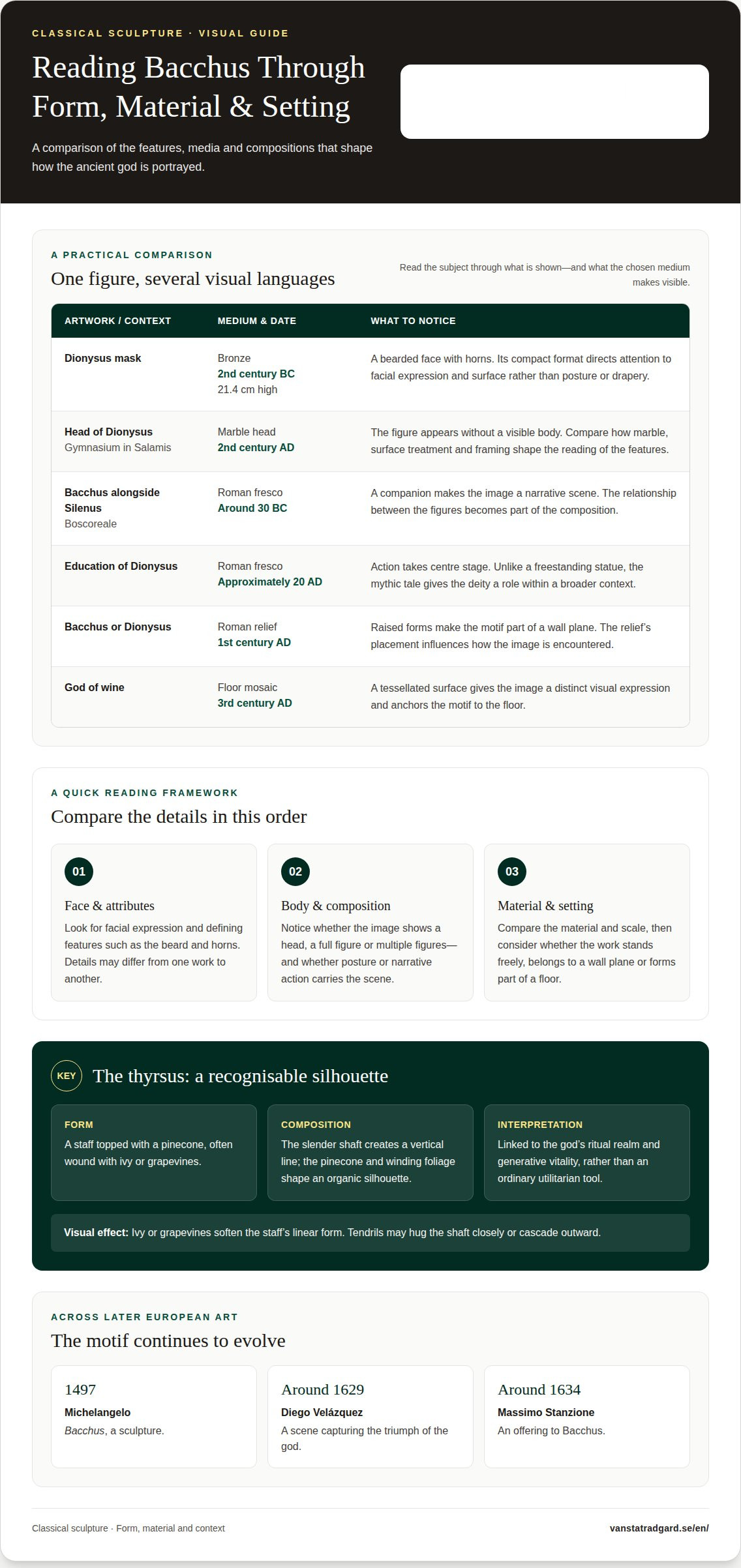
A bronze mask from the 2nd century BC depicts Dionysus with a beard and horns. The mask stands 21.4 centimeters high. Its pronounced features lend the face a distinctive character. The compact format also means the viewer engages with the deity primarily through facial expression and surface, rather than posture or drapery.
A marble sculpture of the head of Dionysus from the gymnasium in Salamis dates to the 2nd century AD. Here the face appears without a visible body. Compared to the bronze mask, the marble reveals a different artistic solution: material, scale, and surface treatment alter how the features are perceived. These artifacts offer tangible examples of variation within the very same iconographic realm.
Roman depictions also demonstrate how the figure could be integrated into narrative compositions. A fresco from Boscoreale, dated to around 30 BC, portrays Bacchus alongside Silenus. The named companion transforms the scene into something more than an isolated portrait. The viewer can interpret the dynamic between the figures as an essential part of the imagery's narrative.
Another Roman fresco, from approximately 20 AD, depicts the education of Dionysus. Here, the action takes center stage. This narrative focus differs from a freestanding statue, where posture and facial features typically carry the composition. The fresco illustrates how a mythic tale could assign the deity's persona a distinct role within a broader context.
Reliefs and mosaics provide further points of comparison. A Roman relief from the first century AD depicts Bacchus or Dionysus, while a floor mosaic from the third century AD shows the god of wine. The raised forms of the ornamental relief and the tessellated surface of the mosaic create distinct visual expressions. Both artworks anchor the motif to a defined architectural plane.
A garden statue therefore need not adhere to a single rigid template. A beard and horns evoke the bronze mask from the 2nd century BC, whereas an isolated head recalls the find from Salamis. Such comparisons allow the observer to discern between different artistic interpretations of the subject. They also make it easier to recognize which traits predominate in any given sculpture.
Following antiquity, the motif continued to endure across European art. Michelangelo's sculpture Bacchus dates to 1497. Around 1629, Diego Velázquez painted a scene capturing the triumph of the god. Massimo Stanzione depicted an offering to Bacchus around 1634. These works illustrate how the subject continually re-emerged across both sculpture and painting.
Begin by observing the face, the posture of the body, and any accompanying figures. The Boscoreale fresco, for instance, presents two figures, whereas the Salamis marble find consists solely of a head. Next, compare material and dimensions. This approach allows one to appreciate the distinct qualities of the piece without assuming that all representations are identical.
Placement also profoundly influences how a sculpture is experienced. A freestanding figure can be appreciated from multiple angles, whereas a relief belongs to a wall plane and a mosaic to a floor. Roman examples demonstrate how medium dictates the encounter with the image. In a garden setting, silhouette, visible patina, and surrounding architecture merge into a singular overall impression.
This artistic breadth becomes evident when contrasting the bronze mask, the marble bust, and the wall paintings. Facial features, scale, and composition provide varied entries into the iconography. By examining the elements individually, one can better understand how a classical statue relates to ancient predecessors and which visual tradition it carries forward.
The bronze mask dates to the 2nd century BC and measures 21.4 cm in height. These details help separate two facets of the object: its historical timeframe and its physical scale. The beard and horns simultaneously evoke a more formidable divine entity than a neutral countenance. When the mask is viewed purely as a face rather than a complete figure, these specific traits carry immense weight in defining how the subject is perceived. They offer the viewer concrete markers to compare against other representations of Dionysus, without dictating that every portrait depict him in the same manner.
The marble sculpture of Dionysus' head from the gymnasium at Salamis dates to the 2nd century AD. Alongside the bronze mask, it demonstrates how a head alone can command immediate recognition, even when the torso is absent. The comparison need not imply adherence to a single archetype. Instead, it directs focus toward which details the sculptor chose to carry the motif, and how medium and framing define the viewer's experience. A face can serve as an intense distillation of the deity, whereas a full-length figure also invites reading of stance and surroundings. In this way, attributes serve as illuminating clues rather than a rigid prescription for every piece.
Thyrsus, Grapevines, and Ivy as Symbols
The attributes surrounding the ancient god of wine form a cohesive visual language, in which foliage and staff evoke fertility, nature, and revelry. The thyrsus is a staff topped with a pinecone, often wound with ivy or grapevines. In a sculpture, it may be grasped in the hand or rest beside the figure. Its distinctive shape renders the subject instantly recognizable, even from afar.
The structure of the staff establishes a clear vertical line within the composition. The slender shaft contrasts with the pinecone and winding foliage, which lend the summit an organic silhouette. The thyrsus thus reconciles crafted geometry with natural growth. In classical iconography, it is linked to the god's ritual realm and generative vitality rather than to an ordinary utilitarian tool.
The pinecone crowns the staff, drawing the eye upward. Ivy or grapevines entwined around the shaft soften its linear rigidity. A sculptor may allow the tendrils to hug the staff closely or cascade outward. In either case, the tension between structural direction and flowing botanicals forms a vital aspect of the artistic expression.
The grapevine relates directly to grapes and wine, two cornerstones of the god's traditional domain. A cluster held in the hand, draped over a shoulder, or resting against the torso helps the viewer read the subject. The serpentine line of the vine also imparts movement to an otherwise static stone surface. Delicate grapes and leaves generate subtle shifts in light and shadow, particularly in deeply modeled carving.
The grapevine can also symbolize the seasonal cycle of cultivation: growth, ripening, and harvest. This reading reflects the motif's ties to agriculture and fertility. A solitary cluster provides an understated hint, whereas abundant vines convey lushness and vitality. The density of detail is not a rigid convention, but a deliberate artistic choice.
Ivy differs from the grapevine in leaf shape and the absence of fruit clusters. In sculptural ornamentation, its dense foliage can form a continuous garland around the staff or body. Because ivy represents evergreen resilience, it is frequently interpreted as an emblem of enduring vitality and longevity. This balances the grapevine's immediate association with harvest and seasonal abundance.
When both botanicals appear together, the sculpture gains nuanced layers of meaning. The grapevine evokes wine, cultivation, and the harvest, while ivy suggests eternal verdancy. The thyrsus unifies these elements, gathering the winding flora along its shaft. An astute reading begins by distinguishing leaves from fruit, and then observing how they harmonize.
In a garden statue, setting directly affects how these details are perceived. An upright thyrsus stands out crisply against a calm architectural anchor or hedge, whereas winding tendrils can blend gracefully into surrounding greenery. If the sculpture is positioned near climbing plants, an elegant dialogue emerges between carved stone and living foliage. Distance, natural light, and backdrop determine which attributes catch the eye first.
When interpreting a piece, look for three concrete markers: the staff's pinecone, the grapevine's fruit, and the ivy's distinct leaves. Observe whether the foliage wraps around the thyrsus or rests loosely across the torso. This distinction reveals how the sculptor structured the iconography. A thoughtfully designed outdoor setting allows these classical motifs to interact seamlessly with plantings and classical garden architecture.
In mythic narrative, the staff can take on a dynamic role beyond still representation. In The Mark of Athena, Bacchus repels Ephialtes and Otis back into Tartarus by touching them with his thyrsus. This scene illustrates how an iconic attribute can drive action rather than merely serve as an emblem of identity. The staff becomes a focal point where vegetative symbolism meets divine authority: the familiar silhouette gains dramatic resonance through its active use. At the same time, the thyrsus ensures the connection to the wine god remains unmistakable, even amidst dramatic events.
In sculpture, a comparable tension can arise without depicting physical motion. A hand firmly grasping the staff suggests sovereignty and control, whereas a staff leaning loosely against the body imparts a relaxed, contemplative poise. The botanical ornamentation is therefore far more than mere embellishment: it anchors the figure's contours to the implement, harmonizing the entire composition. The viewer reads the staff as a symbol, while the eye follows its path and tactile relief. When grapes, foliage, and pinecone converge upon it, the symbolism becomes palpable in the stone. Subtle variations across pieces stem from how boldly the sculptor balances organic abundance, structured form, or implied movement. Restrained carving allows the staff's silhouette to command attention, whereas lavish vines blur the boundary between divine emblem and nature. Both approaches employ the same revered iconography, yet impart their own distinctive presence.
Vansta Trädgård
Vansta Trädgård helps you view garden architecture as a comprehensive whole, where a classical statue can interact harmoniously with structures, sightlines, and curated plantings. If you wish to enrich the setting around a sculpture with an elegant space for cultivation and leisure, Vansta Trädgård offers bespoke, architect-designed greenhouses and orangeries, including Vansta Orangerier and Vansta Classic orangeries. The portfolio also includes bespoke greenhouses and THE ROSE greenhouse collection.
The choice of building shapes how different garden zones intersect and how a classical figure is framed from both interior rooms and outdoor terraces. Vansta Trädgård's architectural designs are ideally suited for those planning a cohesive estate aesthetic rather than simply positioning a standalone statue. Contact Vansta Trädgård to discuss an architect-designed greenhouse or orangeri tailored to your grounds.
Give the Statue a Natural Place in the Garden
A classical sculpture commands a far more compelling presence when its placement is carefully considered. Study the garden from multiple vantage points: through your home's windows, along primary pathways, and from your preferred seating areas. A stone niche, low retaining wall, or lush evergreen hedge can frame the figure gracefully without competing with its delicate carving. The distance to adjacent plantings also influences how the stone's form and patina emerge through the changing seasons.
When selecting a statue of Bacchus, draw inspiration from your garden's existing architectural lines and the atmosphere you wish to evoke. The piece can serve as a serene architectural anchor or play an active role within a grander vista of walkways and borders. Vansta Trädgård proudly offers timeless cast stone statues from Haddonstone for classical garden landscapes.
If you would like to explore how a statue of Bacchus can complement your outdoor sanctuary, you are warmly invited to contact Vansta Trädgård about statues. Allow your selection to develop thoughtfully, ensuring that your garden's artwork finds a home that feels entirely natural, harmonious, and enduring.