

A classical garden statue is never just a beautiful decoration; it serves as an architectural anchor that lends your outdoor environment both structure and a sense of eternity. It is a bold truth that properly placed gar…
Classical Garden Statue: A Guide to Timeless Elegance and Architectural Harmony
4. sep 2026
A classical garden statue is never just a beautiful decoration; it serves as an architectural anchor that lends your outdoor environment both structure and a sense of eternity. It is a bold truth that properly placed garden art can transform a simple green space into a living work of art that breathes historical continuity and artisanal pride. You have surely experienced the frustration of searching for objects that feel genuine, only to be met with materials that look fragile or cannot withstand the changing Nordic climate. The concern that the statue might lose its character during a snowy winter or appear out of place in relation to the garden's other proportions is a challenge that requires both knowledge and a delicate touch.
In this guide, you will learn how to choose and place classical garden statues to create a sophisticated outdoor space inspired by ancient European garden ideals. We delve into the art of working with high-quality cast stone, a material that not only withstands the test of time but also ages with a magnificent natural patina. By understanding the interplay between form and architectural harmony, you can create focal points that elevate your entire property. We guide you through the process of investing in timeless quality that lasts for generations, where every detail contributes to an atmosphere of serene luxury and a feeling that your garden has always belonged right here.
Key Takeaways
- Learn how aesthetic principles from ancient Greece and Rome create symmetry and timeless architectural balance in your outdoor environment.
- Discover why a classical garden statue made of high-quality cast stone is the premier choice for elegantly enduring the challenging Swedish climate.
- Gain practical insights into how to place statues as strategic focal points to define sightlines and create a sense of space.
- Understand the art of caring for your objects so they develop a beautiful natural patina that enhances the garden's historical character over generations.
- See how investments in artisanal garden art elevate the property's overall impression and harmonize with exclusive orangeries and greenhouses.
What defines a classical garden statue?
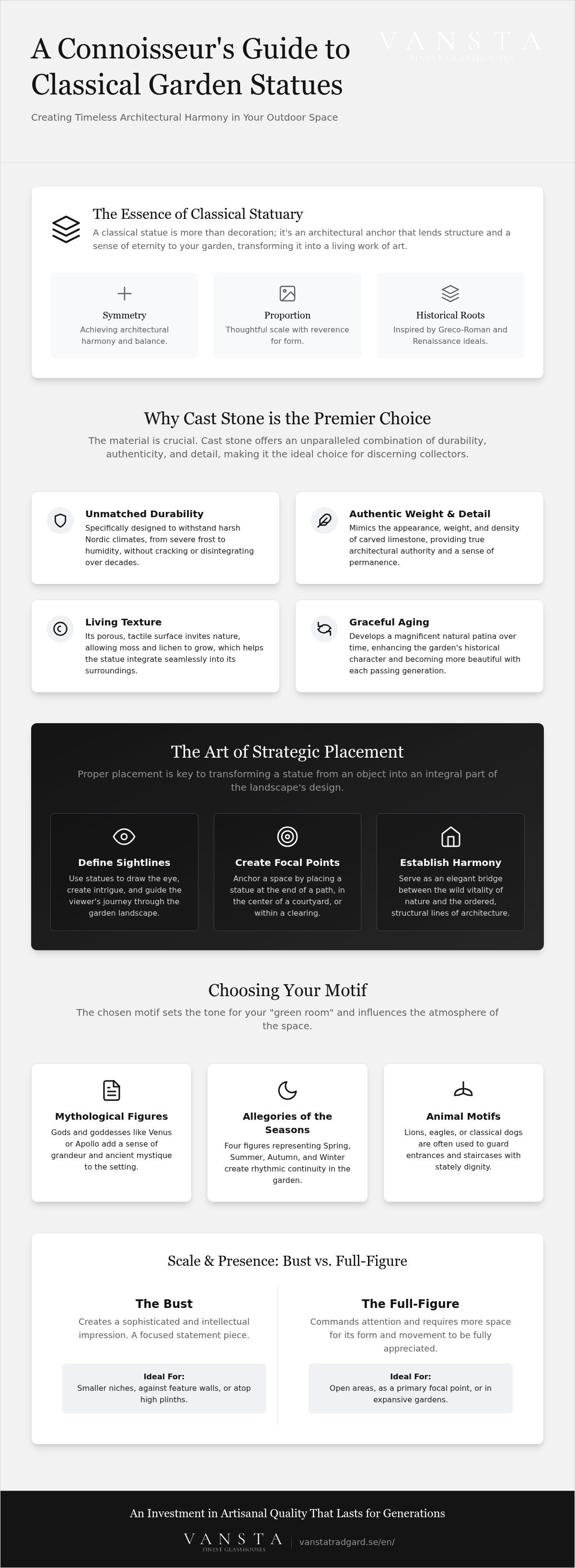
Choosing a classical garden statue means inviting a millennia-old tradition of beauty and order into your outdoor environment. This style rests on the aesthetic cornerstones formed in ancient Greece and Rome, principles later revived and refined during the Renaissance. It is not about fleeting trends but about a pursuit of architectural harmony through strict symmetry, thoughtful proportions, and a deep reverence for human anatomy. While a simple decoration often feels like a temporary addition, the classical statue functions as a permanent part of the garden's framework.
The difference between mass-produced ornaments and genuine garden art lies in the richness of detail and the weight of the material. An authentic classical statue has the ability to anchor the viewer's gaze and give the garden a spiritual dimension that extends beyond the purely decorative. It is interesting how these motifs, despite their historical heritage, work just as effectively as contrasting focal points in a minimalist, modern garden as in a traditional manor park.
Historical Roots and Inspiration
Classical garden art has journeyed through centuries, from the strictly geometric Italian Renaissance gardens to the more romantic and expansive English landscape parks. Throughout time, statues have been used to weave together narratives, celebrate virtues, or manifest the owner's status and education. For those who wish to delve deeper, there is a rich history of garden sculptures that shows how these elements have evolved from religious symbols to central architectural components. Fundamentally, the classical statue serves as an elegant bridge between nature's wild vitality and architecture's ordered lines.
Common Motifs in the Classical Range
Within the classical design language, motifs often found carry deep symbolism. The choice of figure immediately sets the tone for the "green room" and influences how we perceive the place's atmosphere. Here are some of the most prominent categories:
- Mythological Figures: Gods and goddesses like Venus or Apollo add a sense of grandeur and ancient mystique.
- Allegories of the Seasons: Four figures representing spring, summer, autumn, and winter create a rhythmic continuity in the garden.
- Animal Motifs: Lions, eagles, or classical dogs guarding entrances and staircases with dignity.
The Importance of Material Choice: Why Cast Stone is the Premier Choice
The material is absolutely crucial for whether a classical garden statue is perceived as a genuine work of art or a temporary decoration. Cast stone has long been the obvious choice for the discerning garden owner seeking durability. Unlike natural stone, which is extremely costly and time-consuming to hand-process, cast stone offers almost unparalleled precision. Haddonstone's unique manufacturing process results in a surface that not only mimics the appearance of carved limestone but also possesses its weight and density. It is precisely this physical mass that gives the statue its architectural authority; it feels permanent, rooted in the ground, and becomes a natural extension of the house's architecture.
In our challenging Nordic climate, where strong fluctuations between frost and humidity test every outdoor construction, durability is a critical factor. A classical garden statue from Haddonstone is specifically designed to withstand these stresses without cracking or disintegrating. It is an investment that endures decades of Swedish winter and maintains its integrity year after year.
The Unique Properties of Cast Stone
Cast stone's primary strength lies in its ability to combine extreme detail with a living surface texture. While plastic feels lifeless and concrete often comes across as cold and industrial, cast stone has a porous surface that invites nature. This tactile structure allows the statue to quickly integrate into its surroundings. Details in facial features or drapery are maintained with sharpness, while the material breathes and interacts with light in a way that recalls the finest historical sculptures in European palace gardens.
Patina – The Art of Aging with Dignity
In a classical garden, a perfect, clinically clean surface is rarely the goal. Instead, a natural patina is sought, telling a story of the passage of time. Weather and wind gradually transform the new object into a timeless feature that appears to have stood in place for centuries. Moss and lichen take hold on the surface, giving the statue an organic softness and depth. For those seeking guidance on preservation and cleaning, expertise in Care and Maintenance is available to ensure the process occurs favorably. One can choose to accelerate the patina with natural methods or gently clean the statue to maintain its original luster. This transformation is part of the charm and contributes to the sense of historical continuity that characterizes a well-planned outdoor space. If you are looking for inspiration on how these material choices can enhance your environment, you can explore our curated selection of exclusive garden art.
The Art of Placement: Creating Architectural Focal Points
Placing a classical garden statue is about much more than just finding an empty space; it is an architectural dialogue between the object and its surroundings. By using statues as focal points, you can guide the viewer's eye and create a sense of order and purpose in the garden. A well-considered placement transforms a static figure into a dynamic anchor that defines the character of the entire space. This aesthetic rests on a long tradition where every sightline, or vista, has been carefully planned to create both surprise and harmony. Anyone who studies a history of classical garden sculpture quickly realizes how crucial the interplay between sculpture and nature has been in creating the most iconic European environments. In a modern context, the statue serves as a perfect counterpoint to the strict lines of architect-designed greenhouses, where the lightness of glass meets the timeless weight of stone.
Creating Sightlines and Room Divisions
A statue functions best when it concludes a visual axis, for example, at the end of a pathway or as a central point in a parterre. By using statues in pairs, you can mark entrances or transitions between different garden rooms, creating a clear architectural rhythm. It is also wise to consider how the statue is perceived from inside the home. By placing artworks in direct relation to sightlines from winter gardens, you extend the garden season and allow classical elegance to be present even during the darkest months of the year.
Scale and Proportions
One of the most common mistakes is choosing a statue that is too small and "disappears" into the surrounding greenery. To give a classical garden statue the right authority, a plinth or pedestal is often required to elevate the motif and provide it with the correct height in relation to the viewer's gaze. The background also plays a crucial role; a dark, clipped hedge or a natural stone wall creates a contrasting effect that makes the statue's details stand out more clearly. To create an even more dynamic environment, you can combine your sculptures with Haddonstone fountains. The movement and sound of water create a living background that enhances the statue's tranquility and gives the garden an almost poetic atmosphere where form and function merge.
Care and Maintenance for Generations
An investment in a classical garden statue is an investment for the future. By caring for your objects correctly, you ensure that they not only retain their value but also become more beautiful with each change of season. It rarely involves time-consuming work. Instead, it is about understanding the nature of the material and allowing it to age with dignity. A statue from Haddonstone is created to live outdoors; it breathes and reacts to its environment in a way that cheaper materials can never emulate.
Many garden owners wonder when algae and moss should be removed and when they should be allowed to remain. In a classical garden, natural growth is often seen as an asset that gives the object character and a deeper sense of history. If, however, the moss begins to obscure delicate details in facial features or intricate ornamentation, a gentle cleaning may be appropriate. It is a balancing act between preserving the coveted patina and protecting the statue's artistic expression from being erased by the passage of time.
Cleaning Tips for Cast Stone
When it's time for cleaning, you should always prioritize the gentlest methods to avoid damaging the stone's surface. Pressure washing is strictly forbidden; the powerful jet can penetrate the porous structure of the cast stone and cause micro-cracks. Instead, follow these simple steps:
- Use a soft brush and clean water to brush away loose dirt and organic material.
- Avoid chemical cleaning agents that can discolor the stone or disturb its natural pH balance.
- For stubborn stains, a very mild soap solution and patience are often sufficient.
By regularly keeping the surface free from accumulations of leaves and wet soil, you reduce the risk of deep discolorations that do not contribute to the desired patina. Should the statue incur minor chips or damage, these can often be seen as part of its unique history, but if necessary, they can be repaired with a special stone compound to preserve the object's integrity.
Winter Care in a Nordic Climate
The Swedish climate places high demands on outdoor architecture. A classical garden statue made of high-quality cast stone is naturally frost-resistant, but water is its greatest enemy during winter. If water remains in bowls or hollows and then freezes, frost heave can occur, which can lead to permanent damage. It is therefore crucial that the statue is placed on a plinth or a foundation with good drainage. The statue should never stand directly on grass or soil where moisture can be drawn up from below by capillary action.
Haddonstone's material is specifically designed to withstand the extreme cycles of freezing and thawing that we experience in the Nordic region. This makes them a safe choice for our latitudes, and you rarely need to cover the statue if the drainage is correctly implemented. To find the perfect foundations that secure your investment, you can explore our range of Haddonstone statues and plinths.
Investing in Quality: Haddonstone and Vansta Trädgård
Choosing a classical garden statue from Haddonstone is a decision that extends far beyond the purely aesthetic; it is a value-preserving investment in your property's architectural soul. A well-chosen sculpture acts as an anchor that gives the garden weight and a sense of historical continuity. There is a clear connection between well-planned garden art and a property's total market value. Just as an exclusive kitchen or a built-in library elevates the interior status of a home, a classical garden statue creates an exterior environment that breathes luxury and permanence. It is a detail that signals that nothing has been left to chance.
Vansta Trädgård acts not only as a retailer but as a curated expert and advisor throughout your entire project. We understand that every garden has its unique character and that the choice of artwork must harmonize with both the building's style and the surrounding nature. By combining your statues with exclusive outdoor furniture, you create a complete and inviting environment where every element works together to impart a sense of timeless British elegance.
The Craftsmanship Behind Every Statue
Every single object carries a history of craftsmanship that spans decades. The process begins with handmade molds where the unique cast stone is carefully packed to ensure perfection in every line and detail. This authenticity, with deep roots in British craft tradition, makes each product feel alive and unique. It is not a matter of mass production but of genuine artistry where the final finish gives the stone its characteristic appearance of carved limestone. For specific projects with unique requirements, there is also the possibility to discuss customized solutions, making it possible to realize even the most ambitious visions.
Create Your Dream Garden with Vansta
Our expertise extends from the grand strokes to the smallest decorative detail. We help you see the whole picture, whether it concerns building permit drawings for magnificent orangeries or the strategic placement of a single statue. Through personal advice on style and proportions, we ensure that your investment receives the authority it deserves. For those seeking concrete inspiration, we recommend a visit to our display garden. There, you can see with your own eyes how the materials age, how shadows fall over the classical motifs, and how thoughtful garden architecture creates a sanctuary for recovery and beauty.
Realize Your Vision of Architectural Harmony
An investment in a classical garden statue is an act that extends beyond the present, weaving together historical craftsmanship with the enjoyment of future generations. By consciously choosing materials like high-quality cast stone, you ensure that your garden art not only endures the Scandinavian climate but also gains in beauty with each passing year. The architectural interplay between form, placement, and sightlines transforms your outdoor environment into a place of contemplation and timeless elegance where each focal point carries its own story.
As an authorized retailer of Haddonstone in Sweden, we have shared our passion and expertise in classical garden architecture since 2003. We help you find the details that elevate your property and create a sense of lasting luxury. Let your garden become a living reflection of your personal aesthetic where every element is chosen with care and knowledge. Explore our exclusive range of Haddonstone statues here and begin the journey towards an outdoor environment that ages with unparalleled beauty and character.
Frequently Asked Questions about Classical Garden Art
Which material is best for a garden statue in Sweden?
Cast stone is undoubtedly the best material for the Swedish climate as it combines the aesthetics of natural stone with superior durability. Unlike natural stone, cast stone is more resistant to frost heave thanks to its specific density. It is a living material that is allowed to age and develop a beautiful patina over time. This ensures that your classical garden statue blends into its surroundings in a way that objects made of plastic or concrete can never achieve under Nordic conditions.
How do I make my new statue look old faster?
To accelerate the patination, you can brush the statue's surface with natural substances such as sour milk or diluted fertilizer. These substances provide nutrients that encourage the growth of moss and lichens. By placing the statue in a shady and damp location during the first few seasons, the right conditions are created for the surface to acquire the coveted, antique appearance. It's a classic trick that quickly gives your classical garden statue a sense of historical rootedness in your outdoor environment.
Do I need a foundation for my garden statue?
A stable and well-drained foundation is necessary to prevent the statue from sinking or tilting over time. The foundation also protects against frost heave and capillary moisture that can rise from the ground. By using a matching plinth or pedestal made of cast stone, you not only ensure stability but also give the artwork the architectural height required. This highlights the statue's details and makes it a clear focal point that harmonizes with the garden's other proportions and sightlines.
How do I clean a cast stone statue without destroying the patina?
Gently clean the statue with only lukewarm water and a soft brush to remove loose dirt and algae. It is important to avoid pressure washing and strong chemicals as these methods can damage the stone's pores and remove the valuable patina. If a more thorough cleaning is required, a mild, pH-neutral soap can be used sparingly. Regular maintenance primarily involves keeping the surface free from leaves and soil accumulations to preserve the delicate details without destroying the aged appearance.
Can a classical statue fit into a modern garden?
A classical statue works excellently as a sophisticated contrast in a minimalist and modern garden. The organic forms and historical references create a visual counterpoint to strict architectural lines and hard material choices. By integrating a classical motif into a contemporary setting, an exciting encounter between different style epochs is created, giving the garden a curated and timeless expression. It is about using the object as an architectural anchor that breaks up the monotony and gives the place a unique soul.
What is the difference between a statue and a sculpture in a garden context?
In garden architecture, a statue usually refers to a figurative representation of a human or an animal, often with mythological connotations. A sculpture is a broader concept that also includes abstract forms and modern art. In the classical garden tradition, statues are often preferred for their ability to convey stories and a sense of tradition. The choice between these depends on the atmosphere you wish to create; the statue often gives a more formal impression, while the sculpture focuses on pure form and structure.
Are Haddonstone statues resistant to frost and snow?
Haddonstone's products are specifically designed to be frost-resistant and withstand the stresses that a Nordic climate entails. The material is denser and less porous than ordinary concrete, which prevents water from penetrating and causing damage at sub-zero temperatures. Since Vansta Trädgård began supplying these statues in 2003, they have proven their durability in Swedish gardens. The prerequisite for full frost resistance is that the statue is placed on a well-drained foundation so that water never remains in direct contact with the object.