

An architectural detail can be the decisive difference between an ordinary patio and a timeless outdoor room that exudes European elegance and permanence. Many garden owners dream of that specific, classic framing that a…
Balustrade in the Garden: A Buying Guide to Classic Garden Architecture 2026
6. јул 2026.
An architectural detail can be the decisive difference between an ordinary patio and a timeless outdoor room that exudes European elegance and permanence. Many garden owners dream of that specific, classic framing that a balustrade in the garden provides, but hesitate due to the fear that the material will lose its luster or crack when the Nordic frost bites into the ground. This is a highly justified concern, as the subtle difference between high-quality, handcrafted cast stone and simpler concrete often determines whether the structure ages with dignity or deteriorates prematurely.
We understand that you are looking for a solution where form and function interact to create a harmonious extension of your home, rather than just a practical boundary protection. In this guide for 2026, we provide you with the expertise needed to choose the right material and understand the architectural proportions required for your investment to feel as self-evident in a hundred years as it does today. We will go through how to identify genuine craftsmanship, how to navigate current safety requirements, and how to create a design plan that enhances the character and value of your entire property.
Key Takeaways
- Learn to distinguish between high-quality cast stone and ordinary concrete to ensure a frost-resistant construction that ages beautifully over generations.
- Discover how a balustrade in the garden creates architectural weight and defines the garden's spatiality as a natural extension of the home.
- Get guidance on how to choose the right proportions and placement to create visual harmony between the garden structure and the house's scale.
- Understand the technical requirements for a stable installation, including foundation requirements and correct spacing between balusters.
- Explore the art of combining the durability of stone with living elements through strategic use of climbing plants and vertical structures.
What is a balustrade in the garden and why invest in one?
A balustrade in the garden is far more than a simple protective railing; it is an architectural expression that anchors the building in the landscape and gives the outdoor environment a sense of order and harmony. While a common fence often serves a purely functional role, the balustrade acts as a permanent structure that defines spatiality with weight and authority. To truly understand What is a balustrade from a historical perspective, we should look to the Italian Renaissance. It was here that the form was refined to create magnificent terraces that connected the strict geometry of palaces with the free forms of nature. In Sweden, we have a long tradition of using these elements in ancient manor environments to mark the transition between the cultivated and the wild.
Investing in a balustrade is about adding lasting value to the property. It is an architectural detail that not only enhances the aesthetic impression during summer blooms but also remains as a beautiful silhouette even during winter's rest. A well-planned balustrade in the garden signals quality and a long-term perspective on ownership, where each stone module is chosen to age with dignity and character.
Components of a Balustrade: An Anatomical Review
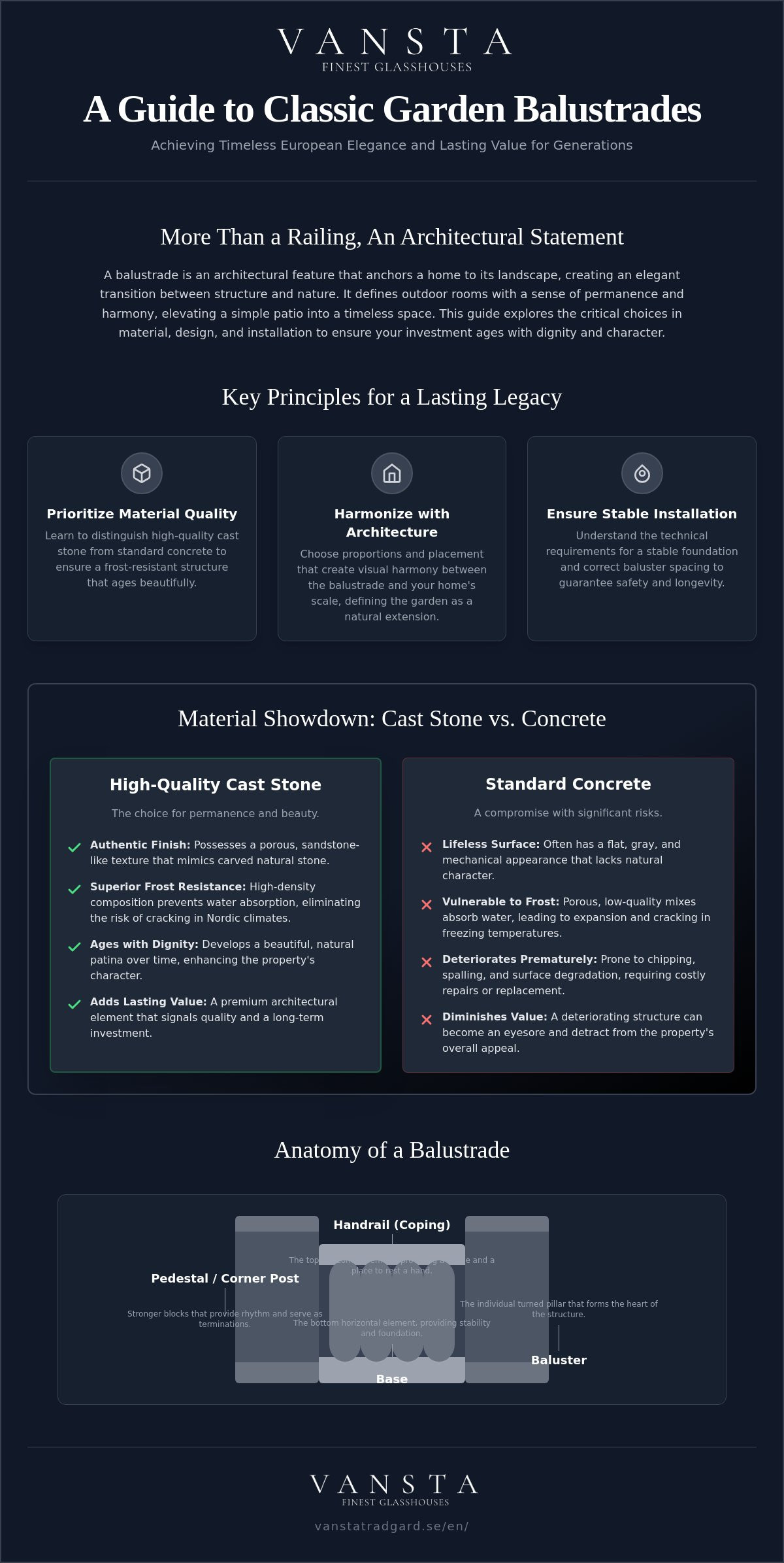
To create a balanced whole, an understanding of the individual parts that make up the structure is required. Each component has a specific role in the visual flow:
- The Baluster: The individual, turned pillar that forms the heart of the balustrade. Its shape can vary from strictly classic to richly decorated, setting the tone for the entire environment.
- Handrail (Coping) and Base: These horizontal elements serve as the frame. The base provides stability while the handrail, with its generous profile, invites you to rest your hand on the stone.
- Pedestals and Corner Posts: These stronger blocks break up the row of balusters. They create a necessary rhythm and serve as natural terminations at stairs or corners.
Aesthetic Benefits of Stone Balustrades
One of the main advantages of choosing stone over wood or metal is the immediate sense of permanence. The natural texture and color variations of stone create a dialogue with the garden's other materials, from gravel paths to rendered facades. By using balustrades, one can guide the eye and create sightlines that lead to the garden's highlights.
The structure also serves as a perfect backdrop for other architectural elements. The massive stone contrasts beautifully with the delicate glass sections in our classic greenhouses, where the weight of the stone meets the lightness of the glass in a timeless symbiosis. It is in this encounter between the built and the growing that the true magic of the garden arises.
Material Choice: Why cast stone surpasses concrete
The choice of material is the single most important factor when planning a balustrade in the garden. It not only determines the lifespan of the structure in the demanding Nordic climate but also how well it blends with the surrounding architecture. Many make the mistake of equating cast stone with ordinary concrete, but the difference in both aesthetics and durability is monumental. While standard concrete often has a lifeless, gray, and mechanical surface, high-quality cast stone possesses a porosity and texture that is almost impossible to distinguish from carved natural stone. It is about craftsmanship and material knowledge.
In Sweden, frost resistance is an absolute requirement. The density of the material is crucial here. A balustrade in the garden made of porous or low-quality concrete risks absorbing water which then expands at sub-zero temperatures, leading to cracking. Cast stone from reputable manufacturers like Haddonstone is designed to withstand these stresses. By following classic Garden Design Principles, one can create a structure that is not only technically durable but also ages with a beauty that only time can bring forth.
Haddonstone vs. Standard Concrete
The most striking difference lies in the surface finish. Haddonstone has a sandstone-like feel that reflects light in a soft and natural way. The color choices are carefully composed to harmonize with historical building materials; from the cool Portland tone to the warm Bath stone or the more rustic Terracotta. Unlike industrial concrete, which often looks worse with age, cast stone develops a coveted patina. It naturally attracts mosses and lichens, making the balustrade quickly feel like an integrated part of the garden's ecosystem rather than a foreign element.
The Role of Natural Stone in the Exclusive Garden
Genuine natural stone is, of course, the ultimate choice for those seeking total authenticity, but it often entails challenges in the form of extremely high costs and difficulties in finding exactly matching parts for future expansions. Cast stone offers a perfect balance here; it provides the luxurious expression of natural stone but with a precision in casting that significantly facilitates installation. To create a cohesive environment, one can advantageously combine their balustrades with other elements, such as Haddonstone fountains, to create a focal point that exudes European elegance. For those seeking the ultimate harmony between architecture and nature, we offer an exclusive range of balustrades and columns in cast stone that realize the vision.
Design Principles: Creating harmony and spatiality
When planning a balustrade in the garden, the focus is not solely on the product itself, but on how it interacts with the house's architecture and the garden's natural flow. A well-placed structure serves as a visual guide that directs the eye towards important focal points. To achieve timeless elegance, an understanding of proportions and scale is required. If the balustrade is too massive, it risks dominating the environment; if it is too delicate, it loses its authority. The secret lies in letting the house's proportions dictate the balustrade's height and weight, creating a seamless transition between the built and the green.
Symmetry is the golden rule in classic garden design. By starting from a central axis, such as a patio door or a central path, a sense of order and calm is created. Rhythm and repetition are equally important tools. Instead of letting a row of balusters run uninterrupted, pedestals and corner posts are used to create necessary visual breaks. These elements provide stability and allow us to play with geometric forms. To truly understand the importance of craftsmanship in these constructions, one can study the advantages of cast stone, a material that allows the precision required to achieve perfect symmetry.
Framing the Terrace
A balustrade around the terrace serves as an elegant demarcation that defines the outdoor space without excluding nature. It creates a safe room where one can enjoy the surroundings. To enhance the atmosphere during the darker hours of the day, discreet lighting can be integrated into or next to the pedestals, giving the stone a magical shimmer. To complete this environment, the choice of furnishings should match the weight of the stone. We recommend combining the structure with exclusive outdoor furniture that reflects the same sense of craftsmanship and durability.
Level Differences and Stairs
In gardens with hilly terrain, the balustrade becomes an indispensable tool for transforming necessary stairs into architectural jewels. By letting the handrail follow the slope of the stairs, a dynamic movement is created that connects different levels. Here, safety and aesthetics meet; even with significant drops, a sophisticated look can be maintained by choosing balusters with the right profile. It's about seeing the staircase as an opportunity to add vertical structure and create a visual connection that makes the entire garden feel like a cohesive, well-planned whole.
Planning and Installation: Technical considerations
Realizing the vision of a balustrade in the garden requires more than just an eye for aesthetics; it requires technical precision and thorough preparatory work. Since cast stone constructions possess significant weight, groundwork is fundamental to the final result. A stable, frost-free concrete plinth is an absolute requirement to prevent settlements that could otherwise disrupt the exact lines. Without a correct foundation, even the most skilled craftsmanship risks being affected by the ground's natural movements during the winter months, which in the worst case leads to cracking in the joints.
When calculating material requirements, a general rule of thumb is that four balusters per linear meter are needed to achieve a classic balance. However, it is important to weigh the aesthetic expression against current safety requirements. According to the Swedish National Board of Housing, Building and Planning's regulations for railings where children may be present, openings should not be wider than 100 mm. Installation is preferably carried out with stainless steel dowels and a specially adapted mortar. This is crucial to avoid future rust stains that could otherwise penetrate and discolor the stone's light surface.
The question of building permits is often central for permanent installations. A balustrade is legally considered a wall or a fence, which means certain rules apply. Generally, no building permit is required if the height is less than 1.2 meters. For a sheltered patio next to a single or two-family house, one can build up to 1.8 meters without a permit, provided the structure is placed within 3.6 meters of the house. However, if your balustrade in the garden is closer to the property line than 4.5 meters, the neighbor's written consent is required. As local regulations may vary, one should always consult the municipal building committee before starting the project.
Checklist before ordering
Before placing your order, it is important to have an exact drawing of the area. Identify where corner posts and pedestals should be placed to create a symmetrical rhythm. Remember to choose coping stones and end posts that harmonize with the house's other details. A consultation with a qualified architect can often be well-invested time to ensure that the stylistic match is perfect.
Maintenance for eternal beauty
One of the great advantages of cast stone is its minimal maintenance. To preserve the stone's natural luster, lukewarm water and a soft brush are usually sufficient. Whether one chooses to wash away moss and lichens is a matter of taste; many prefer the patina that gives the structure a historical character. However, it is wise to inspect the joints after each cold winter. If moisture penetrates micro-cracks, it can affect stability in the long run. To ensure that your planning is both technically correct and aesthetically perfect, we offer assistance with building permit drawings and applications as part of our comprehensive service.
Complete the Vision: Combine stone with vertical greenery
The meeting between eternal stone and ephemeral greenery is where the true soul of the garden is born. A balustrade in the garden forms the architectural framework, but it is the vibrant climbing of plants that breathes softness and poetry into the structure. By integrating living elements, one can break up the strict lines of the stone and create an environment that feels both ancient and organic. It is about finding the perfect balance between enduring craftsmanship and nature's constant change, a philosophy that permeates everything we create at Vansta Trädgård. When the stone acts as a backdrop for delicate foliage and fragrant flowers, a timeless harmony is created that elevates the character of the entire property.
To create drama and height in the garden's focal point, one should work with layers. A balustrade defines the horizontal plane, but to achieve its full architectural potential, vertical exclamation points are required. By allowing climbing plants to reach upwards, a visual connection is created between the ground and the sky, giving the garden room a sense of spaciousness and enclosure at the same time. It is in these details that classic garden architecture truly comes into its own, where each element has a well-thought-out place in the grand whole.
Rose Arches: The Perfect Partner for the Balustrade
A rose arch functions as a natural portal that marks the transition from one part of the garden to another. When placed as an opening in a balustrade in the garden, an inviting passage is created that leads the visitor further. It is crucial to choose plant supports in materials that correspond to the weight and authority of the stone; sturdy wrought iron or high-quality steel harmonize beautifully with the texture of cast stone. Together, they create a romantic tunnel effect where roses are allowed to envelop the architecture in a living mantle, enhancing the feeling of a secret and well-preserved garden room.
Plant Towers for Focus and Structure
Plant towers offer a unique opportunity to create focus behind or along a balustrade. By strategically placing the towers, climbing roses or clematis can be allowed to bloom just above the stone railing, creating an interesting interplay between the materials. These structures support the plants while also serving as sculptural elements during the winter months. To achieve a cohesive vision where every detail interacts, you can explore our collection of rose arches and plant towers to complete your garden architecture. It is through these conscious combinations of stone and greenery that you create a place for rejuvenation that only grows more beautiful with each passing year.
Realize your vision of a classic garden
Choosing a balustrade in the garden is a decision that extends far beyond the present. It is an investment in architectural permanence and a tribute to the timeless principles of classic craftsmanship. By prioritizing materials with high density, like our exclusive cast stone, you ensure that your construction not only withstands the demanding Nordic winters but also develops a beautiful patina that becomes more characterful with each passing year. As an exclusive retailer of Haddonstone, we offer architect-designed solutions where the highest standard of craftsmanship meets technical precision, creating a harmonious and value-preserving extension of your home.
When you combine the weight of stone with well-chosen proportions and symmetry, you create an environment that exudes calm and exclusivity. To complete your vision and soften the architectural lines with living, vertical greenery, you can find your perfect rose arches and plant towers at Vansta Trädgård. We are ready to help you transform your outdoor environment into a place where form and function merge in an eternal symbiosis. Let your garden become the oasis of elegance and rejuvenation you have always dreamed of.
Frequently asked questions about balustrades in the garden
How high should a balustrade in the garden be?
A balustrade in the garden should in most cases have a height of between 70 and 90 centimeters to achieve architectural balance. If the structure functions as a safety railing at a drop height exceeding three meters, the Swedish National Board of Housing, Building and Planning requires a height of at least 110 centimeters. For purely decorative purposes on terraces, a lower profile is often sufficient to maintain sightlines out towards the greenery without the visual impression becoming too heavy.
Do I need a building permit to install a balustrade?
A building permit is usually not required if the balustrade is less than 1.2 meters in height and is considered an open fence or a lower wall. If you build a sheltered patio within 3.6 meters of the residential house, the height can be up to 1.8 meters without a permit. However, remember that written consent from neighbors is always required if the placement is closer to the property line than 4.5 meters to avoid future legal complications.
What is the difference between cast stone and ordinary concrete?
Cast stone differs from ordinary concrete through its artisanal surface finish and high density that mimics natural sandstone. While concrete often appears gray and industrial, cast stone has a living texture that ages beautifully over time. The higher quality in the casting process also makes the material significantly more resistant to the Nordic climate's frost cycles compared to simpler concrete products that can more easily crack during extreme temperature fluctuations.
How do you mount balusters on an existing wall?
Mounting is done by drilling into the existing wall and anchoring the balusters with stainless steel dowels and an adapted cement mortar. It is crucial that the wall is stable and level before work begins to ensure that the handrail is perfectly straight. The use of stainless steel prevents rust from penetrating the stone and creating unsightly discolorations that could otherwise spoil the aesthetic impression of the light stone.
Can I install a balustrade myself or is a professional required?
It is entirely possible for a skilled DIY enthusiast to install a balustrade in the garden, but due to the weight of the stone, professional help is often recommended. Each part weighs considerably, and the precision in the jointing is crucial for the structure's durability and final appearance. A professional has the experience required to handle the groundwork and ensure that all proportions are mathematically correct in relation to the house's scale.
How do I prevent the balustrade from cracking during winter?
The best protection against frost damage is to choose a material with low water absorption and ensure a stable, frost-free foundation. By using high-quality cast stone, the risk is drastically reduced as water cannot penetrate the core of the material in the same way as in porous concrete. Also ensure that the joints are completely sealed so that water cannot remain inside the structure, which is otherwise the most common cause of damage.
Which plants are best suited with a stone balustrade?
Classic choices such as climbing roses, lavender, and formally clipped boxwood create a timeless harmony with the gray-white tones of the stone. Plants with a soft, overhanging growth habit, such as lady's mantle or ivy, help to soften the architectural lines and give a more organic feel. To create vertical drama, the balustrade can be combined with plant towers where clematis are allowed to climb and bloom just above the handrail's profile for a romantic effect.
How much maintenance does a Haddonstone balustrade require?
A Haddonstone balustrade requires minimal maintenance beyond occasional cleaning with water and a soft brush when needed. The material is designed to age naturally and attract moss and lichens, which gives a coveted antique feel that deepens the garden's character. We recommend an annual inspection of the joints to ensure that no moisture penetrates, but otherwise, the stone is virtually maintenance-free for many decades to come.