

What matters is not only how the water moves, but whether you choose an individual component or an assembled solution. Centerpieces for fountains are nozzles that shape the spray pattern, whereas a fountain set combines …
Stainless Steel Fountain Nozzles and Fountain Sets
30 Eki 2026
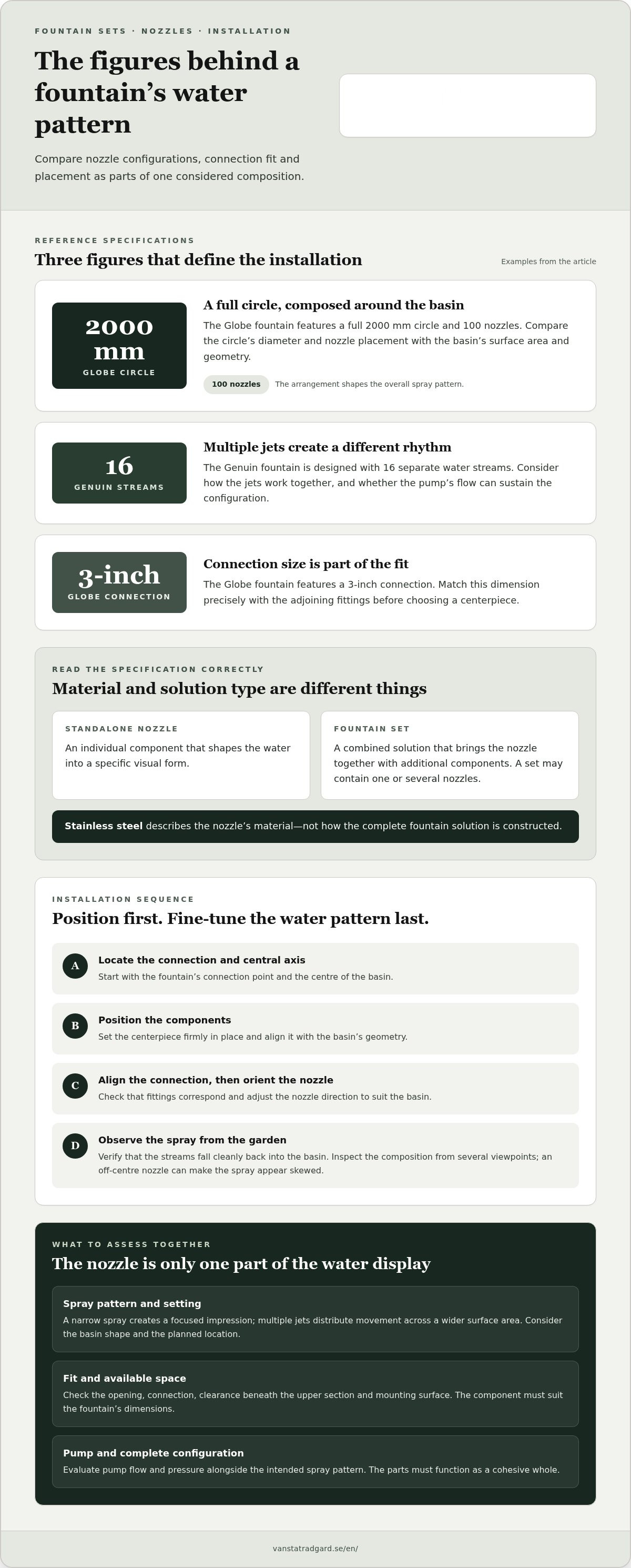
What matters is not only how the water moves, but whether you choose an individual component or an assembled solution. Centerpieces for fountains are nozzles that shape the spray pattern, whereas a fountain set combines multiple parts into a single solution. Stainless steel describes the nozzle's material, not how the entire fountain solution is constructed.
It is natural to first notice the shape of the water jet and the fountain's overall expression. However, the interplay between the nozzle, the fountain's design, and the garden's architecture dictates how the water feature is perceived within its setting.
Here you will discover what distinguishes stainless steel nozzles from fountain sets with nozzles, and what factors are worth considering when comparing options. We explore how your choice relates to the spray pattern, materials, and placement, helping you select a solution that complements the broader ensemble. This makes it easier to determine which component or set fulfills both your aesthetic ambitions and practical requirements.
Key Takeaways
- Distinguish between a standalone nozzle and a fountain set containing multiple components to ensure you compare solutions on equal terms.
- Match the connection and dimensions with the fountain's construction; the Globe fountain features a 3-inch connection.
- Evaluate the pump's flow rate and pressure alongside your desired spray pattern, as these parts must function as a cohesive whole.
- Plan the installation around stable positioning and proper fitting so that the water jet achieves its intended visual expression.
- Regular cleaning keeps the nozzle apertures clear and preserves the fountain's water pattern over time.
Fountain Sets with Nozzles
A fountain set brings together the nozzle and additional components into an integrated solution. Compare spray pattern, connection size, and pump capacity before making a selection.
Nozzles in the Fountain Set
The nozzle shapes the water into a specific visual form. A set can contain one or several nozzles, depending on the design. Review the specification to see which parts are included. Also assess whether the nozzle delivers a single cohesive jet or multiple distinct water streams. This distinction influences the fountain's character and how the water interacts with its surroundings.
Take the fountain's planned location as your starting point. A narrow spray pattern creates a focused impression, whereas multiple jets distribute movement across a wider surface area. Consider also whether the nozzle's orientation suits the shape of the basin. A set is not inherently appropriate simply because several components are packaged together. Each element must suit the fountain's intended purpose and your desired water display.
The Globe fountain demonstrates how dimensions define a larger installation. It features a full 2000 mm circle and 100 nozzles. In this instance, the circle's diameter and the placement of the nozzles are fundamental to the overall spray pattern. Compare such specifications with the surface area and geometry of your basin. The number of nozzles alone does not reveal how the finished installation will look.
By contrast, the Genuin fountain is designed with 16 separate water streams. This provides a clear illustration of how multiple jets can generate a different rhythm compared to a solitary jet of water. When comparing sets, evaluate how the nozzles function as an ensemble. The number of openings and the distribution of the jets help you understand the engineering, yet the pump's flow must also be capable of sustaining the configuration.
Installing the Centerpiece
Installation begins by locating the fountain's connection point and central axis. Ensure that the centerpiece sits firmly and aligns with the geometry of the basin. The Globe fountain features a 3-inch connection, a dimension that must correspond precisely with the adjoining fittings. Avoid choosing a component based solely on aesthetic appeal. Proper fit determines whether the installation can be assembled as intended.
Proceed in a structured sequence: first position the components, then align the connection, and finally adjust the nozzle orientation. Verify that the water streams fall cleanly back into the basin. If the nozzle sits off-center, the spray pattern will appear skewed, even if all components are properly connected. Inspect the arrangement visually from several vantage points before finalizing the installation.
Following installation, the spray pattern will reveal whether fine-tuning is required. Compare the position of the jets relative to the fountain's center and perimeter, observing how the composition appears from garden paths. A fountain set becomes part of the site's architecture when proportions, water movement, and siting harmonize. Base your selection of components on the fountain's dimensions and specified connections.
What Sizes and Dimensions of Fountain Centerpieces Suit Different Fountains?
Begin with the fountain's opening and mounting method. Measure the diameter of the opening where the component connects, and note whether the connection is internal or external. These specifications help you distinguish between parts that appear similar at first glance. Compare these measurements with the product's technical description before deciding.
The connection size represents only one aspect of fit. Examine how much clearance is available beneath the upper section of the fountain. A long stem may require unobstructed space under the stone, whereas a wide collar may need to rest flat against the surface. Measure both the opening and the surrounding surface area. This ensures the component fits without obstructing adjacent parts.
The shape of the fountain also determines which size feels visually balanced. A tall centerpiece can introduce an assertive vertical accent to a low basin. A broader upper section may prove more suitable when the fountain's center already exhibits a pronounced profile. View the fountain from multiple angles. Proportions shift depending on sightlines and distance from paths, planting beds, and seating areas.
Drawing a simple dimensioned sketch before evaluating alternatives is often helpful. Mark the center point, the connection diameter, and the available depth. Include the fountain's outer contour as well. A sketch makes it easier to verify clearances and spot potential obstructions, such as a support ridge or existing pipework.
- Measure the diameter of the opening and the connection type.
- Note the free depth beneath the upper section of the fountain.
- Check the width of the mounting surface.
- Compare the centerpiece height with the overall fountain silhouette.
- Mark any potential obstructions and hose routings.
Pay close attention to how dimensions are stated. Technical drawings often indicate total component length alongside dimensions for the connection itself. Match the relevant measurement with the corresponding part of the fountain. Do not confuse the outer diameter with the opening's inner diameter. If the connection is threaded, verify thread size and type against the manufacturer's technical specifications.
Once physical fit is established, consider the water pattern. A high-reaching nozzle requires an open setting where the spray has room to breathe. A low, gentle spray pattern can highlight an ornate bowl or ornamental relief. Consider how the water jet reads from key vantage points across the garden. Accurate dimensions thus support both dependable mechanical installation and a harmonious aesthetic impression.
When comparing centerpieces for different fountains, start with the connection and placement. Then proceed to height, width, and desired spray pattern. Following this order separates technical compatibility from stylistic preferences. Record the dimensions and compare them systematically. This gives you a sound basis for selecting a component that complements both the fountain's construction and the garden's architecture.
How to Choose a Centerpiece Based on Fountain Pump Flow and Pressure?
Begin by reviewing the pump's flow rate and operating pressure. Flow rate indicates the volume of water the pump displaces, while pressure determines how water is propelled through the nozzle. Select the centerpiece in conjunction with the pump. Pump wattage alone does not guarantee a balanced spray pattern.
Compare the pump's operating parameters with the nozzle's requirements. Look for recommended flow and pressure ratings in the product documentation. Consider how water depth, hose routing, and vertical head affect water delivery. A long hose run or an elevated spray nozzle alters hydraulic conditions. Evaluate the complete installation rather than the pump in isolation.
The Neptune fountain is rated to aerate 375 m³ of water per hour. This figure relates to aeration capacity, not direct water flow through a centerpiece. Differentiate between total aeration volume and the pump delivery to the nozzle itself. Refer to the appropriate technical data when evaluating components; otherwise, you risk drawing conclusions from figures that describe entirely different functions.
Next, examine how the nozzle distributes water. A single aperture concentrates flow into a single plume. A nozzle with multiple outlets divides flow among several jets. The pump's output must accommodate the collective demand. Confirm whether the manufacturer specifies a target operating pressure for the intended spray pattern.
Conduct the comparison systematically:
- Record the pump's rated flow rate and pressure head.
- Review the centerpiece's recommended operating conditions.
- Factor in hose length and vertical elevation changes.
- Examine how the nozzle distributes flow among its outlets.
- Compare the final configuration against your desired spray pattern.
The height and shape of the water jet depend on the interaction between pump and nozzle. Pressure that does not align with nozzle geometry can produce an unexpected water pattern. When a pump feeds several outlets, the flow divides among them. Evaluate the combined requirements of the nozzle rather than the criteria for a single aperture.
If the spray pattern appears weak or uneven, inspect operating conditions first. Check hose routing and couplings, then ensure the nozzle apertures remain unobstructed. Adjust one variable at a time. This makes it straightforward to determine whether the issue stems from pump settings, hose geometry, or the nozzle itself.
Finally, balance mechanical performance with aesthetic intent. A towering jet demands generous space and purposeful placement. A low spray pattern allows the fountain's material texture and shape to take center stage. Select the pump and centerpiece as an integrated system, providing the intended water movement with a dependable technical foundation suited to the fountain's architectural presence.
How to Install a Centerpiece in a Fountain?
Precise installation begins with the fountain's underlying structure. Identify the center point, connection fittings, and pump access. Lay out the centerpiece, connectors, and hose sections, comparing them with the manufacturer's installation instructions. This establishes a clear sequence of work before assembly begins. Exercise care around the aperture of stone fountains.
Clean the mounting surface to remove debris, sediment, and mineral deposits. Verify that the opening is free from structural defects, as an irregular edge can destabilize the fitting. Check the condition of the hose and the profile of the connection. Arrange components in the order of installation to avoid having to dismantle previously fitted elements.
Follow this procedure for a centerpiece with a pump connection:
- Position the pump so that the connection remains easily accessible.
- Feed the hose through to the fountain's central aperture.
- Secure the centerpiece according to its specific fitting and instructions.
- Align the nozzle toward the center of the basin prior to final inspection.
Always work from the fountain's actual design. Different models utilize different types of connections. Never force components together if they resist. Instead, cross-reference thread pitch, orientation, and mating surfaces with the product manual. If the design includes a dedicated bracket, secure it before fastening the nozzle.
Align the centerpiece visually from multiple perspectives. Observe it from the basin edge as well as from surrounding garden paths. Central alignment ensures that the spray pattern complements the geometry of the fountain. In a circular basin, any variation in clearance from the rim is immediately noticeable; in an elongated basin, alignment should follow the intended longitudinal axis.
Once assembled, inspect the hose run. A kinked or compressed hose restricts water flow and may pull the centerpiece out of true. Ensure fittings seat squarely against their mating surfaces. Conduct this inspection before filling the basin and testing the spray pattern.
Turn on the pump in accordance with instructions. Check that water exits through the intended outlets. Note whether spray lands outside the basin or cascades unevenly. Switch off the pump and adjust the orientation as needed. Making one adjustment at a time clarifies which modification achieves the desired effect.
If the spray pattern remains uneven, recheck the position of the centerpiece. Inspect the hose coupling and the nozzle opening. A loose fitting or misaligned component detracts from the overall presentation. When installing fountain centerpieces, exact fit and precise alignment are just as vital as the water pattern itself.
How to Clean and Maintain Fountain Centerpieces
Always switch off the fountain pump before beginning maintenance. Remove the centerpiece according to its design and place small fittings on a clean surface to keep them organized. Inspect the nozzle openings prior to cleaning; fine particles can disrupt the spray pattern even when the exterior appears spotless.
Rinse the centerpiece with clean water and use a soft-bristled brush to remove visible deposits. Work gently around nozzle apertures, as stiff bristles or abrasive tools can score the surface. With stainless steel nozzles, it is especially important to tailor cleaning methods to the finish and follow product guidelines.
Follow a straightforward cleaning sequence:
- Turn off the pump and detach the centerpiece.
- Rinse away loose sediment with clean water.
- Gently clean openings using a soft brush.
- Rinse again and inspect surfaces and fittings.
- Reassemble the components and align the nozzle.
After cleaning, hold each aperture up to the light. A trapped grain of sand or mineral flake will distort the water jet once the fountain is operating. Inspect the assembly for hairline cracks, loose connections, or visible wear. Note any components that may need future attention; keeping a simple record streamlines subsequent maintenance.
During reassembly, ensure couplings fit securely. Verify hose positioning and check that no lines are pinched between components. Aim the nozzle toward the center of the basin. Activate the pump and evaluate the spray pattern from the side. If the jet deviates, switch off the pump and readjust the alignment.
Throughout the season, fallen leaves, airborne dust, and mineral scale accumulate around the nozzle. Inspect the openings whenever you notice changes in the water pattern. A tilted or fragmented plume often signals that a check is due. Clean both the centerpiece and exposed connectors rather than simply altering the nozzle angle.
Ahead of freezing weather, winterize the fountain components according to manufacturer guidelines. Water trapped inside can cause frost cracking in vulnerable materials. Pay particular attention to bowls, unions, and recesses where water naturally collects. Store removable components in a dry, frost-free environment when specified.
Routine inspections help you detect scale before it compromises the fountain's aesthetic appeal. To select a matching replacement or new design, you can view fountain centerpieces and compare configurations against your fountain's connection.
Vansta Trädgård: Vansta Orangeries
Vansta Trädgård is a natural partner when integrating a fountain into a larger architectural garden scheme. If you are planning an orangerie or greenhouse, strategic positioning, sightlines, and material selections ensure the water feature serves as an intentional architectural anchor. Vansta Trädgård offers Vansta Orangerier, Vansta Classic orangeries and greenhouses, including THE ROSE greenhouse collection.
When the placement of a fountain influences how a greenhouse or orangerie connects to the main residence and surrounding grounds, viewing these elements as an integrated environment is invaluable. Vansta Trädgård's architect-designed greenhouses and orangeries provide an ideal starting point for these considerations.
Contact Vansta Trädgård or visit vanstatradgard.se to explore the collection.
Give the Water Feature a Thoughtful Placement
The next step is to treat the fountain as a key element of the garden's overall composition rather than a standalone feature. Observe how it interacts with walkways, planting schemes, and the architectural character of the house facade. A well-considered placement makes it easy to choose a spray pattern and aesthetic language that feel native to the setting.
For those seeking to incorporate fountains as fine garden art, Vansta Trädgård provides Haddonstone Fountains. Selecting centerpieces for fountains can then proceed from a holistic view: the fountain's individual character, its placement, and how the movement of water will be experienced from different vantage points across the garden.
Take the next step by comparing designs to discover which solution best complements your property's architecture. Explore fountain centerpieces and let your chosen detail contribute to an enduring, harmonious landscape.