

Can a technical necessity like sun protection actually be the detail that perfects an orangery's architectural expression? For many, the dream of a glasshouse becomes a challenge when the summer sun is at its highest and…
Shading in an Orangery: A Guide to Architectural Harmony and Climate Control
2 set 2026
Can a technical necessity like sun protection actually be the detail that perfects an orangery's architectural expression? For many, the dream of a glasshouse becomes a challenge when the summer sun is at its highest and the temperature rises beyond comfort. Finding the right balance for shading in an orangery is not just about thermal control. It is a sophisticated art form where a lively play of light meets solid craftsmanship and technical precision.
We understand the hesitation that arises when elegant glass sections risk being hidden behind solutions that feel alien to the building's soul, or the worry when delicate Mediterranean plants have their leaves scorched by the merciless light. In this guide, you will learn how to create a pleasant indoor climate year-round by combining stylish design with effective temperature regulation. We explore how tailored solutions and timeless material choices preserve the orangery's aesthetic value and transform the room into a cool, peaceful oasis for both rest and cultivation, regardless of seasonal changes.
Key Takeaways
- Discover how a well-balanced microclimate protects delicate Mediterranean plants from scorching sun rays and ensures their well-being during the warmest months of the year.
- Learn to choose the right shading in an orangery that harmonizes with the building's unique architecture and preserves its timeless elegance.
- Gain insight into how the choice between internal and external solutions affects both heat reflection and the orangery's exterior profile.
- Understand the importance of including climate-smart features and automation already at the sketch stage for a seamless and functional end result.
- See how custom sun protection acts as a value-preserving investment that transforms your orangery into a comfortable living space year-round.
Why shading is crucial for the orangery's ecosystem
The beautiful glasshouse, a modern interpretation of the classic Orangery tradition, is a place where the boundary between outside and inside blurs. But with large glass surfaces comes a responsibility for the internal climate. Without a well-thought-out strategy for shading in an orangery, the dreamy environment quickly turns into a place where the heat becomes overwhelming. Glass has a unique ability to capture the sun's energy, creating accumulated heat that affects everything from the plants' respiration to your own desire to linger at the breakfast table during high summer.
For the plants that often inhabit these rooms, such as olive trees, citrus, and fragrant jasmine, light is vital, but direct radiation can be treacherous. When the sun's rays pass through the glass, they are intensified, which can lead to leaf burn and critical dehydration. By controlling the light input, an environment is created where plants can thrive without stress. It's about mimicking the natural protection that a cooling breeze or a wandering cloud provides in their original environments.
Human comfort is another central aspect. An orangery should function as an extension of the home, a place for social gatherings and relaxation. Through effective thermoregulation, the season is significantly extended. This ensures the room remains pleasant even when the sun is at its highest, while also protecting the interior from the fading that inevitably occurs with unprotected exposure.
The Balance Between Light and Heat
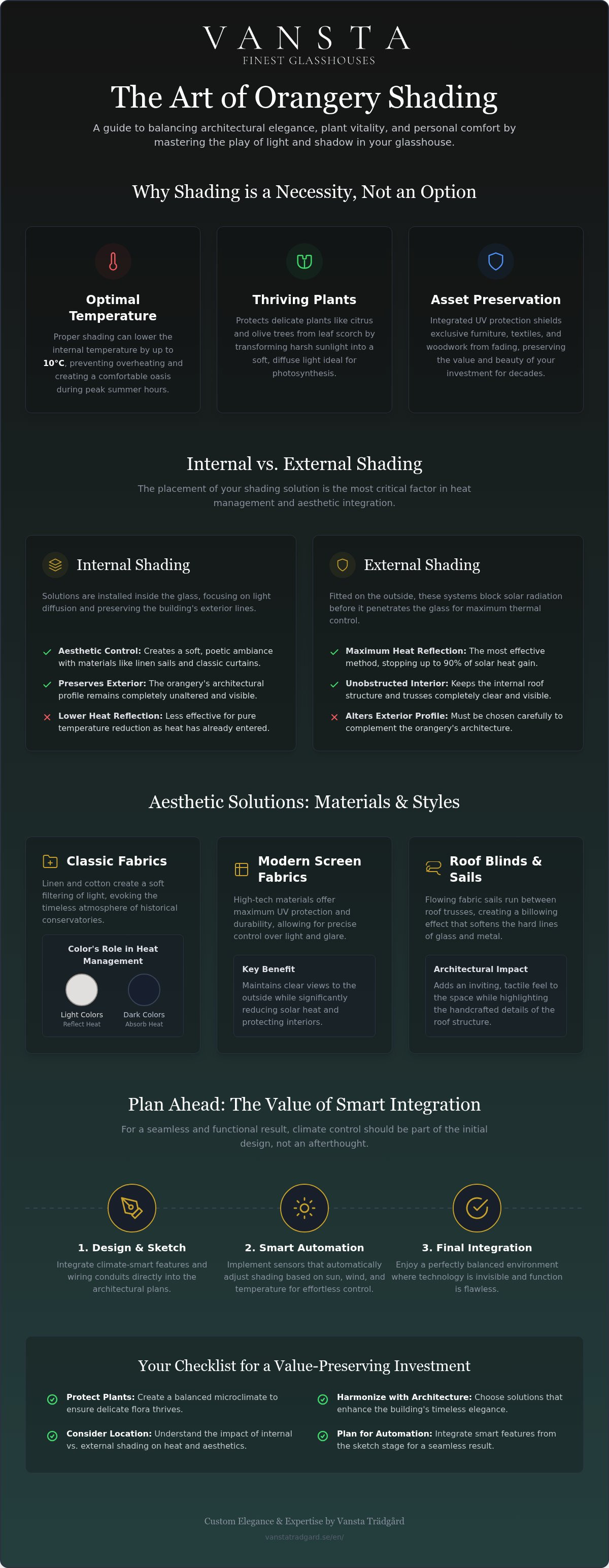
It is a common misconception that shade means darkness. In a professionally designed orangery, the aim is instead to transform direct, harsh sunlight into a soft and diffuse light. This diffuse light is actually more effective for plant photosynthesis as it reaches all nooks and crannies of the foliage without burning the surface. Properly chosen shading in an orangery can lower the temperature by up to 10 degrees during the warmest hours, creating that characteristic, cool atmosphere associated with exclusive conservatories.
Protection for Exclusive Materials
An orangery from Vansta is often furnished with carefully selected details, from timeless Oxleys furniture outdoor furniture to classic pots and artworks. UV radiation is merciless to both textiles and natural materials. By integrating shading, the luster of your furniture is preserved and the durability of the woodwork is extended. It is an investment in the building's long-term preservation; a controlled climate reduces material movement and keeps surfaces beautiful for many decades. Protecting your investments is part of the responsible ownership of an architectural gem.
Aesthetic shading solutions: From classic curtains to modern fabrics
Choosing the right shading in an orangery is a balancing act between preserving the architecture's lines and creating an optimal climate. It's about viewing sun protection as an integrated part of the building's aesthetics rather than a later addition. The choice of material often lies between the timeless charm of natural fibers and the technical superiority of modern fabrics. For those seeking an atmosphere that breathes classic English garden, linen and cotton are obvious choices. These materials create a soft, almost poetic filtering of light that evokes historical conservatories and stately home environments.
The color choice plays a crucial role in the final result, both visually and functionally. Light colors such as cream white or pale sand reflect away a large part of the heat radiation and maintain the room's airiness. Darker tones can certainly give a more dramatic and cozy impression, but they tend to absorb more heat, which requires more active ventilation. By studying various Greenhouse shading options, it becomes clear that the material's density and reflectivity are the most important factors for achieving a pleasant microclimate.
Classic Roof Blinds and Sails
Flowing roof blinds, often called sails, are a favorite in more traditional constructions. When the fabric runs between the roof trusses, a billowing effect is created that softens the hard surfaces of glass and metal. This gives the room an inviting and tactile feel. To highlight the orangery's handcrafted details, the blinds can be mounted with discreet wire systems that allow the roof trusses to remain visible. In a humid environment, where plants constantly emit water vapor, it is necessary to choose natural materials carefully or treat them to prevent mold growth and maintain their durability over time.
Modern Screen Fabrics for Maximum Control
For those who prefer a stricter and more minimalist style, modern screen fabrics offer a technical solution that does not compromise the view. These semi-transparent materials allow the eye to wander into the garden while effectively blocking up to 90 percent of incoming heat. The fabric often has a reflective backing that is invisible from the inside but works wonders for thermoregulation. When these systems are integrated into architect-designed greenhouses, the result is seamless and professional. It is a sophisticated solution where advanced technology is hidden behind a surface of timeless elegance, allowing the architecture to speak for itself without distracting elements.
Internal versus external shading: Function meets aesthetics
The choice between internal and external shading is one of the most critical decisions in the planning of a conservatory. It involves a technical functional analysis where thermal efficiency is weighed against architectural integrity. To achieve optimal shading in an orangery, an understanding of how solar energy interacts with the glass is required. External shading stops radiation before it reaches the glass surface, while internal solutions manage the energy once it has already penetrated the room. The difference in temperature control is noticeable, but the choice also affects the building's visual character and maintenance needs over time.
Here are the primary factors to consider when choosing placement:
- Heat Dissipation: External systems can block a significant portion of solar energy before it heats the glass, making them technically superior for pure temperature control.
- Weather Impact: Internal systems live in a protected environment, which drastically extends the lifespan of textiles and mechanics as they are not exposed to rain or pollution.
- Aesthetic Profile: External awnings change the building's silhouette and require careful design so as not to obscure handcrafted details or roof friezes.
Internal Shading – Creator of Atmosphere
When the focus is on creating a cozy and inviting environment, the internal solution is often unsurpassed. By placing textiles on the inside of the glass, the orangery is transformed from a cool glass structure into a living, tactile room. Professional providers like Axent Shutters Blinds & Shades LLC demonstrate how custom interior treatments can be expertly integrated into these environments to balance style and protection. Here, one can work with materials that soften acoustics and create a beautiful play of shadows over the stone slabs of the floor and classic Haddonstone pots. Since the system is protected from Nordic winds and downpours, the materials retain their original luster for a very long time. It is a solution that emphasizes long-term sustainability and internal harmony, perfect for environments where social interaction is central.
For those who prioritize a cool climate during the warmest hours of the day, external shading is the most potent method. By creating a barrier on the outside of the glass, the greenhouse effect is prevented more effectively than with any other method. Modern, high-quality systems are often equipped with intelligent wind and sun sensors that automatically regulate the protection, providing worry-free use. However, there are challenges in our climate; strong gusts of wind and snow loads place extremely high demands on the durability of components. Integrating external shading in an orangery therefore requires an architectural sensibility so that the technical cassettes harmonize with the building's classic lines without dominating the exterior. For homeowners seeking these high-performance exterior solutions, Lamonta Zonwering offers custom-made options that combine technical excellence with a discreet profile.
Plan your shading: Automation and smart features
Well-thought-out shading in an orangery doesn't start when the summer sun bakes, but already at the drawing board during the planning phase. By including sun protection as a fundamental part of the construction, solutions that feel tacked on or disturb the building's architectural lines are avoided. In a modern orangery, motorization is not just a matter of convenience; it is a prerequisite for creating a stable microclimate that functions even when you are not on site to manually adjust the blinds. It's about letting technology work proactively to protect the values you have created in your glasshouse.
The integration of technology into a classic environment requires sensitivity and a deep understanding of the interplay of materials. It's about letting the most advanced technology work silently, hidden behind handcrafted details and elegant profiles. During the winter half of the year, shading plays another, but equally important, role. It can then function as an extra insulating layer that helps retain heat during cold nights, while also dampening the harsh winter sun that can irritate the eye when it is low in the sky and reflected in the snow.
Digital Climate Control in a Classic Setting
Modern sun sensors are the orangery's invisible guardians. They react to light intensity and heat radiation long before the room has become too warm, ensuring that shading is activated at precisely the right moment. By connecting the shading with the orangery's automatic ventilation and heating system, an intelligent ecosystem is created that breathes in sync with the weather outside. Via intuitive apps, you can monitor and control the climate from your phone, providing security for both your delicate Mediterranean plants and your interior. It is a technical security that allows you to fully enjoy the room without constantly having to monitor the thermometer.
Architectural Integration of Technology
The challenge of adding modern technology to architect-designed environments is to preserve the historical feel and the building's soul. In our Vansta Classic constructions, we place great emphasis on concealing motors, cabling, and tracks within the profile systems so that they become a natural part of the building. For the more complex roof forms in THE ROSE greenhouse collection, custom solutions are required where the shading follows the glass's curvature with utmost precision. The goal is always for the technology to be invisible until the moment it is needed. To begin the journey towards your dream project, you can explore our architect-designed greenhouses & orangeries where form and function meet in perfect harmony.
Custom elegance with Vansta Trädgård's expertise
At Vansta Trädgård, shading in an orangery is considered an inseparable part of the building's architectural DNA. We see it not as an isolated accessory, but as a tool to sculpt light and define atmosphere. Through our deep expertise in both planning and building permit drawings, we ensure that every solution harmonizes with the orangery's unique character. It is a holistic journey where we guide you from the initial architectural sketches to the final technical installation. Our focus is always on craftsmanship quality and aesthetic perfection, where we combine technical precision with a poetic sense for the room's atmosphere.
Creating an optimal climate requires an understanding of both biology and building technology. We view each project as a work of art where material choices must reflect the exclusivity that our glasshouses represent. By choosing solutions tailored to your unique construction, we avoid compromises and instead create an environment where plant well-being and your personal comfort are central.
From Vision to Reality
Each construction requires its own specific solution, whether it concerns the strict lines of Vansta Classic or the more organic forms in THE ROSE greenhouse collection. We help you navigate between different technical textiles and mounting methods to find the system that best serves your vision. It is also about creating an interplay between the building's fixed elements and its interior. When the filtered, shaded light falls over a classic fountain or carefully selected pots from Haddonstone, a magical dynamic arises that transforms the room into a living work of art. By choosing durable materials that age with dignity, we ensure that your investment remains just as beautiful decade after decade. For a deeper understanding of how to realize your dreams, please read our article Orangery: A complete guide to timeless architecture.
Invest in Quality of Life
Integrating high-quality shading in an orangery is more than a practical measure; it is an investment in both the property's value and your personal quality of life. By ensuring a pleasant climate every day of the year, an oasis for recuperation is created that invites tranquility, whether the sun is blazing or autumn rain is lashing against the glass. It transforms the orangery into a room to actually live in and use for social gatherings, rather than just observing from a distance during the few days when the temperature happens to be perfect. For those seeking inspiration on how architecture and garden can merge into a seamless whole, we recommend our guide Architect-designed greenhouses: A guide to exclusive garden architecture. Our role as your advisor is to ensure that every detail contributes to a harmonious and value-preserving environment for the future.
Create the room of the future in perfect light and harmony
Realizing the dream of a glasshouse is about finding the subtle balance between the sun's life-giving rays and the room's thermal well-being. We have seen how well-thought-out shading in an orangery acts as an architectural bridge between function and aesthetics, where the choice of materials and technology determines both the health of the plants and your own recuperation. By integrating smart automation and timeless textiles already in the planning phase, an environment is created that breathes calm and permanence through all the year's changes.
With over 20 years of experience in exclusive glasshouses, we bring a deep understanding of how every detail, from the roof truss profile to the fabric's transparency, contributes to the final experience. Our architect-designed solutions are always uniquely adapted to your property's conditions and represent uncompromising quality in both material selection and craftsmanship. It is a value-preserving investment in a lifestyle where the boundary between garden and home blurs in the most elegant way.
Let us help you create the perfect climate in your orangery – Contact Vansta Trädgård
We look forward to working with you to shape a place for future memories, where every moment is surrounded by timeless beauty and architectural perfection.
Frequently asked questions about climate control and sun protection
Which material is best for shading in an orangery?
The choice depends on the desired atmosphere and technical requirements. High-performance technical fabrics with a reflective backing are unsurpassed for heat control. For a more classic feel that breathes English garden tradition, natural textiles like linen are a beautiful alternative. These materials create a soft, diffuse light that protects your plants without darkening the room. We always recommend materials that harmonize with the exclusive profiles of our glasshouses for a lasting result.
Can I install shading retrospectively in my existing greenhouse?
Yes, it is entirely possible to add sun protection retrospectively. We offer tailored advice to find a solution that matches your existing construction. However, to achieve the highest degree of architectural integration, it is best to include shading already in the planning phase. This allows us to conceal motors and tracks within the load-bearing profiles; it preserves the building's elegant and clean lines without visible interventions that disturb the overall impression.
How much does shading lower the temperature in an orangery?
Correctly dimensioned shading in an orangery can lower the indoor temperature by up to 10 degrees during the warmest hours of the day. By blocking direct sunlight before it accumulates in floors and walls, a stable microclimate is created. This is crucial to prevent sensitive Mediterranean plants from being stressed by extreme heat. It also transforms the room into a pleasant social area where one can comfortably stay even during the most intense sun hours of high summer.
Do I need a building permit for external awnings on my orangery?
In most cases, no building permit is required for external awnings as they are considered a reversible facade alteration. However, if your orangery is part of a cultural heritage environment or subject to specific detailed development plan regulations, the rules may vary. Since we at Vansta have deep expertise in building permit drawings and application processes, we can help you navigate correctly. We ensure that the sun protection not only complies with regulations but also enhances the property's architectural value.
Which color of shade fabric is most effective against heat?
Light colors such as cream white, sand, or pale gray are most effective at reflecting away solar energy. Dark colors tend to absorb heat, which can cause the temperature closest to the glass to rise. By choosing a light fabric, you maximize reflection while maintaining an airy and open feel in the room. It's about balancing the thermal effect with the aesthetic vision for your interior and your unique garden environment.
How do I clean and maintain my roof blinds in the orangery?
Maintenance is minimal but important for long-term durability. Internal roof blinds are naturally protected from wind and pollution, which keeps them beautiful for a long time. Regular dusting with a soft brush or gentle vacuuming is usually sufficient to remove pollen and dust. If necessary, more technical fabrics can be cleaned with a damp cloth and mild soapy solution. It is a simple process that ensures the textiles retain their luster and function for decades.
Does automatic shading work with natural ventilation?
Automation and natural ventilation are a perfect team for climate control. Through intelligent control systems, shading can be activated when the sun's rays reach a certain intensity, while automatic window openers regulate airflow based on temperature. This creates an autonomous ecosystem that breathes in sync with the surroundings. It gives you the security that the orangery takes care of itself; this is especially valuable for the well-being of plants when you are not at home yourself.
Is internal shading sufficient to protect my plants?
For most plants, internal shading in an orangery provides excellent protection against leaf burn and dehydration. By filtering the harsh light, plants receive the diffuse light they need for photosynthesis without being exposed to direct radiation. Although external shading is more potent for lowering the overall room temperature, an internal solution often goes a long way to creating a harmonious environment where both people and Mediterranean plants can thrive year-round.