

A cast stone balustrade is not just a beautiful finish to a terrace; it is an architectural anchor that gives your garden an immediate sense of historical gravitas and structure. You probably dream of that harmonious set…
Cast Stone Balustrades: A Complete Buying Guide for Timeless Garden Architecture 2026
10 wrz 2026
A cast stone balustrade is not just a beautiful finish to a terrace; it is an architectural anchor that gives your garden an immediate sense of historical gravitas and structure. You probably dream of that harmonious setting reminiscent of a classic English park, but at the same time feel some hesitation about the material's durability in our Nordic climate or how the heavy stone elements should actually be integrated into your existing environment. This is a legitimate concern, because an investment in fixed architecture is as much about technical precision as it is about aesthetic intuition.
In this guide, you will learn how to choose and integrate exclusive cast stone balustrades to create a timeless setting that combines classic elegance with modern durability. We explore everything from frost resistance and the beautiful patination of Haddonstone's craftsmanship to practical advice on building permit drawings and how to create visual harmony between the house's architecture and the garden's fixed elements. By understanding the interplay between form and function, you can transform your outdoor environment into a place of recuperation that only grows more beautiful with the years and represents a value-preserving investment for the future.
Key Takeaways
- Learn to identify genuine craftsmanship and why cast stone balustrades from Haddonstone offer unique frost resistance and a patina that only grows more beautiful with the years.
- Gain insights into how to analyze your property's architecture to choose a balustrade that harmonizes with both the house's style and the garden's proportions.
- Receive practical guidance on the importance of stable groundwork and how correct foundation ensures that heavy stone elements retain their elegance for decades.
- Discover how to navigate the process of building permits and technical installation to realize the vision of a classic architectural setting.
What are cast stone balustrades and why are they a superior choice?
A garden without fixed architecture can often feel fleeting and lack clear direction. By introducing cast stone balustrades, a sense of permanence is created, as if taken from the grand Italian Renaissance villas or the ancient English manor parks. It is about much more than a simple demarcation; it is a way to frame the landscape and give the residence an extended architectural voice that speaks of quality and tradition. This type of fixed architecture acts as an anchor for the eye and gives the garden a structure that remains even when the greenery rests during winter.
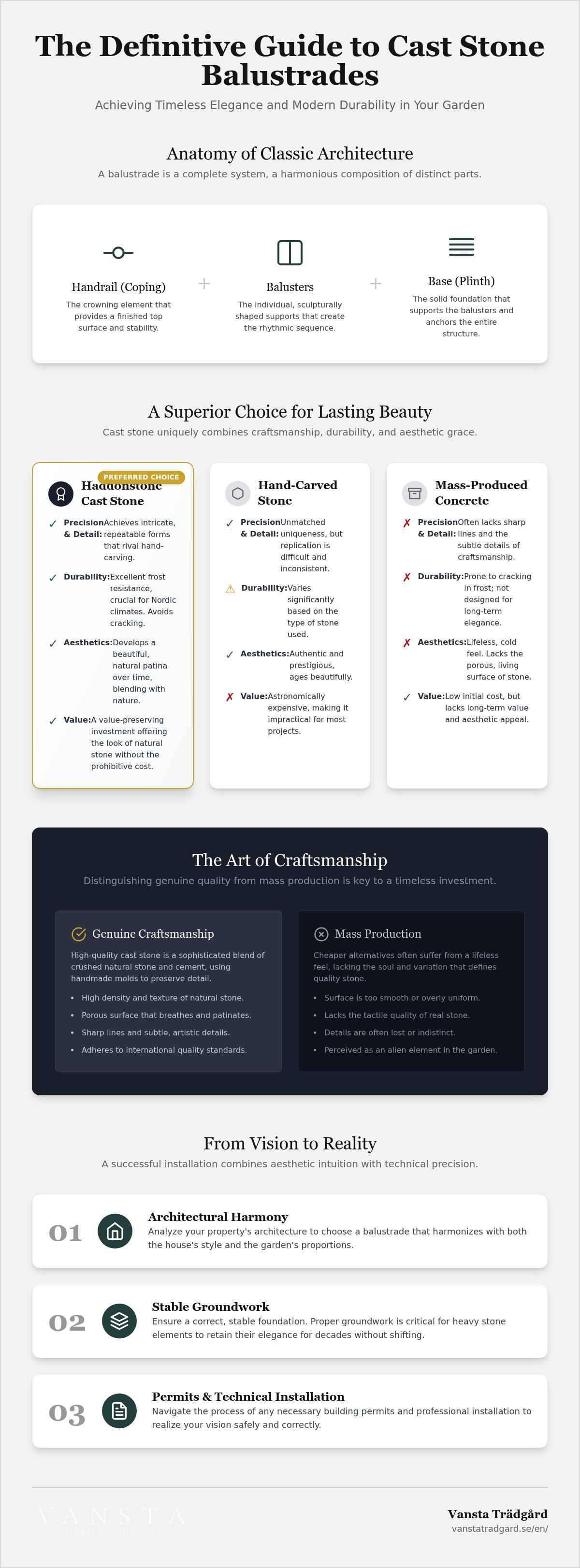
Why do discerning architects and garden enthusiasts often choose cast stone over hand-carved natural stone? The answer lies in the unique combination of craftsmanship and durability. Cast stone allows for a level of detail and precise repetition of forms that would be astronomically expensive to achieve by hand-carving sandstone or limestone. At the same time, the material possesses the same weight, density, and tactile quality as natural stone. It is an investment in the home's exterior environment that not only withstands the test of time but actually collaborates with it to create a more beautiful result with each passing year.
The difference between a baluster and a balustrade
For the uninitiated, the terms may seem interchangeable, but the language of architecture is precise and beautiful in its logic. A balustrade is the complete system, a harmonious composition consisting of three main parts: the base, the individual balusters, and the crowning handrail. What is a baluster? It is the individual, often turned or sculpturally shaped support that is repeated to create the rhythmic sequence that gives the balustrade its character. By varying the distance between these balusters, one can control the garden's visual tempo, from airy and open to more monumental and enclosed. It is this repetition that creates the calm rhythm we associate with classic elegance.
The unique properties of cast stone
Cast stone's primary strength lies in its ability to age with rare dignity. Unlike cold, machine-made concrete, high-quality cast stone has a porous and living surface that allows the material to breathe. In our challenging Scandinavian climate, this is a crucial property. The material absorbs moisture in a way that allows it to quickly develop a beautiful patina where moss and lichen take hold. This makes the construction blend with the surrounding nature and appear to have stood in place for centuries.
Haddonstone's specific blend also ensures frost resistance, which is absolutely necessary to avoid cracking during cold winters. It is a material that not only mimics the aesthetic of natural stone; it behaves like it, but with a structural reliability that makes it a preferred choice for durable outdoor architecture. The result is a maintenance-free investment that increases the property's value and creates an atmosphere of timeless luxury.
Quality Factors: Distinguishing Craftsmanship from Mass Production
The difference between an architectural detail and a simple building product lies in the precision of the craftsmanship. Cheaper alternatives often suffer from a lifeless concrete feel, where the surface is too smooth or lacks the natural variation that gives the stone its soul. When investing in cast stone balustrades, one should look for a density and texture reminiscent of sandstone or limestone. It is the small irregularities and the tactile surface that determine whether the construction will be perceived as an integrated part of the garden or as an alien element.
To ensure that the material is of the highest class, there are international Quality Standards for Cast Stone that regulate everything from compressive strength to water absorption. Haddonstone represents an absolute gold standard here. By using handmade molds, the sharp lines and subtle details that are often lost in mass-produced systems are preserved. It is this attention to detail that allows a balustrade from Vansta Trädgård to stand side by side with historical originals without shame.
The craftsmanship process behind exclusive cast stone
Cast stone is a sophisticated blend of crushed natural stone and cement, where the proportions are crucial for the final result. By using a high proportion of stone dust, a surface is achieved that not only looks like natural stone but also ages identically. The process requires patience; allowing the stone to cure slowly is absolutely crucial to avoid the internal stresses that otherwise lead to frost cracks in our cold climate. Vansta Trädgård works exclusively with manufacturers who respect this time-consuming tradition, ensuring a product with exceptional longevity.
Durability and long-term maintenance
One of the most appealing aspects of cast stone is its ability to become more beautiful over time. While wooden railings require annual painting and metal can suffer from corrosion, the stone develops a living patina of moss and lichen. If one prefers the original, clean look, a gentle cleaning with water and a soft brush is usually sufficient. It is an investment that requires minimal work but yields enormous visual returns. To create a complete architectural environment, one can advantageously combine the weight of stone with vertical elements such as elegant towers, arches, and trellises, creating an interesting dynamic between the massive and the delicate.
Design Guide: Choose the Right Style for Your Property
Choosing the right aesthetic for your cast stone balustrades requires a deep understanding of the property's soul. It's about creating a visual dialogue between the building and its surroundings, where every line and curve contributes to the whole. A neoclassical villa often requires a stricter, more symmetrical design that reflects order and balance. At the same time, a building with more romantic or eclectic features can support richly decorated balusters with complex profiles. The choice of style sets the tone for how the entire outdoor environment is perceived, from a grand manor feel to a more intimate and sheltered garden idyll.
Proportions are the heartbeat of architecture. A balustrade that is too low can feel insignificant, while a too-high construction risks blocking the garden's most beautiful views and creating a barrier rather than a frame. Typically, one aims for a height that feels safe for someone leaning against the handrail, but still allows for clear sightlines over the landscape. The color choice of the cast stone is also crucial for the final result. A light limestone-white tone gives a crisp and modern impression, while an antique gray shade immediately imparts a sense of historical weight and the passage of time.
When studying Restoration of historical balustrades, one clearly sees how crucial the richness of detail is to preserve a place's unique character. It is not just a matter of function, but of managing an aesthetic heritage. The placement of these elements requires thought. A well-placed balustrade can transform a simple terrace into an architectural stage or serve as an elegant divider leading the visitor down a staircase to the garden's hidden rooms.
Classic styles and their origins
The Vincenza style draws inspiration from Italian Renaissance architecture and provides a sophisticated, timeless elegance suitable for most classic environments. For projects seeking more drama and clear verticality, Gothic motifs offer a pointedness that creates a unique character. In addition to the proven standard systems, there is always room for custom-designed solutions. This allows us to adapt every detail to specific wishes, ensuring that the final result is as unique as the property itself.
Creating spatiality with fixed architecture
A balustrade works excellently as an architectural frame for the garden's other elements. By using it to circularly or rectangularly frame a Haddonstone fountain, a natural focal point is created and a sense of an enclosed, exclusive garden room. It creates a soft but clear transition between the formal zone closest to the house and the freer nature outside. By combining balustrades with columns, one can also create portals that frame selected sightlines and direct the viewer's gaze towards the horizon.
Structural Harmony: Combine Stone with Towers, Arches, and Trellises
A garden's true character often emerges in the subtle meeting between different textures and materials. When the horizontal, monumental lines of cast stone balustrades meet delicate, vertical metal structures, an architectural dynamic arises that is difficult to achieve with only one material. It is this balance between the stone's unwavering weight and the metal's light elegance that creates an environment that feels both thoughtful and alive. By integrating vertical elements, the eye is allowed to wander; it gives the garden a three-dimensional space and a sense of a curated landscape where every detail has its given place.
Working with height differences is a classic approach in garden architecture to prevent the environment from feeling flat or monotonous. A long stretch of cast stone balustrades can advantageously be broken up with strategically placed rose towers or arches. These act as visual exclamation points and provide space for blooming volume that softens the stone's fixed contours. This creates a kind of "green wall" that provides shelter and intimacy without losing architectural sharpness. To achieve perfect harmony, it is crucial to maintain a consistent style level throughout the project. The materials should complement each other in both quality and expression to create a cohesive atmosphere.
Selected products for vertical structure
To match the inherent power of a stone construction, elements with substance are required. The Brighton Rose Arch is a solid arch whose proportions harmonize well with the weight of a balustrade. If you want to break up a horizontal line with punctuated floral volume, the Obelisk I Rose Tower is an excellent choice. For those seeking a more niche aesthetic, a semicircular wall trellis Exedra can create a classic backdrop. It is a perfect solution for highlighting a statue or a beautiful fountain in direct proximity to your stone elements.
Practical tips for climbing plants
The choice of vegetation is the final brushstroke in the architectural composition. Fragrant climbing roses or delicate clematis highlight the stone by climbing along its surface and creating soft contrasts. For a more contemporary feel, you can use the Bauhaus Trellis, whose geometric lines provide an exciting counterpoint to the traditional stone. For those who want to go all the way and let the stone architecture merge with glazed constructions, we recommend reading more about architect-designed greenhouses as a natural extension of the garden's fixed elements.
Feel free to explore our curated assortment of exclusive towers, arches, and trellises to find the perfect complements to your garden architecture.
Planning and Installation: From Vision to Reality
Realizing a dream of classic garden architecture requires more than just an eye for aesthetics. It demands technical precision and a deep understanding of the material's inherent weight and physics. When planning for cast stone balustrades, the groundwork is the most critical factor for a durable and beautiful result. A balustrade is a massive construction that weighs significant amounts per linear meter, which places high demands on the foundation. Without a stable and frost-free base, even the most exclusive installation risks suffering from settlements that destroy the harmonious lines over time.
Another aspect that often raises questions is the legal framework surrounding fixed constructions. Since a balustrade often changes the property's exterior appearance or functions as a safety railing, a building permit is often required. This is a process that can feel intricate, but it is also where our expertise becomes most valuable. Vansta Trädgård supports our customers throughout the entire journey, from the first sketches to finished building permit drawings. We ensure that the technical documentation is correct and that the architecture complies with the regulations for fixed installations, especially when it comes to safety aspects at higher elevations such as balconies and roof terraces.
Project planning and drawings
A professional drawing is the bridge between your vision and the final result. It is at the drawing stage that we ensure the proportions between balusters and handrails correspond to the house's scale. We often act as architectural advisors in larger projects where the balustrade is part of a more comprehensive plan. This could involve creating a magnificent frame for an exclusive orangery, where the monumental weight of the stone creates a beautiful contrast against the delicate glass sections.
Steps for a successful installation
The installation of heavy cast stone elements requires both patience and craftsmanship. Each part must be handled with the utmost care to preserve the fine details of the surface. During installation, stainless steel dowels and specially adapted fastening materials are often used to allow the stone to breathe and move minimally with temperature changes. Grouting is the final step that creates a seamless and uniform impression. Once everything is in place, one can choose to let nature handle the patination at its own pace, or use specific techniques to accelerate the appearance of the coveted moss that gives the stone its timeless soul.
Create an Architectural Heritage in Your Garden
Investing in cast stone balustrades is giving your property a voice that speaks of quality and timelessness for generations to come. By choosing craftsmanship from world-leading Haddonstone, you not only ensure exceptional frost resistance adapted for our demanding Nordic climate but also an aesthetic richness of detail that only grows more beautiful with the years. We have seen how the interplay between technical precision and artistic vision transforms an ordinary outdoor environment into a place filled with historical gravitas and harmony.
With our deep expertise in building permit processes and architect-designed environments, we help you navigate from the first visionary sketches to a completed installation that elevates your entire garden architecture. Let the monumental elegance of stone meet the vibrancy of greenery to create a personal oasis that breathes both tranquility and exclusivity. To perfect your vision and add further dimensions of vertical beauty, you can explore our exclusive collection of towers, arches, and trellises for your garden. We look forward to helping you realize your garden dream and create an environment where every detail feels like a lasting work of art.
Frequently Asked Questions about Cast Stone Garden Architecture
Do I need a building permit to install a balustrade in my garden?
Yes, in most cases, a building permit is required because a balustrade is considered a fixed structure that alters the property's exterior or functions as a safety railing. Vansta Trädgård has extensive experience with these processes and offers professional building permit drawings to facilitate your application. It is important to check local regulations before starting the project, especially if the installation is at a higher elevation where specific safety requirements must be met to ensure stability and security.
What is the difference between cast stone and regular concrete?
The difference lies primarily in the material's composition and aesthetic expression. Cast stone consists of crushed natural stone mixed with cement, which gives a porous and living surface that mimics sandstone or limestone. Regular concrete is often smoother and lacks the tactile quality that makes cast stone balustrades age with a beautiful patina. Haddonstone's artisanal method also ensures significantly higher detail and a natural variation in texture that can never be achieved with mass-produced concrete.
How heavy are cast stone balustrades and do they require a special foundation?
These architectural elements are very heavy and therefore require a stable and frost-free foundation to avoid future settlements. A correctly executed cast concrete slab or a stable foundation is necessary to support the weight of balusters, handrail, and base. Without solid groundwork, the structure risks moving, which can lead to cracking in the joints and destroy the straight lines. We always recommend consulting an expert on the soil conditions of your specific property.
Can cast stone balustrades be left outdoors year-round in the Swedish climate?
Yes, Haddonstone's products are specifically designed to withstand extreme weather conditions and are completely frost-resistant. The material has a unique ability to breathe, which reduces the risk of frost heave even during cold winters. The cast stone is developed to absorb moisture in a controlled manner, allowing it to quickly develop a natural patina of moss and lichen. This makes the installation blend into the surrounding environment and become more beautiful with each passing season in our Nordic landscape.
How do I clean my balustrades without destroying the patina?
If you want to preserve the coveted patina, you should avoid high-pressure washing, as the strong pressure can damage the stone's porous surface and remove natural moss. The best way to clean the stone is to use lukewarm water and a soft brush to gently wash away superficial dirt or algae. If you prefer a more newly produced look, there are specific cleaning agents for stone, but we usually recommend letting the material age naturally to achieve that classic manor feel.
What height of balustrade is recommended for a terrace?
The recommended height is often governed by the balustrade's function and placement. As a pure garden demarcation, a lower height of approximately 60 to 70 centimeters is often aesthetically pleasing to preserve sightlines over the landscape. However, if the structure functions as a safety railing on a terrace or balcony, a height of at least 90 to 110 centimeters is often required according to current building regulations. For those considering modern alternatives, specialists such as MrGlass offer professional glass bannister installations that ensure safety without compromising the landscape view. Proportions are crucial for the balustrade to feel balanced in relation to the house's architecture and the garden's other elements.
Can I combine different styles of balusters in the same system?
Technically, it is possible to combine different models, but to achieve architectural harmony, we recommend sticking to a cohesive system. Each collection from Haddonstone is designed with specific proportions where the base, baluster, and handrail interact to create a uniform rhythm. Mixing different styles can easily create a cluttered impression. If you are looking for a unique expression, it is better to work with custom-designed solutions that are adapted to your specific wishes and your property's character.
How long is the delivery time for architectural details from Haddonstone?
Since every detail from Haddonstone is handcrafted to ensure the highest quality, you should expect a delivery time of several weeks or months depending on the scope of the project. This involves genuine craftsmanship where the stone needs time to cure properly before being shipped. We therefore recommend starting the planning of your cast stone balustrades well in advance. By including us early in the project planning, we can help synchronize the delivery with your other garden project for a seamless result.