

A garden without clear architectural anchors risks remaining a beautiful but shapeless collection of plants that never quite manages to capture the viewer's gaze or create a sense of lasting harmony. It is in this border…
Haddonstone Planters: A Buying Guide to Timeless Garden Architecture 2026
7. авг 2026.
A garden without clear architectural anchors risks remaining a beautiful but shapeless collection of plants that never quite manages to capture the viewer's gaze or create a sense of lasting harmony. It is in this borderland between wild nature and conscious architecture that Haddonstone planters step in, not just as functional vessels, but as timeless sculptures that give your outdoor environment an immediate sense of history and gravitas. We understand that the investment in exclusive cast stone is often accompanied by considerations about how these heavy elements are best integrated into an existing environment, and not least a concern about how they handle the challenging frost cycles of the Nordic climate compared to simpler concrete replicas.
In this 2026 guide, we help you navigate the choices that will define your garden's character for generations to come, from understanding the significance of genuine craftsmanship to selecting the right material for your specific location. You will discover how to create a garden that feels architecturally complete, where materials are allowed to age with dignity and develop a beautiful patina. We explore the differences between classic cast stone and the technically advanced TecStone, as well as how to strategically place your planters to create the focal points that transform an ordinary patio into an internationally inspired and serene garden experience.
Key Takeaways
- Learn why Haddonstone planters represent a value-retaining investment by combining ancient British craftsmanship with durability that far surpasses industrial concrete replicas.
- Gain insight into the differences between classic cast stone and TecStone to choose the material that best balances aesthetic patina with the demands of frost resistance in our Nordic climate.
- Discover how to analyze your home's architectural style to choose the right design language, whether the goal is Elizabethan elegance or contemporary minimalism.
- Understand the importance of integrating your planters with complementary elements such as edging and paving to create a clear and professional garden structure.
- Ensure a successful result through practical preparations regarding groundwork and logistics, guaranteeing that your heavy stone elements rest stably for generations.
Why invest in Haddonstone planters for your outdoor space?
Choosing Haddonstone planters is about more than just acquiring planting vessels; it is a conscious decision to add architectural history to your personal outdoor environment. For over five decades, Haddonstone has been synonymous with the finest in British garden art, where each object carries a visual weight that mass-produced alternatives completely lack. The difference between handcrafted cast stone and industrially produced concrete is fundamental to the end result. While industrial concrete often feels dull and lifeless, cast stone possesses a unique surface texture and luster reminiscent of natural, carved limestone. Many garden owners reflect on the material's origin and wonder: What is cast stone? It is fundamentally a material that combines extreme durability with aesthetic finesse, making each planter function as an architectural focal point throughout all twelve months of the year, whether filled with summer blooms or standing frost-nipped in winter attire.
To truly understand the craftsmanship and patience required to create these timeless objects, we offer a glimpse into the manufacturing process behind the scenes:
The legacy of British craftsmanship
Haddonstone's history is deeply rooted in the English country house tradition, where the preservation of classical proportions and rich detail is absolutely central. The brand uses unique molds often based on historical originals from ancient estates, giving the products an authenticity that cannot be copied. For Swedish homes, where we often strive for a balance between austere modern and classically cozy, these objects provide a much-needed contrast. They connect your garden with an international tradition and are widely used in the restoration of historical environments worldwide, guaranteeing a quality that can withstand expert scrutiny.
Cast stone's unique ability to age
One of the most fascinating features of Haddonstone planters is how the material interacts with the forces of nature. Unlike plastic that fades or terracotta that often cracks during the Nordic winter, cast stone has a porosity that invites a living surface. Over time, a natural patina develops where moss and lichens take hold, making the vessel blend with its surroundings in an almost poetic way. It is a process where the object actually becomes more beautiful with each passing year. It is this characteristic, combined with the material's high density, that makes these objects often regarded as future antiques; they are investments that last for generations and only increase in character over time.
Material choice and durability: TecStone versus classic cast stone
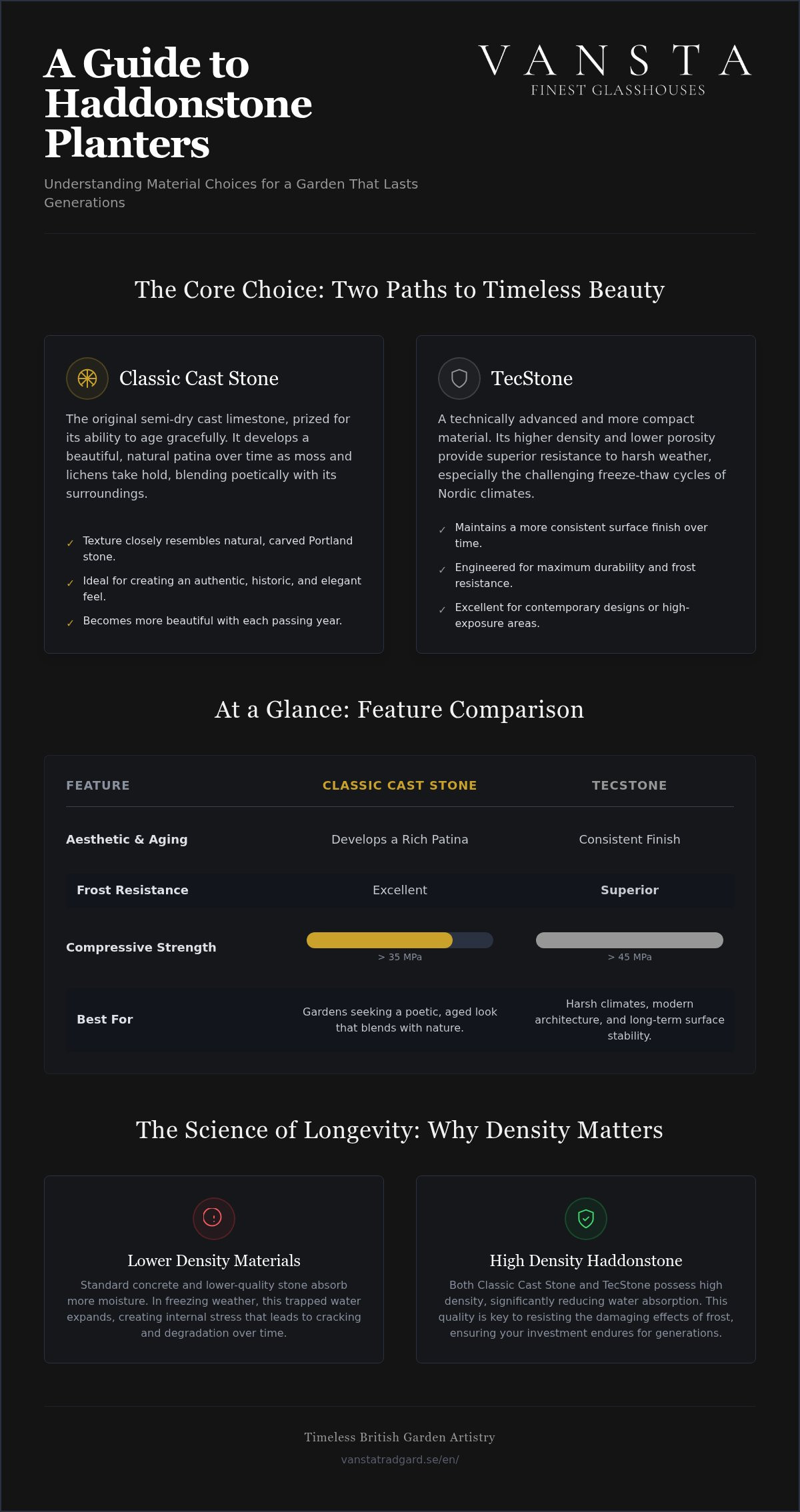
The choice of material is crucial for how your stone elements interact with the Scandinavian climate and what visual maturity they achieve over time. Haddonstone primarily offers two material types that both rest on a foundation of traditional garden architecture, but differ in density and surface. Density is key to long-term durability. A material with high density absorbs less moisture, which reduces the risk of internal stresses occurring when the temperature drops below freezing. Classic cast stone has a compressive strength of over 35 MPa, while the more compact TecStone reaches over 45 MPa. These values exceed most industry standards and ensure that your vessels withstand the stresses year after year.
Classic Haddonstone cast stone
This is the original; a semi-dry cast limestone with a texture almost identical to natural Portland stone. Its main strength lies in its ability to quickly develop a patina. The material's surface is slightly more porous than that of wet-cast alternatives, causing it to absorb the character of its surroundings faster. It is the perfect choice for Haddonstone planters placed in sheltered garden rooms, orangeries, or at entrances where one desires that timeless, weathered feel reminiscent of historic English estates.
TecStone: The modern alternative for tougher environments
TecStone is produced through a wet-cast process that results in a significantly denser and smoother surface. This finish is not only more resistant to dirt; it is also ideal for structurally demanding objects or very large planters that are completely exposed to the elements. In public environments or on open terraces where wear and tear are higher, TecStone is often chosen for its exceptional strength. It is a material that retains its "newly made" appearance longer, although over the years it also acquires a subtle and elegant maturity.
Regardless of which material you prefer, proper drainage is absolutely essential to keep your vessels intact. If water remains in the planter during winter, expansion due to frost can cause cracking that destroys the stone from within. Always check that drainage holes are free of roots and soil. A generous layer of expanded clay aggregate at the bottom, combined with raising the planter slightly off the ground with pot feet, guarantees that your Haddonstone planters will remain a part of your garden for decades. If you are unsure which material suits your specific plant hardiness zone, you can delve into our range of architectural solutions for professional guidance.
Choosing the right style: From Elizabethan Jardiniere to modern minimalism
The architecture of the house forms the foundation for your garden's visual language. Before deciding on a specific model, it is wise to analyze the building's lines and material choices to create a seamless transition between indoors and outdoors. Successful integration of Haddonstone planters requires a good sense of proportion; one of the most common mistakes is underestimating the scale required in an open outdoor environment. In the open landscape, objects tend to appear smaller than they do in a showroom. By choosing a size that feels almost challengingly large, you create architectural calm and a weight that anchors the vegetation to the ground.
Classic jardinieres and urns
For gardens that exude tradition and timeless elegance, models like the Elizabethan Jardiniere are an obvious choice. Its rich detail and intricate patterns draw inspiration from a legacy of historic cast stone, where the finesse of craftsmanship is allowed to take center stage. To give these vessels the authority they deserve, placement on a matching pedestal is often recommended. This creates a vertical axis in the garden room and elevates the plants to eye level. Classic choices such as clipped boxwood or standard bay trees reinforce the formal feel and give the garden a structure that endures even during the winter months.
Contemporary and minimalist planters
In encounters with new functionalism and contemporary architecture, a stricter and more minimalist design language is often required. Haddonstone's modern collections focus on geometric perfection and clean surfaces that complement large glass sections and natural materials. Here, you can advantageously work with repetition to create a visual rhythm. By placing identical, cylindrical or cubic vessels along a facade or pool edge, an order is created that calms the eye. The clean forms act as a frame that highlights the natural architecture of the plants, where, for example, ornamental grasses or multi-stemmed trees are given a clear stage to perform on.
Daring to mix classic elements in an otherwise modern environment can be a very effective way to add soul and character to a newly landscaped garden. A single, richly decorated urn placed against a smooth wall or a minimalist hedge acts as an architectural exclamation mark. It creates an interesting dialogue between the past and the present, where the quality of the material becomes the common denominator that binds the different stylistic expressions into a harmonious whole. When choosing your Haddonstone planters, think of them as permanent furniture that should withstand being viewed from the house's windows every day, all year round.
Designing with structure: Framing with planters, edging, and paving
An architectural detail reaches its full potential only when placed in the right context. For Haddonstone planters, this means they should never be viewed as isolated objects, but as an integrated part of the garden's floor and fixed structure. A common oversight is to place a heavy stone element directly on a soft surface, which often results in the object visually sinking into its surroundings instead of elevating it. By creating a conscious foundation of paving, you give the planter the stage it requires to function as an architectural anchor. It's about creating a dialogue between the planter's form and the horizontal lines of the groundwork, where the combined weight of the materials creates a sense of permanence and order.
The role of edging in garden design
Edging acts as the garden's brushstroke; it defines where one surface ends and another begins. When placing exclusive vessels, it is wise to use edging to frame the specific area, whether it is a gravel circle or a paved platform. By matching the material of your vessels with the right framing, you reinforce the handcrafted expression. We recommend that you explore our curated selection of edging and paving stones to find the perfect shade that harmonizes with the cast stone's natural patina. Well-placed edging also prevents soil and plants from encroaching on the planter's foundation, preserving its clean aesthetic over time.
Creating spatiality with large planters
Large planters possess a unique ability to act as room dividers and guides. By using planters as symmetrical pillars at an entrance or along a sightline, you create a natural rhythm in the garden. This is particularly effective when used to frame larger structures. There is a natural synergy between architect-designed greenhouses and classic garden art, where the weight of the vessels balances the lightness of the glass structure. Place a pair of stately urns at the greenhouse entrance to create a welcoming portal that connects the building with the surrounding greenery.
This methodology transforms your outdoor environment from a collection of plants into a cohesive architectural work where form and function interact in perfect harmony. Every choice, from the smallest edging stone to the most monumental urn, contributes to building an environment that feels both thoughtful and timeless. If you are planning a major change to your garden structure, you can consult our experts in outdoor architecture to ensure that every detail, material choice, and placement interacts optimally to create lasting aesthetic value.
Practical tips before your purchase from Vansta Trädgård
Realizing the vision of a classic garden requires more than just an eye for aesthetics; it necessitates careful technical planning. When choosing Haddonstone planters, you are investing in objects with significant physical weight, which places specific demands on both logistics and sub-base. By integrating these elements early in your project planning, you ensure not only a visually perfect result but also a cost-effective installation process. It is in the details, such as the choice of the right shade of stone or the exact bearing capacity of the ground, that the difference between a beautiful garden and an architectural masterpiece arises. An early dialogue with Vansta Trädgård makes it possible to coordinate delivery with other landscaping work, which often saves both time and unnecessary expenses for heavy lifting afterwards.
Logistics and handling of heavy elements
Many of the most stately vessels in the collection weigh several hundred kilograms even before being filled with soil and plants. It is therefore crucial to check the ground's bearing capacity where the object is to be placed. A sub-base of compacted gravel, decorative stone, or solid paving is necessary to prevent the planter from settling unevenly over time. For placement on soft surfaces, a prepared paddock or a hidden concrete slab beneath the surface layer is often required. Vansta Trädgård supports you with expertise regarding crane truck deliveries and logistics, so you can feel confident that the heavy elements are handled with the care they deserve. Having the right machinery ready upon arrival is often a prerequisite for the most monumental pieces, and we help you assess the needs based on your specific plot.
From drawing to finished garden dream
To achieve a harmonious whole, the planters should be seen as an extension of the house's fixed architecture. They often play a central role when we design and plan exclusive orangeries, where they serve as visual bridges between indoor comfort and the outdoor environment. Vansta Trädgård sees itself not merely as a retailer, but as your advisor throughout the entire process, from the initial sketches to the final planting. By choosing the right color tone and surface treatment from the start, you create an environment that feels as if it has always been there. To perfect your design and create those sharp lines that define a professional installation, we recommend that you also explore the full range of edging and decorative stone that perfectly complements your Haddonstone planters.
Realize your vision of a timeless outdoor environment
Choosing Haddonstone planters is a conscious step towards creating a garden that not only flourishes for the moment but matures with dignity over decades. By combining material choices like TecStone with thoughtful framing of edging and paving, you build an architectural structure that withstands the test of time. As an exclusive Swedish retailer, we at Vansta Trädgård offer the unique combination of architectural expertise and passion for garden art required to transform a drawing into a living, sustainable reality.
Let your garden become a place of recovery where every detail, from the smallest patinated surface to the large monumental urns, tells a story of quality and craftsmanship. We invite you to explore how these classic elements can elevate your outdoor environment to new heights of elegance. Find the perfect edging for your Haddonstone planters here and begin the journey towards a garden that will be admired for generations. Your dream of an architecturally complete outdoor environment is just one well-planned choice away.
Frequently asked questions about Haddonstone planters
Are Haddonstone planters completely frost-resistant in Sweden?
Yes, these vessels are designed to withstand severe cold, but proper drainage is an absolute prerequisite for durability. If water remains and freezes inside the vessel, the expansion risks damaging the stone from within. By using pot feet and ensuring that the drainage holes remain open, you create the best conditions for your vessels to last for generations. For particularly exposed locations in northern Sweden, the TecStone material is often recommended for its extra high density.
How heavy are the planters and do I need to reinforce the ground?
These stone elements possess significant weight, and large models often weigh several hundred kilograms. It is therefore necessary to prepare a stable foundation of compacted gravel or paving stones to avoid settling over time. If you place heavy Haddonstone planters on a deck, you should first check the structure's bearing capacity with a professional. A stable foundation ensures that the vessel stands securely and maintains its architectural linearity despite the ground's natural movements throughout the year.
Can I plant directly in a Haddonstone planter?
It is perfectly fine to plant directly in the vessels as long as you create a functional drainage layer at the bottom. We recommend a generous layer of expanded clay aggregate covered with a geotextile fabric before filling with high-quality potting soil. This prevents fine particles from clogging the drainage holes and protects the stone from unnecessary moisture exposure from within. For sensitive plants, a plastic inner pot can facilitate future repotting and provide an extra protective layer for the roots.
How quickly do the planters acquire their characteristic patina?
The patination process begins immediately, but the speed is entirely controlled by the planter's placement and the local microclimate. In a humid and shady environment, a beautiful surface of moss and lichens can develop within the first two seasons. If you prefer to maintain the original appearance longer, the planter should be placed in a sunny and airy spot. Many choose these vessels precisely for their unique ability to age with a natural elegance reminiscent of historic, carved natural stone.
What is the difference between Haddonstone and regular concrete?
The main difference lies in the material's composition and the artisanal manufacturing method. Haddonstone is a cast stone based on crushed limestone, which gives a structure and luster almost identical to natural sandstone. Regular concrete often has a coarser finish and lacks the density required for the same level of detail. With a compressive strength that far exceeds standard concrete, these vessels are built to function as permanent architectural features rather than temporary decorations.
How do I clean my stone planter without damaging the surface?
Cleaning should be done gently with only lukewarm water and a soft brush to preserve the stone's natural surface. Absolutely avoid high-pressure washing, as the powerful water jet can damage the fine surface structure and drive moisture into the pores. If you want to remove algae, a mild soap solution can be used, but remember that the natural patina is often part of the vessel's aesthetic value. Regular inspection to ensure drainage holes are free of roots is the most important maintenance.
Are Haddonstone planters available in different colors?
Yes, the range includes several classic color tones developed to harmonize with various architectural styles. The most common options are the light Portland stone, the warmer yellowish Bath tone, and shades such as Terracotta, Coade, and Slate. Since the color pigments are integrated throughout the stone mass, they do not fade in the sun but retain their depth and character over the years. The choice of color should be guided by the house's facade and the color of surrounding ground materials.
How do I best combine planters with edging for a uniform style?
To achieve an architectural whole, you should match the planter's color tone with the edging material choice. By framing the area where the planter stands with matching edging, you create a clear space in the garden and highlight the vessel as a focal point. This also prevents grass or weeds from growing directly against the stone, which significantly facilitates maintenance. A uniform material palette gives the garden the calm and sophisticated feel that characterizes a professionally planned outdoor environment.