

A garden urn is never just a container for soil; it is an architectural cornerstone that defines the outdoor environment long after summer's greenery has receded. Many recognize the resigned feeling when a carefully sele…
Urns & Pots: A Buying Guide for Timeless Garden Architecture 2026
31 Ağu 2026
A garden urn is never just a container for soil; it is an architectural cornerstone that defines the outdoor environment long after summer's greenery has receded. Many recognize the resigned feeling when a carefully selected vessel cracks during winter's frosty nights or when the material loses its luster and begins to look unassuming after just one season. It is a difficult art to find objects that not only complement the vegetation but actually speak the same elegant language as the house's fixed architecture and the garden's long-term vision.
In this guide for 2026, we help you identify vessels that combine architectural beauty with lifelong durability for your garden or orangery. By focusing on craftsmanship and timeless material choices, you will learn to choose urns & pots that become a lasting investment for the future. We explore how the right choice of cast stone and classic design allows the vessels to develop a beautiful patina over time, creating a rare harmony between the elements of nature and the permanent structure of the home.
Key Takeaways
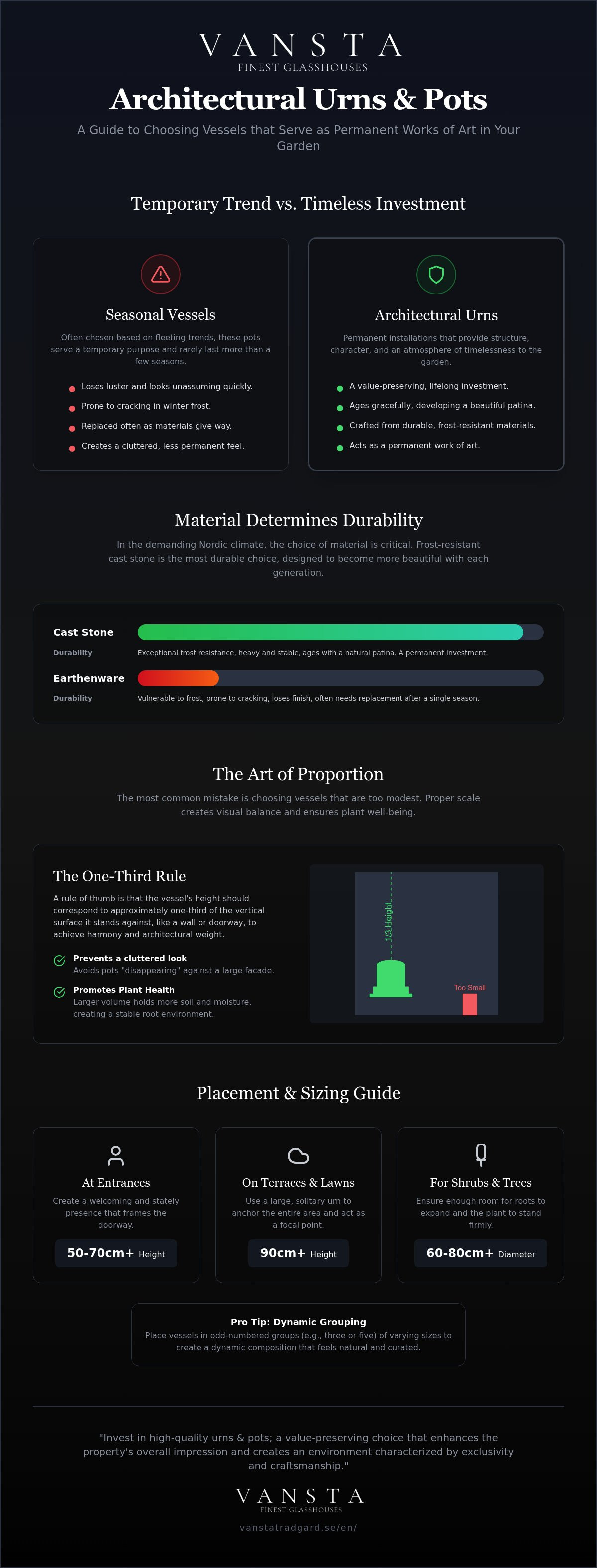
- Learn to distinguish between temporary seasonal vessels and architectural urns that serve as permanent works of art in your outdoor environment.
- Discover how to calculate the correct proportions to prevent your vessels from disappearing into the environment and instead create visual balance against the house's architecture.
- Understand why frost-resistant cast stone is the most durable choice for urns & pots in our demanding Nordic climate.
- Gain insight into how exclusive materials from Haddonstone develop a timeless patina that makes your investment more beautiful with each generation.
- Explore placement strategies that create dramatic focal points and blur the line between garden and conservatory.
What defines an architectural urn or pot?
When we observe a well-planned outdoor environment, we quickly realize that certain elements serve as anchors for the eye. An architectural urn is precisely such an element; a permanent installation that provides structure and character regardless of the season. Unlike simple seasonal pots, which are often replaced as trends shift or materials give way, architectural vessels form part of the garden's permanent art. To understand What defines an urn in a historical and aesthetic context, we must consider its ability to elevate a place and create a sense of dignity and history.
Craftsmanship is absolutely crucial here. It's about the weight of the material, the precision of the casting, and how the surface interacts with light and shadow. Quality urns & pots in cast stone develop a natural patina of lichens and moss over the years, making them blend with their surroundings and feel as if they have always stood there. It is this ability to age gracefully that transforms an object into an heirloom and creates an atmosphere of timelessness that cheaper materials can never replicate.
The Urn as the Garden's Focal Element
A strategically placed urn acts as an exclamation mark in the landscape. Inside an orangery, a stately urn can create a verticality that balances the large glass surfaces and lush plants. By working with paired vessels at an entrance or along a central path, a rhythm is created that guides the visitor forward and establishes visual balance. There is an inherent sense of security in symmetry. Urns can also be used as magnificent finishes on a balustrade or a wall, where they crown the structure and give it an architectural weight that few other details can match.
Classic Design vs. Modern Trends
In a world where trends are often fleeting, classic design offers a rare permanence. Designs from venerable manufacturers like Haddonstone are based on proportions that have been appreciated for centuries. It's about matching the vessel's style with the architectural era of the house to create a cohesive environment. A Baroque urn with rich ornamentation can elevate a stately manor setting, while a more austere, neoclassical model perfectly suits a more minimalist architecture. Investing in high-quality urns & pots is not just an aesthetic upgrade; it is a value-preserving investment that enhances the property's overall impression and creates an environment characterized by exclusivity and craftsmanship.
Size and Proportions: Finding the Perfect Balance
The most common mistake in garden design is choosing vessels that are too modest in size. Small pots tend to disappear against a house facade or in vast greenery. They create a restless and cluttered impression instead of the architectural weight one strives for. To achieve harmony, an awareness of scale is required. A rule of thumb is that the height of the vessel should correspond to approximately one-third of the vertical surface it stands against, whether it's a wall or a doorway.
Beyond aesthetics, volume plays a critical role in plant well-being. Larger urns & pots hold more soil, providing a more stable microclimate for the roots. The soil retains moisture longer, and the nutrient reserve becomes larger. This is a prerequisite for plants like olive trees or topiary boxwood to thrive year after year without being stressed by dehydration. A larger vessel gives the plant the freedom it needs to reach its full potential.
Grouping vessels at different heights creates a dynamic composition. By working with Placement and styling of objects in varying sizes, depth is built into the environment. This gives a sense of a curated exhibition rather than a random placement. Odd numbers, such as groups of three or five, are often perceived as more natural and balanced to the human eye.
Measurement Guide for Different Environments
At entrances, vessels with a height of at least 50 to 70 centimeters should be chosen to provide a welcoming presence. To further enhance this first impression during the autumn months, you can check out Porch & Poise for professional fall porch decorating services that use pumpkins and mums to complement your architectural features. On large terraces and open lawns, one can dare to go up in scale; a solitary urn of 90 centimeters or more becomes a natural focal point that anchors the entire area. For larger shrubs and small trees, a diameter of at least 60 to 80 centimeters is required for the roots to have room to expand and the plant to stand firmly.
Weight and Stability
A great advantage of robust cast stone urns is their natural weight. In windy locations, such as on an open terrace or by the coast, they stand firmly without risk of tipping over. Plan the placement carefully, as a large cast stone urn filled with soil is difficult to move afterwards. For placement on balconies or roof terraces, always check the structural load-bearing capacity, as the total weight quickly becomes significant. If you are looking for inspiration for your own outdoor environment, you can explore our curated selection of Haddonstone Pots to find the perfect balance.
Material Choice Determining Durability: Cast Stone vs. Earthenware
The choice of material is the single most important factor in whether your urns & pots will be considered a temporary decoration or a permanent part of your garden architecture. Traditional earthenware and terracotta have a timeless charm, but their porous nature makes them vulnerable in the Nordic climate. When water penetrates the material's pores and then freezes, it expands with a force that often leads to cracking or flaking of the surface. Cast stone offers a technical superiority here through its density and specific composition, making it almost impervious to the damaging effects of frost.
One of the most fascinating aspects of high-quality cast stone is its ability to develop a patina. Unlike plastic or metal, which often look worse with age, cast stone interacts with its surroundings. Light, moisture, and time work together to give the surface a unique character where lichens and moss gradually take hold. This creates a sense of history and permanence. For this process to remain an aesthetic asset, proper drainage is crucial. Without functioning drainage, water can remain in the vessel, which not only harms the plants' roots but also increases the risk of frost damage from within, regardless of how durable the material is.
Haddonstone: World-Class Garden Art
For decades, Haddonstone has been synonymous with artisanal perfection. Their unique casting technique results in a material that is identical in appearance to carved natural stone, but with a more consistent quality and higher resistance to weathering. Every detail is hand-finished to ensure that no seams or irregularities disturb the architectural expression. Extensive durability tests have ensured that these vessels can withstand extreme weather conditions, from scorching sun to severe cold. This makes them a significantly more cost-effective investment than natural stone, without compromising on the exclusive feel or aesthetic weight.
Maintenance and Care of Exclusive Urns
Caring for your cast stone urns & pots requires minimal effort, but the right touch preserves their beauty for generations. If you want to clean the vessels, you should use a soft brush and lukewarm water; avoid chemicals and high-pressure washers that can damage the natural patina. Before winter, it is wise to ensure that the drainage holes are free of soil and debris. Placing the urn on small feet, known as "pot feet," lifts the vessel from the ground and prevents it from freezing stuck, further securing the material's lifespan in our demanding climate.
Placement and Styling for Maximum Visual Impact
The boundary between outdoors and indoors is increasingly blurred in modern architecture, where the home and garden are seen as a cohesive unit. By using the same type of exclusive vessels in their conservatories as on the terrace outside, a seamless visual connection is created. This provides a sense of space and continuity that extends the season and makes greenery feel present all year round. Here, plant selection becomes crucial; a strictly clipped boxwood in a classic vessel provides an architectural sharpness that beautifully contrasts with the large glass surfaces of the conservatory.
As dusk falls, lighting is the tool that brings the urn to life and highlights its three-dimensional form. A discreet ground spotlight illuminating the vessel from below emphasizes the material's unique structure and the artisanal details of the casting. Shadow play against a background wall or facade adds an extra dimension of mystery and elegance, ensuring that the garden remains vibrant even during the dark hours of the day.
Framing Entrances and Pathways
Symmetry is one of the most effective ways to create a welcoming and authoritative first impression. Paired pots at an entrance signal order, care, and timeless elegance. To add further dignity, the vessels can advantageously be placed on pedestals. This elevates the vegetation to eye level and gives the entire arrangement increased architectural authority. For those wishing to create a complete environment, these arrangements can be combined with Haddonstone fountains, where the gentle movement of water and the permanence of stone create a harmonious balance.
Seasonal Variation in Classic Vessels
Architectural vessels in cast stone are beautiful objects in themselves, but they also serve as a perfect stage for the changing seasons. Spring plantings with crisp tulips and narcissi highlight the urn's rich details, while evergreen arrangements of yew or holly provide necessary structure during the cold season. In late autumn, dried materials, such as branches of witch hazel or dogwood, can be used to create a graphic and modern look resting on a classic foundation. Feel free to explore our full range of Haddonstone Pots to find the objects that best enhance your property's unique character.
Exclusive Favorites from Vansta Trädgård's Collection
At the heart of Vansta Trädgård's philosophy lies the conviction that every detail in the outdoor environment should carry its own voice and history. Our curated collection of urns & pots from Haddonstone is not just a collection of vessels; it is a gallery of architectural masterpieces. Here, the clean lines of austere classicism meet the rich ornamentation of Baroque, creating opportunities to refine everything from private courtyards to expansive park environments. Each object is carefully selected for its ability to function as an architectural backbone that endures when seasonal flowers have faded.
These vessels find their natural place in environments where aesthetic demands are highest. When designing an architect-designed greenhouse, the choice of urn becomes an extension of the building's own soul. It's about creating a visual dialogue between the lightness of glass surfaces and the solid weight of cast stone. For projects requiring something truly extraordinary, we also offer the possibility of custom dimensions and unique designs. This allows us to adapt the vessels to specific architectural conditions, ensuring that every investment becomes an integrated and harmonious part of the property's overall impression.
Urns That Carry a History
Many of the models in our range are direct replicas of historical originals found in ancient English manor gardens and castle parks. The richness of detail is striking; from finely chiseled acanthus leaves to classic festoons and symbolically charged emblems. It is this artisanal precision that makes these urns & pots often regarded as collector's items rather than simple garden accessories. By introducing these historical references into a modern garden, a bridge is created between past and present, where each vessel contributes an aura of permanence and cultural depth.
Find Your Style in Our Online Store
Choosing the right urn requires both an eye for design and an understanding of the material's technical properties. In our online store, we have made it easy to navigate through different styles and sizes, but we also know that larger projects often require a more personal touch. We therefore offer expertise and advice for those planning more extensive park environments or complex garden rooms. It is reassuring to know that you are investing in quality adapted for our climate and that only becomes more beautiful with each passing year. We invite you to explore the entire collection of Haddonstone Pots to begin the journey towards a more timeless and architectural garden.
Create an Architectural Heritage in Your Garden
Investing in the right urns & pots is about significantly more than just temporary aesthetics; it is a decision concerning your property's long-term architectural value and character. By choosing materials like frost-resistant cast stone from Haddonstone, you ensure that your vessels not only survive the demanding Nordic climate but also develop a unique patina that only time can bestow. We have seen how conscious choices regarding proportions and strategic placement transform a simple vessel into a permanent part of the garden's backbone.
Vansta Trädgård has offered expertise in outdoor architecture since 2003, and we are proud to be an authorized retailer of Haddonstone in Sweden. Our passion lies in combining historical craftsmanship with modern function to create environments that inspire for generations. A well-chosen urn is a timeless investment that enhances both quality of life and the property's aesthetic value. Let your garden reach its full potential with details that exude quality and permanence.
Explore our exclusive collection of urns & pots here
Frequently Asked Questions about Architectural Urns and Pots
Are your urns and pots completely frost-resistant?
Yes, our urns and pots from Haddonstone are made from a unique cast stone specifically adapted to withstand the Nordic climate and its severe frost. The material's density prevents water from penetrating the pores, which eliminates the risk of frost damage. However, it is crucial that drainage functions flawlessly so that water does not remain inside the vessel. This technical superiority makes them a permanent and secure investment for your outdoor environment year-round.
How much does a typical cast stone urn weigh?
The weight of our vessels varies greatly depending on the model and size, but cast stone is a solid and heavy material. A smaller urn can weigh around 20 to 30 kilograms, while the most monumental park urns can weigh several hundred kilograms. This weight is a great advantage as it guarantees stability in windy locations and provides the architectural gravitas that characterizes exclusive urns & pots. We recommend planning the placement carefully before planting.
Can I get help choosing the right size for my terrace?
Of course, we provide our expertise to help you find the optimal balance for your terrace or garden. Vansta Trädgård has been working since 2003 to create harmonious outdoor environments, and we have a deep understanding of how scale and proportions interact with the house's architecture. We help you calculate the correct dimensions so that your vessels are neither perceived as too small nor too dominant, but instead elevate the entire property's aesthetic expression and value.
Do the urns require any special maintenance?
Maintenance for our cast stone products is very limited, which is part of their charm. To preserve the beauty of the vessels, it is usually sufficient to brush them off with a soft brush and lukewarm water when needed. Avoid strong chemicals or high-pressure washers, as these can damage the material's surface and natural patina. The most important step is to regularly check that the drainage holes are free of soil and debris to ensure good drainage before winter.
How does the patina on cast stone develop over time?
Patination is a living process where the cast stone gradually interacts with light, moisture, and surrounding vegetation. Over time, the surface develops a natural character where lichens and moss can take hold, giving the vessel an appearance reminiscent of carved natural stone. This process is highly individual and depends on the placement's microclimate. Many of our customers value this development precisely because it contributes to a timeless sense of history and makes the vessel blend with the garden.
Are there drainage holes in all your pots?
Yes, as standard, our vessels are delivered with pre-drilled drainage holes to ensure plant health and the long-term durability of the material. Correct drainage is a prerequisite for avoiding oxygen deficiency at the roots and for protecting against frost damage during winter. If you plan to use your urns & pots in an environment where drainage is not desired, for example, on a sensitive indoor floor, we recommend using an inner pot or a saucer that collects excess water.
Can I also use these urns indoors in an orangery?
We offer secure delivery nationwide for all our products. Since the urns are often both large and heavy, they are usually shipped on pallets with professional transport partners. Delivery takes place to the property line or as close as the vehicle can get. Upon receipt, it is important to bear in mind that some models require carrying assistance or mechanical aids to be moved to their final location. We are happy to advise on logistics and handling prior to your delivery.