

TL;DR: A cast stone garden fountain is a frost-resistant, self-circulating solution that you install yourself without a plumber by placing the pump in a closed-loop water system.
Cast stone withstands cold better than pl…
Cast Stone Garden Fountain: A Guide to Classic Elegance and Durability
Sep 5, 2026
TL;DR: A cast stone garden fountain is a frost-resistant, self-circulating solution that you install yourself without a plumber by placing the pump in a closed-loop water system.
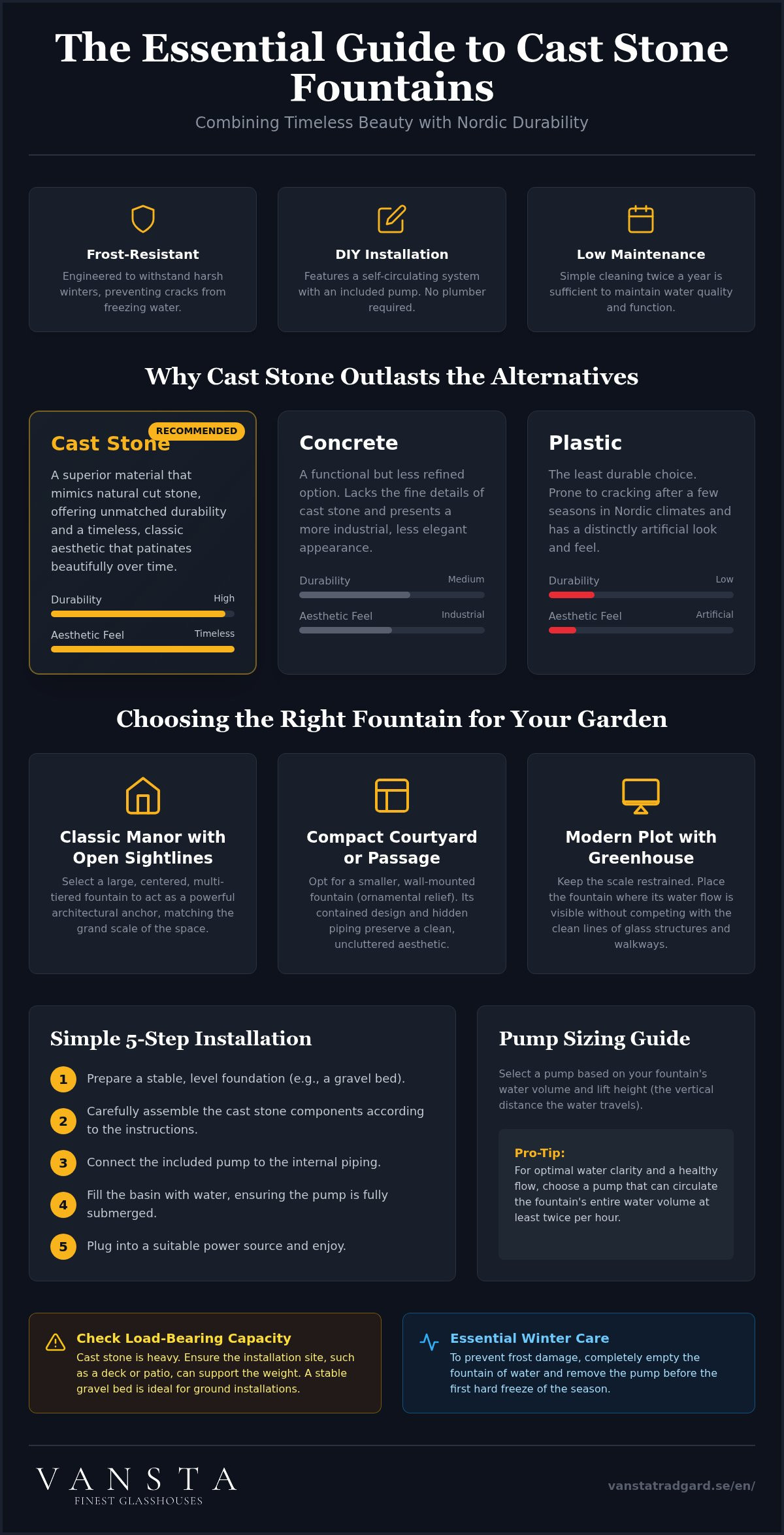
- Cast stone withstands cold better than plastic and concrete but requires emptying before winter.
- Installation requires no craftsman as the system is powered by a simple included pump.
- Cleaning twice a year is sufficient to maintain water quality and pump function.
- Avoid cast stone on weak load-bearing decks, as the material's high weight requires a stable gravel bed. By choosing a stone fountain (high-quality cast stone), architectural beauty is combined with cold resistance (frost-resistant cast stone) adapted for the Swedish climate. Thanks to a self-circulating fountain (closed-loop water system for wall fountains that recirculates water without a permanent water connection), no permanent plumbing installation is required, allowing you to easily install it yourself. This makes your durable water feature a stable architectural anchor in the garden. The questions guiding the choice are the same throughout the guide: does the scale suit your plot, does the material withstand winter, and can you manage the assembly without fixed piping?
The Right Fountain for Your Plot Based on Three Garden Types
When investing in a stone fountain, it is wise to consider your plot's scale, design language, and spatial structure. In customer projects, we notice that a large model requires an unobstructed view to function as an architectural anchor in the garden. A classic symmetrical park area, a smaller courtyard, or modern EXCLUSIVE GREENHOUSES, ORANGERIES, WINTER GARDENS Vansta place entirely different demands on aesthetic balance.
Three typical locations and concrete choices:
- Classic manor environment with an open sightline: choose a centered, multi-tiered self-circulating fountain so that the proportions support the entire space.
- Compact courtyard or narrow passage: choose a smaller wall-mounted fountain (ornamental relief) where hidden piping and included materials maintain a clean overall impression.
- Modern plot with a greenhouse or orangerie nearby: keep the scale restrained and place the fountain where the water flow is visible without competing with glass surfaces and walkways.
Precision in water flow and hidden piping facilitates both assembly and the visual result, without visible water pipes breaking the overall aesthetic.
Cast Stone Gives Your Garden a Durable and Timeless Architectural Anchor
A stone fountain creates an elegant architectural anchor in the garden and allows the stone mass to change beautifully over the years. According to Wikipedia 2026, the material is manufactured to mimic natural cut stone, providing a finish close to natural stone.
Cast stone withstands cold, so you avoid damage caused by water freezing inside a material, expanding and cracking it during the Swedish winter. Ready-made package solutions are delivered with included piping, meaning you don't need to hire an external plumber. A system that guides the water flow's movements contributes to a calm atmosphere around seating areas and paths. Some customers mistakenly assume that product recommendations are hidden advertisements for individual actors. If you want to read more about the craftsmanship, the guide Balustrades and Columns in Cast Stone: A Comprehensive Guide is available.
Investments in genuine natural materials provide long-term quality as the stone surface ages outdoors.
In the thread "A greenhouse can be so beautiful, Garden Forum" on forum.odla.nu, a user writes:
"Excuse me, but there is a somewhat paranoid attitude towards my post here. I have nothing to do with Vansta!" (source)
Comments on forums show that buyers sometimes feel suspicious when asking for advice on cast stone products. This highlights the need for independent and factual information about the durability of the craftsmanship in the Nordic climate.
Cast Stone Lasts Longer Than Concrete and Plastic
Compared to cheaper alternatives like plastic, a stone fountain offers stronger durability and a timeless feel.
Cast stone patinates beautifully in outdoor environments. Plastic often cracks after a few seasons in our Nordic outdoor environment, while concrete lacks the fine details. The material's weight and structure create a lasting solution when you seek quality that endures season after season. Read more about durable stone products in Balustrades and Columns in Cast Stone: A Comprehensive Guide. The comparison directly reflects the differences:
| Material | Durability | Aesthetic Feel |
|---|---|---|
| Cast Stone | High | Timeless and classic |
| Concrete | Medium | Industrial |
| Plastic | Low | Artificial |
What few consider: cast stone ages with dignity, and a stone fountain enhances the garden's character as its surface patinates.
Dimension the Pump According to Volume and Lift Height
The correct pump capacity is dimensioned according to your garden fountain's total water volume and the intended lift height. In practice, it quickly becomes apparent how an incorrect pump negatively affects water dispersion (how the water sprays): the flow loses its elegant dynamic if the pressure is too weak.
A powerful model suits large installations with a high drop height. Smaller water arrangements, however, require a more subdued flow. The pump drives your closed-loop water system for wall fountains that recirculates water without a permanent water connection (self-circulating fountain) so that the water movement highlights the craftsmanship's details without splashing outside the basin.
When designing the outdoor environment, the guide Balustrades and Columns in Cast Stone: A Comprehensive Guide can provide more inspiration on timeless architecture. Correct dimensioning ensures an even flow and a garden environment that is easier to maintain.
Tip: Choose a pump that circulates the fountain's entire water volume at least twice per hour for optimal water clarity.
Self-Circulating Fountain Installed Without a Plumber
You rarely need a craftsman because modern fountains are powered by a self-circulating fountain.
A complete water arrangement functions as a closed circuit in an aquarium. Field experience shows that assembly occurs without fixed piping, as the water flow's cycle is managed entirely by the included pump. Vansta Trädgård offers ready-made package solutions where all parts are included from the start.
Installation requires neither a certified plumber nor complicated groundwork. Your stone fountain can therefore be placed freely where it best enhances the outdoor environment.
Five Steps to Stable Installation of the Cast Stone Fountain
Installing a stone fountain requires a stable base to prevent future settlements. Correct assembly secures your self-circulating fountain for many years to come.
- Prepare the foundation: Excavate the ground and lay a stable, level bed of crushed gravel to reduce the risk of ground movement.
- Place the base structure: Position the fountain's base firmly on the foundation so that the structure stands perfectly plumb.
- Install the pump: Install the unit's closed-loop water system for wall fountains that recirculates water without a permanent water connection in the designated water reservoir.
- Build up the levels: Carefully stack the fountain's parts and fit all sealing surfaces precisely.
- Fill with water: Fill the reservoir and start the pump to adjust how the water sprays (water dispersion).
A perfectly level base is crucial to prevent damage caused by water freezing inside a material, expanding and cracking it if water remains unevenly during winter. Proper groundwork saves maintenance later. Common garden fountains do not require a building permit process, so the focus can be on the ground's bearing capacity rather than roof or ridge dimensions.
Avoid Hidden Costs for Shipping and Accessories
Buying a stone fountain involves an investment where both material and transport affect the final price. Heavy cast stone requires secure packaging and special pallet freight, meaning the delivery fee often differs from standard parcel shipments. Therefore, request a complete quote that includes the entire shipping chain before making a decision.
When purchasing lighting or accessories, disappointments regarding quality sometimes arise. Cheap electrical components quickly detract from the overall experience and lead to unnecessary complaints. Choose certified components that withstand cold to avoid damage during the Swedish winter: this saves both money and patience. A stable foundation also prevents future displacements that would otherwise be expensive to correct.
If you hesitate about the shipping cost for heavy stone products: a correctly packaged direct delivery prevents expensive damage during transport.
A commentator in the thread "Garden general" on byggahus.se writes:
"But I argued with Markslöjd and got a number of new products. I also collected a pile of faulty luminaires last spring." (source)
The problem shows how deficient accessories can create conflict and ruin the overall impression during installation. Professional components from the start reduce the risk of faulty luminaires and expensive replacements.
Two Maintenance Occasions Per Year Are Enough for Most Fountains
Cleaning twice a year is usually sufficient to keep a stone fountain in good condition. Simple care significantly extends its lifespan. Regular inspection of a closed-loop water system for wall fountains that recirculates water without a permanent water connection prevents algae growth in the courtyard environment, and clean water is fundamental for both appearance and operation.
During winter, cold and heavy snow loads require proper preparation. Emptying and protection against damage caused by water freezing inside a material, expanding and cracking it are what count; the material withstands cold thanks to thoughtful construction that does not lose bearing capacity over time. Vansta Trädgård offers materials with high durability in the Nordic climate.
Proper plugging simplifies emptying before the cold season. With that habit in place, the fountain functions as an architectural anchor in the garden year after year, and you maintain control over how the water sprays.
When the Cast Stone Fountain Is the Wrong Choice for Your Plot
A stone fountain is the wrong choice for temporary installations or weak load-bearing decks. The material's high weight requires a stable architectural anchor in the garden.
In the National Gallery of Art (2025) historical review, it is described how water arrangements require careful structural planning. If you are looking for simple package solutions without heavy groundwork, handling will be difficult. A complex closed-loop water system for wall fountains that recirculates water without a permanent water connection may also require a qualified plumber for installation.
Placement near trees places high demands on cleaning: leaves covering the fountain's overflow stop the water flow's smooth movement. Thin plastic models suit movable needs, while cast stone requires uncompromising stability. Ask the supplier for support regarding bearing capacity and placement before purchasing, so you avoid the wrong scale on the wrong surface.
Frequently Asked Questions
Why choose a cast stone fountain for your garden?
A stone fountain serves as an aesthetic architectural anchor in the garden and ages beautifully in our Nordic climate. It withstands cold provided you empty it of water before each winter.
Do I need a plumber to install a self-circulating fountain?
No, a self-circulating fountain requires no fixed water installation or help from a plumber. You manually fill the water reservoir and connect the included pump directly to a standard electrical outlet.
How much electricity does a fountain pump use per month?
Energy consumption is low because modern pumps require minimal power to circulate the water. The exact monthly cost depends on the pump's size and local electricity prices; feel free to request a quote for detailed specifications.
How do you keep a fountain clean?
Cleaning is facilitated if you regularly remove leaves and rinse the basin to prevent algae from forming. Adapted cleaning agents protect the material's surface and maintain water quality.
Can I keep the fountain running during winter if I have a heater?
No, completely empty the water section of liquid before freezing temperatures arrive. Otherwise, there is a risk of damage caused by water freezing inside a material, expanding and cracking it, which can damage the material.
Create a Timeless Outdoor Environment for 2026
The right cast stone garden fountain gives your property a permanent architectural anchor in the garden, provided that the scale suits the plot, the material is winter-proofed, and the assembly rests on a load-bearing foundation without unnecessary plumbing.
Vansta Trädgård offers timeless garden architecture and expert advice for exclusive outdoor environments. The team of landscape architects has deep knowledge of classic design and craftsmanship. In 2026, we will develop solutions that provide a harmonious park feel based on your property's specific dimensions and location. Contact us for a personal consultation or a quote tailored to your plot.