

The true character of a garden is never defined by its total area, but by the architectural precision that permeates every single detail. It is a common misconception that limited surfaces require aesthetic compromise...
Small greenhouse with big character: A guide to exclusive garden design in 2026
Mar 27, 2026
The true character of a garden is never defined by its total surface area, but by the architectural precision that permeates every single detail. It is a common misconception that limited space requires aesthetic compromises, but in fact, this is where a small greenhouse can shine like an architectural jewel for your property. We understand the frustration of a market where 80% of the supply consists of fragile plastic solutions that neither honor your home nor withstand the rigors of Nordic winters. You deserve a place where glass meets construction with a precision that brings to mind the classic English estates and their timeless elegance.
In this 2026 guide, we show you how to transform limited square footage into a masterpiece through British craftsmanship and sophisticated design. Combining the expertise of long-established manufacturers like Hartley Botanic with modern aesthetics, we create spaces that not only extend the growing season but also become a natural extension of your home. We explore the specific material choices and proportions required to ensure your investment lasts for generations. This is your guide to creating a personal oasis with expert support every step of the way.
Important Conclusions
- Learn how a smaller-scale, architect-designed glass house transforms limited spaces into aesthetic masterpieces where British craftsmanship takes center stage.
- Discover how the right choice of materials, such as powder-coated aluminum, creates a durable and exclusive small greenhouse with timeless character.
- Gain insight into how to optimize your garden by choosing between elegant wall-mounted solutions or freestanding models as architectural eye-catchers.
- Take advantage of our expert guide that navigates you through everything from functional needs analysis to the legal requirements for building permits and location.
- Be inspired by how classic design and modern precision work together to create a personal oasis for both passionate cultivation and peaceful recovery.
What defines an exclusive small greenhouse?
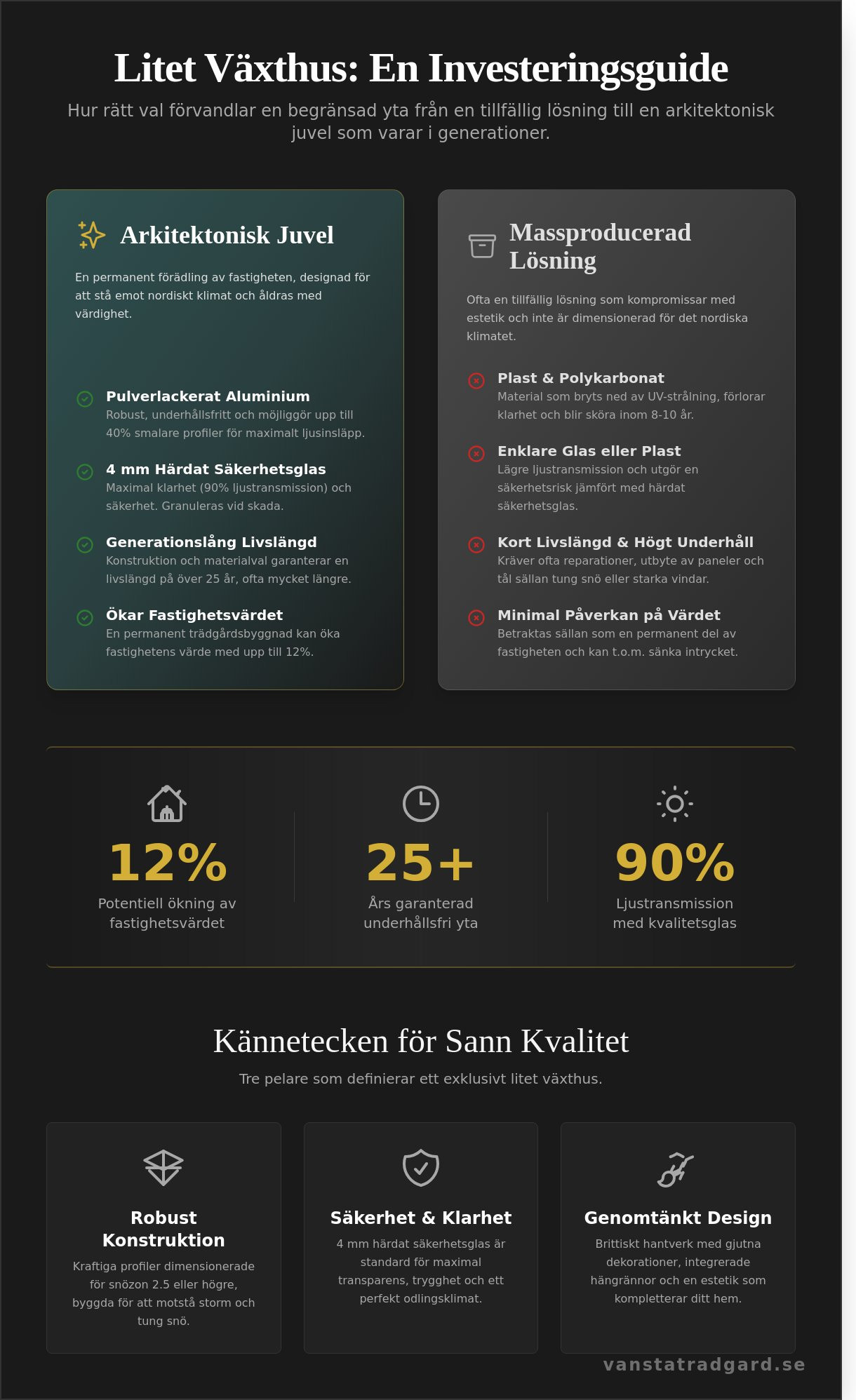
Choosing one small greenhouse is not about compromising your ambitions, but about distilling them to their purest form. The difference between a mass-produced package from a hardware store and an architect-designed glass house is fundamental and concerns everything from the choice of materials to the aesthetic soul. Where the cheaper variant often functions as a temporary crop protection, the exclusive equivalent constitutes a permanent enhancement of the property. According to market data from 2024, a well-designed and permanent garden building can increase a property's total market value by up to 12 percent. It is an investment in both quality of life and architectural heritage that can withstand the trials of the Nordic climate, from heavy slush to powerful autumn storms, year after year.
From functional cultivation support to architectural jewel
In the smaller garden, every square meter becomes critical for the overall impression. An exclusive small greenhouse requires precision in proportions that balance the building's height against the site's existing sight lines. By working with generous glass sections and narrow, strong profiles, a visual space is created that deceives the eye; the boundary between outside and inside is effectively blurred. It is about creating a seamless transition where the glass house feels like a natural extension of the residential building. The right placement creates new spaces in the garden, where the light not only benefits the plants but also acts as a candle for the surroundings during the dark hours of the day.
Sustainability that spans generations
The choice of materials is the single most important factor that separates the ordinary from the extraordinary.Plastic and polycarbonate should be consistently avoided in permanent environments, as these materials are degraded by UV radiation and often lose their clarity within 8 to 10 years. Instead, we focus on tempered safety glass and powder-coated aluminium or certified core timber that will age gracefully. British craftsmanship has been setting the standard for quality since 1938, combining timeless Victorian aesthetics with modern engineering.
- Construction: Heavy-duty profiles dimensioned for snow zone 2.5 or higher.
- Glass: 4 mm tempered safety glass that provides maximum transparency and safety.
- Details: Molded decorations and integrated gutters that hide technical solutions.
When craftsmanship is allowed to take its time, the result is a building that not only stands the test of time, but becomes more beautiful with each passing season. It is this long-termism that defines true luxury in the modern garden.
Material selection and craftsmanship for a sustainable aesthetic
The choice of materials defines not only the lifespan of the building but also its soul. When planning a small greenhouse The balance between the technical strength of the materials and their visual weight is crucial to the overall impression. A traditional wooden greenhouse in cedar offers a warm, organic feel that smells of classic British gardening; however, it requires an awareness that natural materials live and change. Aluminum instead offers a maintenance-free existence where the powder-coated surfaces withstand the elements without losing their luster. The precision of the craftsmanship is most clearly visible in the encounters between glass and profile; this is where it is determined whether the construction feels like a temporary solution or a permanent architectural asset.
Aluminum – the modern classic
Powder-coated aluminum has become the gold standard for exclusive glass houses thanks to its enormous load-bearing capacity and resistance to corrosion. By using profiles that are up to 40 percent narrower than equivalent wooden structures, an almost seamless transition between outside and inside is created. This provides maximum light penetration, which is critical for vegetation in limited spaces. Quality manufacturers such as Hartley Botanic use an advanced coating process where the paint is cured in an oven at high temperatures. This results in a surface that is guaranteed not to peel or require repainting for at least 25 years. The choice of color is free; shades such as "Stone" or "Olive Leaf" allow the building to harmonize with the natural palette of the garden.
The role of glass in the atmosphere
Tempered safety glass with a thickness of 4 mm is now an absolute requirement for those seeking both security and clarity. If an accident occurs, the glass granulates into small, harmless pieces instead of sharp shards. However, it is about more than just safety. The purity of the glass affects how light is refracted and how the internal climate is regulated. High-quality glass has a light transmission of around 90 percent. This is crucial in a small greenhouse where every ray of sunlight must be used to optimize growing conditions. The reflections in the glass act as a design element; they reflect the changes in the surroundings and create a visual depth that makes the limited area feel significantly larger than its actual square footage.
The details are what ultimately separate a mass-produced object from genuine craftsmanship. Cast brass fittings, decorative ridges and hidden gutter systems are small but important components that contribute to a timeless aesthetic. When margins are tight, millimeter-precision assembly is required to ensure doors and ventilation windows run smoothly over decades of use. Choosing quality is an investment for the future. Explore our artisanal solutions to see how the right choice of materials can transform your garden dream into a sustainable reality.
Wall greenhouses vs. freestanding models on limited space
The choice between a wall-mounted and a freestanding one small greenhouse is about more than just aesthetics; it is a decision that dictates the entire microclimate of the garden. For those who have a limited area of, for example, 15 to 25 square meters, every centimeter is crucial for the overall impression. A wall greenhouse often optimizes unused house facades and saves up to 30 percent of the available land area compared to a free-standing model with the same cultivation capacity, which leaves more space for social areas and greenery.
Wall greenhouse – an extension of the home
One of the main technical advantages of choosing a wall-mounted solution is the thermal mass. A brick wall with a thickness of 25 centimeters acts as an effective heat reservoir during the sunny hours of the day. In the spring of 2026, we will see an increased demand for these models as they can release stored heat during the night and thereby raise the temperature by up to 4 degrees Celsius compared to the surroundings. This significantly extends the growing season without the need for external heating.
Architecturally, this placement creates a seamless integration where the glass structure appears as a natural part of the original character of the home. However, it requires precision during installation. We always recommend a drainage solution with a slope of at least 1:50 away from the facade to ensure that moisture does not negatively affect the foundation of the house. By matching the greenhouse profiles with the house window frames, a visual harmony is achieved that increases the overall value of the property.
The freestanding greenhouse as horticultural art
A stand-alone small greenhouse acts as a central jewel and an architectural focal point in the garden room. If the structure is placed as a room divider, clear sight lines can be created and different zones can be defined even on a small plot. To maximize the light, the glass house should be placed with the long side facing south, but with a distance of at least 2 meters from high hedges to avoid cast shadows during the critical morning hours.
- Stable foundation: A brick base made of frost-resistant brick not only provides stability but also adds a genuine British craftsmanship feel.
- Welcoming entrance: Create a width of at least 90 centimeters at the entrance to allow easy passage with pots and tools.
- Proportions: Choose a model with a generous ceiling height, preferably over 2.5 meters, to create space despite a small floor area.
The foundation itself is the foundation for both durability and beauty. By using materials such as recycled brick or natural stone, a connection to the past is created that feels both timeless and sustainable. It is in these details, where technical precision meets poetic light, that Vansta Trädgård's expertise really comes into its own.
Checklist: 10 points before buying a small greenhouse
Investing in a small greenhouse is about creating an architectural gem that enhances the spatiality of the garden. Before the first sod is laid, a thoughtful analysis is required to ensure that the glasshouse becomes the timeless retreat you dream of. Here are the crucial points for a successful establishment.
- Define the purpose: Will the house be used primarily for growing sensitive plants or as a conservatory for relaxation? Your choice affects everything from the choice of glass to the flooring material.
- Review building permit regulations: Even smaller structures may require a building permit.Remember that placement closer than 4.5 meters from the property boundary always requires the neighbor's written consent.
- Choice of foundation: A brick parapet provides a classic aesthetic and stabilizes the temperature. Ground screws are a modern alternative for faster installation on sensitive ground.
- Climate control and ventilation: In a confined space, temperatures rise quickly. Ensure that at least 25 percent of the roof area consists of openable windows for optimal airflow.
- Technical infrastructure: Plan for water ejectors and electrical outlets below ground level. This will allow for both automatic irrigation and discreet integrated lighting for the 2026 season.
Design and technical specifications
Your choice of style should reflect the architecture of the house to create a harmonious whole. A Victorian profile with a steep roof angle and decorative ridge details elevates an older house, while a more austere design in anthracite grey complements the lines of modernism. Ensure that the ridge height reaches at least 280 centimetres; this not only provides space for people but also allows tall plants to flourish without restriction. For odd corners or specific plot sizes, custom measurements are often the only way to aesthetic perfection.
Long-term planning and management
Quality is measured in generations, not seasons. Choose materials like powder-coated aluminum to minimize maintenance and avoid future repainting. Check that the manufacturer offers at least a 30-year structural warranty and that replacement parts like specialty glass are available in the future. A well-planned small greenhouse should also be able to grow with your needs, where furnishings such as integrated shelving systems and workbenches can be added later to refine the function.
Explore our curated selection of exclusive greenhouse models which combines British craftsmanship with Scandinavian design.
Create your architectural oasis with Vansta Garden
To realize the dream of a small greenhouse is about much more than just glass and metal; it is a long-term investment in both quality of life and property value. At Vansta Trädgård, we have curated exclusive collections such as THE ROSE and Vansta Classic specifically to maximize the potential of smaller garden spaces. These models combine British Victorian aesthetics with modern precision. Every profile and joint is designed to withstand the Scandinavian climate for decades to come, where the craftsmanship is allowed to take the time required for a perfect result.
The path from the first vision to a finished glass house can seem complex to the uninitiated. That's why we take full responsibility for your project. In 2024 and 2025, we have supported over 150 customers through the arduous process of building permit drawings and government contacts. We ensure that your vision harmonizes with local detailed plans without compromising architectural integrity. To further elevate the environment, we often integrate classic garden art from Haddonstone, whose handmade stonework provides a timeless setting for your green space.
Exclusive collections for demanding environments
Hartley Botanic represent the very best in greenhouse construction and are the only manufacturer recommended by the Royal Botanic Gardens, Kew. Their craftsmanship is built on traditions spanning over 80 years. When standard dimensions are not enough, we create bespoke solutions that are adapted to the unique conditions of your site. To create a complete social space, we often complement your small greenhouse with luxurious aluminum furniture from Oxleys. This furniture is hand-cast to stand outside all year round and age with the same dignity as the glass house itself.
Your partner in garden architecture
Our passion lies in the genuine craftsmanship and timeless design that define an exclusive garden. We help you navigate between legal requirements and aesthetics so that the building becomes the natural centerpiece of your outdoor environment. We see each assignment as a unique work of art where we combine practical function with a poetic depiction of light and plant power. Every detail, from door hardware to roof eaves, is carefully chosen to create a harmonious whole that lasts for generations.
Realize your vision of the perfect garden oasis in 2026
Choosing one small greenhouse is about combining function with a timeless aesthetic that lasts for generations. By following our 10-point checklist, you ensure that every detail, from sustainable material choices to architectural harmony, interacts with the unique character of your property. Vansta Trädgård acts as an authorized partner for the prestigious Hartley Botanic and we offer secure expertise in both complex architectural drawings and local planning permission processes. As a family-owned business with a deep passion for genuine British craftsmanship, we guide you through every technical decision to create a place that breathes quality. Every glasshouse we design becomes a natural extension of the home where light and plant power are at the center of the experience. Let your limited space be transformed into an exclusive place of recovery and beauty that only gets more beautiful with age. We look forward to transforming your dreams into a finished work of art in glass and aluminum that will stand the test of time. Your journey towards a more inspiring outdoor environment begins with a thoughtful choice of design and craftsmanship.
Explore our exclusive greenhouse collections
Frequently Asked Questions About Small Greenhouses and Garden Design
Do I need a building permit for a small greenhouse?
You usually do not need a building permit if your small greenhouse is less than 15 square meters and is classified as a shed according to current Swedish regulations. However, the location requires a distance of at least 4.5 meters from the plot boundary unless the neighbors give their written consent to a closer location. For buildings placed close to public land or roads, a formal building permit from the municipality's urban planning office is always required to ensure the harmony of the cityscape.
Which material is best for a sustainable small greenhouse?
Powder-coated aluminum with stainless steel details is the most durable choice for a small greenhouse in our demanding Nordic climate. The material requires minimal maintenance and resists corrosion for over 30 years without losing its structural integrity. Combined with 4-millimeter tempered safety glass, it creates a construction that retains its timeless beauty and architectural precision through decades of changing seasons and weather.
How do I keep the temperature consistent in a smaller glasshouse?
You can regulate the temperature most effectively with automatic window openers that react at a preset temperature of exactly 18 degrees Celsius. In smaller glass houses, the heat rises quickly when exposed to sunlight; therefore, ridge ventilation and tailor-made shade curtains are necessary components for a balanced climate. By installing a thermostatically controlled fan, you ensure an air exchange of 15 times per hour, which protects your most sensitive plants from the intense heat of summer.
Can I place a greenhouse on a balcony or roof terrace?
Yes, it is perfectly possible to place a smaller glass structure on a roof terrace as long as the load-bearing capacity of the floor can withstand a point load of at least 250 kilograms per square meter.When installed at higher elevations, additional anchoring is required to handle wind loads that can reach up to 25 meters per second during autumn storms. A wall-mounted option saves valuable space and utilizes the property's residual heat to extend the growing season by up to eight weeks.
What is the advantage of a wall-mounted greenhouse compared to a freestanding one?
The main advantage is the ability of the house wall to store solar energy during the day and release heat at night, creating a more stable microclimate for your crops. A wall-mounted small greenhouse also takes up less space in the garden and acts as a natural architectural link between the home and the greenery outside. It becomes a protected oasis that often requires 20 percent less energy for heating than a completely freestanding model.
How do I prepare the soil for a glass greenhouse?
You should prepare the ground by digging to a frost-free depth of approximately 60 to 80 centimeters to avoid frost heaving and settling of the structure. A cast base or a carefully built brick foundation provides the stability required for doors and windows to operate smoothly throughout the life of the house. The ground work is the foundation of the entire investment and should always be carried out with great precision on a flat and well-drained surface.
Can a small greenhouse be used as a conservatory during the winter?
An uninsulated glasshouse works best as a beautiful orangery for winter storage of olive trees and Mediterranean plants at a temperature of around 5 degrees Celsius. To create a comfortable conservatory during the coldest months, insulating glass and a permanent heat source are required to counteract the cold. The British craftsmanship from manufacturers such as Hartley Botanic focuses primarily on optimal growing conditions, but with the right interior design it becomes an atmospheric place for recovery even in December.
What size is considered a "small" greenhouse for home gardens?
In modern garden architecture, a small greenhouse is defined as one with a floor area of between 5 and 12 square meters. These compact models are designed to offer maximum growing pleasure in a limited space without dominating the visual balance or sight lines of the garden. Despite their compact size, they often accommodate over 40 different plants and provide space for both vertical cultivation and a small seating area for reflection among the greenery.