

Imagine if the most decisive detail in your garden is not the flowers, but the foundations they rest on? An outdoor environment without clear vertical eye-catchers risks being perceived as undefined, while the right architectural elements…
Plinths & Pedestals: A Buying Guide for Classic Garden Architecture 2026
Jun 12, 2026
What if the most crucial detail in your garden isn’t the flowers, but the foundations they rest on? An outdoor space without clear vertical eye-catchers risks feeling undefined, while the right architectural elements can transform a simple passage into a grand sightline. We understand the challenge of balancing aesthetic dreams with the harsh demands of the Nordic climate. It’s a legitimate concern to invest in beauty only to see frost blasts destroy the craftsmanship, or to feel uncertain whether heavy, classic urns will stand firm when Swedish winter storms come.
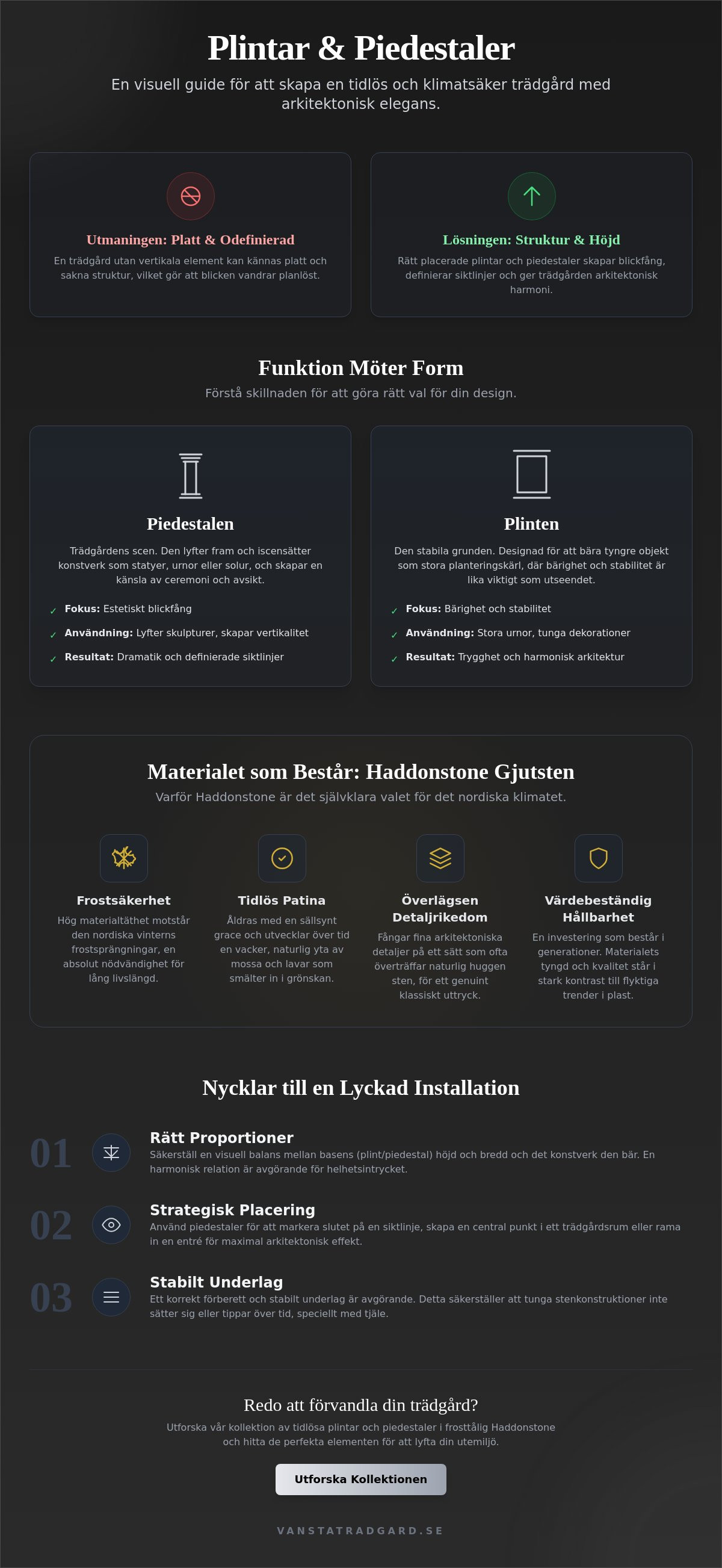
In this guide, you will learn how to take your gardening art to whole new heights by choosing the right plinths. & pedestals in timeless designs. We explore how to create a stable and beautiful base that will not only stand the test of time, but will also be a value-enhancing investment for generations. By mastering proportion and material choice, you can create an aesthetically cohesive environment where every detail interacts in harmony. We delve into how to choose frost-resistant materials like Haddonstone and how to position your objects to create an architectural experience that remains as impressive in 2026 as it will be in the future.
Important Conclusions
- Learn to distinguish between functional building elements and architectural works of art to create drama and verticality in your garden design.
- Discover why frost-resistant Haddonstone is the optimal material choice for terminals & pedestals that will withstand the Swedish winter without losing its richness of detail.
- Get expert insights on how to balance proportions between base and artwork to create harmonious and impressive eye-catchers in your sight lines.
- Understand the importance of proper ground preparation and stable foundations to ensure that heavy stone structures stand securely and beautifully through the decades.
- Explore how timeless designs like the Elizabethan Plinth can be integrated to enhance your home's unique architectural character and style.
What is the difference between plinths and pedestals in garden design?
In classical garden architecture, the distinction between the purely functional and the sublimely aesthetic is often subtle but crucial. An architectural pedestal serves as a deliberate tool to highlight sculptural elements, while a traditional plinth is often seen as a supporting base for heavier constructions. Understanding The difference between plinth and pedestal is fundamental to creating an environment that exudes both stability and elegance. While the construction industry often sees the plinth as a purely technical solution for anchoring, we consider these elements as integral parts of the garden's soul and overall expression.
To get a practical insight into how plinths are traditionally used as load-bearing elements in more functional construction projects, you can watch this instructional video:
The pedestal as the garden's exclamation point
The pedestal is the stage of the garden. It changes everything. By raising a statue, a sundial or a classical urn from ground level, an immediate sense of ceremony and intention is created.In flat, Nordic gardens, the need for verticality is great; without height variations, the eye can easily get lost in the horizontal. A carefully placed pedestal marks the end of the line of sight and gives the eye a place to rest. It's not just about elevating an object, but about transforming a discreet corner into a conscious design point that invites reflection. When choosing terminals & pedestals from our cast stone collections, you are investing in a craft that gives the garden structure even during the leafless winter months.
Plinths for heavier decorations
As we move towards the more robust plinths, the focus shifts towards stability and load-bearing capacity without sacrificing visual heritage. Large planters, such as a magnificent Versailles vase filled with moist soil, require a wider base to prevent damage to the substrate or the vessel from tipping over. Here, the aesthetic match between the plinth and the object it supports becomes absolutely central. A cast stone plinth from Haddonstone harmonizes with the architecture of the house in a way that a simple concrete plinth never can. It supports the weight with dignity. The choice of material is absolutely crucial here; a plinth must not only carry massive weight but also withstand soil moisture and frost blasts over decades of Swedish climate. It is this balance between technical precision and timeless beauty that defines well-planned garden architecture.
The material that makes a difference: Why choose Haddonstone cast stone?
The choice of material is fundamental to how a garden is experienced and how it endures over time. Haddonstone represents the pinnacle of cast stone, a material that combines the natural beauty of limestone with a durability that often surpasses natural stone's own properties. It's easy to be lured by fleeting trends on social media that highlight lightweight plastic or composite materials, but these lack the weight and soul required to anchor a classic design. Haddonstone carries a rich history of cast stone which dates back to antiquity, and its ability to capture fine architectural details makes each object a unique work of art.
One of the most enchanting qualities of this material is how it interacts with nature. Instead of fading or weathering, the stone ages with a rare grace. Over time, a natural patina develops where lichens and mosses can take hold, making your terminals & pedestals merges with the greenery in an organic way. It creates a feeling of timelessness; as if they have always stood there, guarding the garden's paths and sight lines.
Frost protection and long service life
For those of us who live in a climate where temperatures fluctuate dramatically, frost resistance is not a luxury, but a necessity. Haddonstone cast stone has an extremely high material density, which is the result of a unique and carefully controlled manufacturing method. By minimizing porosity, water is prevented from penetrating the interior of the stone. This is critical during Swedish winters. When water freezes, it expands, which in more porous materials inevitably leads to cracking and decay. Our pedestals are designed to remain outside all year round, whether covered in a sparkling blanket of snow or subjected to whipping autumn rain. Maintenance is minimal; a light brushing is usually enough to preserve structural integrity for decades.
The craftsmanship behind every detail
Each individual piece is the result of a craftsmanship that requires patience and precision. The process begins with handmade molds where the stone is hand-packed to ensure perfection in every curve. A classic pedestal often consists of three distinct parts: base, shaft and top. This three-part division is not only aesthetic.It allows the material to work naturally and provides optimal strength that can support very heavy urns or statues without the risk of subsidence.
The choice of color also plays a crucial role in the final atmosphere. The bright Portland gives a crispy, classic feel, while Bath offers a warmer, golden tone reminiscent of English manors. For those seeking a more Mediterranean-inspired warmth, there is Terracotta, a color that glows beautifully in the evening sun. Choosing the right terminals & pedestals is about creating a visual bridge between the facade of the house and the green space of the garden. If you want to explore how these materials feel and look in a real environment, you can see our curated selection at Vansta Garden.
Choosing the right height and design for your eye-catcher
Composing a garden is largely about directing the viewer's gaze through well-balanced lines of sight. The right choice of terminals & pedestals as architectural coordinates that give the landscape its structure. A common misconception is that the pedestal is merely a passive support; in fact, it is what determines whether a work of art is perceived as a natural part of the environment or as an alien element. The proportions between the base and the supporting object are absolutely crucial for harmony. A rule of thumb is that the width of the pedestal should correspond to the base of the urn, but its height must correspond to the scale of the surroundings and the perspective you want to create.
When choosing the height of a sundial, a different mindset is required than for a statue. A sundial is best placed at a height where the viewer can comfortably read the time, often around waist height. A statue, on the other hand, may need to be raised significantly higher to dominate an open space or to be visible above surrounding vegetation. The balance between the pedestal's decoration and the object it carries is an art form in itself. A richly decorated pedestal often requires a more understated object so as not to create visual chaos, while a simple, austere column can give maximum power to a detailed sculpture.
The importance of height for perspective
The choice of vertical level changes the way we experience garden space. Low plinths are often used for heavy, wide urns where a sense of stability and ground-level elegance is sought. They work great along low walls or at stair landings. Tall pedestals, on the other hand, have the ability to lift the gaze towards the treetops or horizon, creating drama in the garden's sight lines. Standard dimensions such as 27 and 30 inches (about 68 and 76 cm respectively) are classic choices that suit most European garden ideals. A 27-inch pedestal provides a human scale at a seating area, while 30 inches is often required for an object to have the right authority at the end of a long path.
The Style Guide: From Elizabethan to Modern
The design choice should always reflect the soul of the house. An Elizabethan plinth, with its historical references and characteristic panels, adds an immediate sense of rich tradition and is a perfect match for older architecture or formal gardens. In more contemporary settings, a plain, undecorated pedestal often works best. It then acts as a discreet backdrop that allows the supporting artwork to speak undisturbed. To create a complete and cohesive environment, you can combine your choices with Haddonstone Fountains. By repeating the same design language and choice of materials in both fountains and pedestals, you create an aesthetic common thread that exudes awareness and timeless exclusivity.
Installation and placement for maximum effect
To install terminals & pedestals in cast stone requires the same architectural consideration as the design choice itself.The weight of the material is a guarantee of quality and durability, but it also requires a foundation that will not give way to frost or soil changes. Before your delivery reaches the gate, the ground should be carefully prepared with a solid layer of gravel and a completely flat surface. An uneven base creates invisible tensions in the stone. Over time, these tensions can lead to cracking, especially when the material is exposed to the stresses of the Nordic climate. It is about giving your work of art the technical conditions to stand firm for generations.
Technical installation on sand and cement bed
To ensure perfect weight distribution, we recommend a mortar bed consisting of eight parts sand and one part cement. This 8-to-1 mixture creates a stable yet flexible enough base that allows the stone to rest heavily without causing harmful twisting or swinging loads. It is a technical detail that is often overlooked in simpler guides, but is absolutely crucial to the long-term stability of the structure. When assembling a pedestal that consists of several parts, such as a base, shaft and top, it is important that each part is centered precisely. Allow the base and the first parts to cure thoroughly before placing the final urn or statue on top. Patience during assembly is an investment in future beauty.
Placement in the garden room
Placement is where garden architecture truly comes to life. A strategically placed pedestal can act as a secret; partially hidden behind a dense shrubbery, it creates a sense of mystery and discovery for those walking along the garden paths. In an open courtyard or at the end of a trimmed hedge, it becomes a majestic centerpiece that anchors the entire outdoor space.
For those who want to blur the line between wild nature and the orderly home, pedestals can be advantageously integrated into architect-designed greenhouses. Within the protective walls of the glass structure, they can support more delicate plants or classic busts, creating a conservatory with an air of timeless elegance even in the darkest months. Working with sight lines means seeing the garden as a series of curated scenes. Each pedestal should have a purpose and a role in the larger story of your property. If you would like personal advice on how best to prepare the ground or position your heavy stone products, you can confidently contact us at Vansta Trädgård for expert support.
Selected favorites from Vansta Trädgård's collection
Our selection of architectural elements is carefully curated to meet the highest standards of both form and durability. Among our most prized items is the Elizabethan Plint, a timeless bestseller that embodies the classic English garden tradition. It is a model that, with its balanced geometry and understated elegance, has the ability to enhance almost any setting. Investing in high-quality terminals & pedestals from Haddonstone is more than an aesthetic upgrade; it is a value-defining investment that elevates the architectural standing of the entire property. When future viewers see a garden where every detail maintains the same high level of craftsmanship, an overall impression of exclusivity and long-term care is created.
Elizabethan Plinth – A Detailed Review
The Elizabethan plinth is not just a foundation, it is a tribute to the craftsmanship that has defined British manors for centuries. Its panelled sides create a subtle play of shadows that brings the stone to life even on overcast days, making it a dynamic feature in the landscape.This plinth is known for its robust three-piece construction, which gives it superior durability. By having the base, stem and plate as separate parts, the weight is optimally distributed, which minimizes the risk of unwanted settling over time. Elizabethan is available in several sizes, which makes it possible to adapt the visual impression to the scale of the garden. A larger version gives authority to a vast lawn, while the smaller models create intimacy in an enclosed courtyard. We often recommend pairing this plinth with classic urns to create an eye-catcher that feels both historically rooted and eternally young.
Functional elegance in every detail
Many of our most popular terminals & pedestals has hollowed-out stems. It is a technical feature that facilitates lifting and installation, but also serves a practical function for the conscious garden owner. The hollow space allows for hidden wiring if you wish to illuminate your artwork from below or integrate discreet technical solutions without disturbing the visual harmony. For specific vessels, such as the stately Versail Vase, we offer pedestals that are precisely tailored to create a seamless transition between vessel and base. This provides an architectural uniformity that is difficult to achieve with standard solutions.
Buy your pedestal online with safe delivery
Ordering heavy stone products can be challenging, but we have refined the process to make it as hassle-free as possible. Each item is safely shipped on a pallet and delivered directly to your door with carefully selected logistics partners who understand the value of what they are transporting. By choosing a curated expert like Vansta Trädgård, you gain access to a knowledge base that extends far beyond the product itself. We guide you through the choice of color and model to ensure the result is just as magnificent as you imagined. Discover our entire collection and find your perfect pedestal or plinth to start your garden transformation today.
Create a lasting legacy in your garden
Transforming your outdoor space into a place of timeless relaxation requires more than just greenery; it requires an architectural backbone that anchors the design in the landscape. By understanding the subtle interplay between form and function, you now have the tools to choose the right terminals & pedestals that not only support your artwork, but which themselves form an essential part of the aesthetic heart of the garden. We have seen how the choice of hand-cast stone from the renowned Haddonstone guarantees a frost-resistant base with lifelong durability, capable of defying the most demanding Nordic winters while aging with rare grace.
Every detail, from the thoughtful proportions of the Elizabethan series to the technical precision of the installation, contributes to a whole where your garden grows in value with each passing year. With our safe home delivery on pallets throughout the country, the step from vision to finished eye-catcher is both safe and easy. Let your garden become an extension of your home where quality and genuine craftsmanship are allowed to take the place they deserve.
Explore our exclusive selection of skirting boards and pedestals here
We look forward to being your trusted advisor as you realize your architectural dreams and create an outdoor environment that exudes harmony, pride, and permanence for the future.
Frequently asked questions about plinths and pedestals
Are your pedestals and plinths frost-resistant?
Yes, all cast stone products from Haddonstone are fully frost-resistant and developed to stand outside in the Nordic climate all year round.The high material density prevents water from penetrating the stone, eliminating the risk of frost cracking even in the coldest winters, making them a safe choice for sustainable garden architecture that lasts for generations.
How much weight can a cast stone pedestal support?
Our pedestals are designed to support significant weights, from classical urns to massive statues and sundials. The exact load capacity varies between models, but the multi-part architectural construction ensures that the weight is evenly distributed across the entire base. Most of our standard models will easily handle the heaviest objects in our curated range.
Do I have to pour a concrete slab under my pedestal?
A solid slab is not always necessary, but a level and stable base is essential for safety. We often recommend a bed of compacted gravel followed by a thin layer of mortar to ensure the pedestal is exactly level. This prevents uneven ground settlement from damaging the stone or causing the entire structure to tilt over time.
Can I use a pedestal indoors in an orangery?
Yes, ours terminals & pedestals works great as a decorative element in both orangeries and conservatories. They are perfect for highlighting busts, exotic plants or artwork and creating a sense of classic elegance under the glass roof. Thanks to the natural stone feel of the material, they contribute to a sophisticated atmosphere in all types of rooms where architecture and greenery meet.
How do I clean my pedestals from moss and algae?
Many gardeners prefer the natural patina that develops over time, but if you want to clean the stone, lukewarm water and a soft brush are usually enough. Avoid harsh chemicals or high-pressure washing, as this can damage the stone's fine surface structure and detail. For more stubborn stains, there are specially adapted cleaning agents that are gentle on the cast stone and preserve its original luster.
Is the pedestal delivered in one piece or in several parts?
Most of our models are delivered in three separate parts consisting of base, shaft and top. This clever construction makes handling during delivery easier and also increases strength by allowing the material to work naturally. During assembly, the parts are carefully centered on each other to create a stable and aesthetically perfect column that can withstand great stress.
What color of cast stone should I choose for my garden?
The choice of color should harmonize with your house and its surrounding architecture. Portland provides a crisp and classic white-gray tone, while Bath offers a warmer, golden hue reminiscent of ancient sandstone. Terracotta is ideal for environments with a more Mediterranean-inspired character. We are happy to help you find the shade that best highlights the unique style and atmosphere of your property.
How do I prevent my pedestal from tipping over?
The key to stability is a perfectly balanced base and a centered placement of the load-bearing object. By using a thin mortar bed between the different parts of the terminals & pedestals creates a cohesive unit that stands securely against both wind and external influences. It is also important to choose a pedestal with a base width that corresponds to the weight and size of the urn.