

A garden without art is like a room without furniture; it lacks the soul and architectural anchors that transform a simple green space into a timeless masterpiece. You've probably felt that hesitation about investing in …
Statues & Busts for the Garden: A Buying Guide to Timeless Elegance 2026
May 22, 2026
A garden without art is like a room without furniture; it lacks the soul and architectural anchors that transform a simple green space into a timeless masterpiece. You've probably felt that hesitation about investing in larger garden art, the worry that exclusive statues & busts might crack when frost bites, or that they might feel out of place in your personal oasis. It's often difficult to judge scale and material through a screen, and the fear of disturbing harmony with incorrect proportions is something most aesthetically conscious garden owners share.
This guide is created to give you the knowledge to choose objects that not only withstand the Nordic climate but actually become more beautiful with each passing year, developing a natural patina. In 2026, we explore how to best place artworks to create dramatic focal points, navigate material choices for maximum durability, and ensure that your investment in genuine craftsmanship becomes an integrated part of your home. Learn how to transform your outdoor environment into a place of recovery where every detail exudes quality and a deep fondness for classic traditions.
Key Takeaways
- Learn to define the difference between fleeting ornaments and the architectural anchors that give your garden a lasting character and visual structure year-round.
- Discover why cast stone's unique porosity and craftsmanship are crucial for resisting Nordic frost and developing a living patina.
- Get guidance on how to ensure your artworks take their rightful place in the greenery through correct scale and the use of pedestals.
- Be inspired by how classic statues & busts can transform niches and colonnades into atmospheric narratives of historical elegance.
- Understand how careful and thoughtful maintenance allows nature's own elements to refine your investments into timeless garden treasures.
The Art of Choosing the Right Statues & Busts for Your Garden Architecture
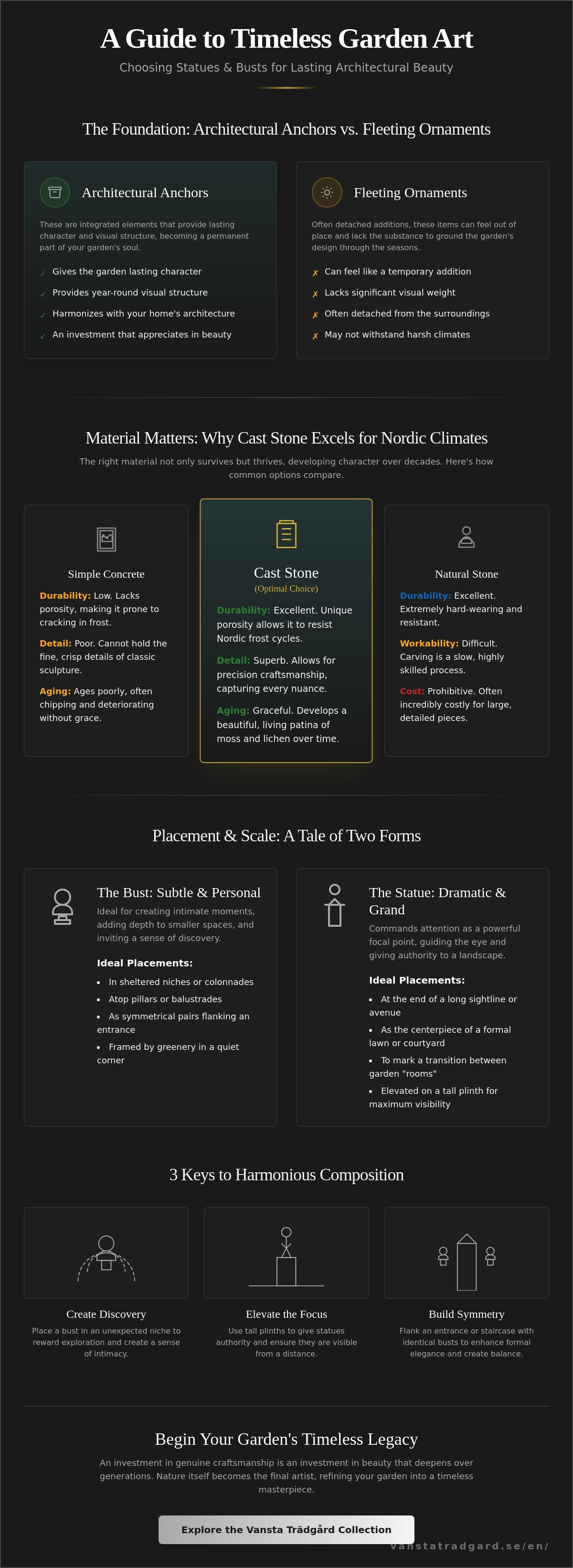
Garden architecture is fundamentally about creating order out of nature's vibrant chaos, and in this work, statues & busts are indispensable tools. They serve as the garden's fixed points, the architectural anchors that give the eye rest and the mind a clear direction. There is a crucial difference between a simple ornament and genuine architectural garden art. The former is often a detached addition, while the latter is considered an integrated part of the whole, chosen to harmonize with the house's proportions and the plot's unique character.
To understand how sculptural elements can transform an outdoor environment into an architectural masterpiece, we invite you to watch this inspiring depiction:
When choosing statues & busts for your garden, you should see them as a long-term investment in spatiality. A well-placed sculpture can guide the viewer's gaze through a long sightline, mark a transition between two garden rooms, or serve as a silent guardian on a hidden path. It's about creating a dialogue between the built and the growing, where the material's permanence beautifully contrasts with the constant change of vegetation and the shifting seasons.
Historical References in Modern Garden Design
The history of garden sculpture extends from ancient Roman villas to the classical English garden style, where every placement was carefully considered to convey both status and beauty. In today's modern gardens, we see a return to these timeless ideals, where busts are often used as elegant terminations of sightlines or placed in niches to add depth to a wall. We often see how these artworks are complemented by Haddonstone fountains, creating an environment where the vitality of running water meets the unwavering calm of cast stone.
Bust vs. Statue: What Suits Where?
The choice between a bust and a full-body statue is primarily governed by the environment they are to inhabit and the feeling you wish to convey. Busts are by nature more subtle and personal; they are best placed on pillars, balustrades, or framed by greenery in a sheltered niche. Full-body statues, on the other hand, often require a larger stage to come into their own. They serve as dramatic focal points on an open lawn or at the end of an avenue. To create a dynamic and living garden, you can advantageously combine objects in different ways:
- Subtle details: Place a bust in an unexpected niche to create a sense of discovery.
- Elevated focal points: Use statues on tall plinths to give authority and visibility from afar.
- Symmetrical pairs: Let identical busts flank an entrance or a staircase to enhance a formal elegance.
Material Choice and Durability: Why Cast Stone Is the Optimal Choice
When choosing statues & busts for a garden that is to last for generations, the material is the single most important factor. Many are attracted to cheaper alternatives in simple concrete, but these often lack the porosity and detail required to create a genuine architectural expression. Cast stone, and particularly that produced by venerable manufacturers like Haddonstone, offers a unique balance between durability and aesthetics. Unlike natural stone, which is often incredibly costly and difficult to work with, cast stone allows for a precision in craftsmanship that highlights every subtle line in the facial features of a bust or the soft, flowing folds in a classic statue's drapery.
By following classical principles of garden architecture, we see that the material's ability to age with dignity is central to the overall experience. A surface that develops moss and lichen over time becomes a living part of the garden's ecosystem, rather than just being perceived as a dead object placed on the ground. This natural patina refines the stone and gives it an authentic antique feel that is impossible to imitate with synthetic materials or superficial painting.
Haddonstone: A Standard for Exclusive Garden Art
Haddonstone has long been synonymous with quality in outdoor architecture. The material is carefully composed to mimic natural limestone, but with a homogeneity that makes it more resistant to erosion. Each object undergoes meticulous hand-finishing by skilled craftsmen, eliminating the seams and irregularities that often reveal mass-produced copies. This creates long-term value where art becomes a value-preserving investment for the future. For those seeking this timeless quality, it is wise to explore Haddonstone statues as a central part of the garden's design.
Frost Resistance in the Nordic Climate
The biggest threat to garden art in Sweden is the rapid fluctuations between positive and negative temperatures during the winter months. The secret of cast stone lies in its controlled porosity; it allows microscopic amounts of moisture to expand without the material cracking from within.For 2026 standards, frost resistance for high-quality cast stone is defined by its proven ability to maintain structural integrity during extreme cycles of freezing and thawing without the surface flaking or cracking. Vansta's collection is specifically curated to meet these requirements, meaning you can safely leave your art outdoors year-round and let winter's hoarfrost add an extra layer of beauty to your sculptures.
- Natural stone: Beautiful and unique, but often extremely heavy and limited in detail for complex motifs.
- Cast stone: Optimized for the Nordic climate with a surface that ages beautifully and resembles limestone.
- Standard concrete: Often lacks the porosity required for frost resistance and rarely develops a beautiful patina.
Placement and Scale: Creating Harmony in the Outdoor Space
Mastering the art of placing statues & busts is about much more than just finding an empty space; it's about understanding the invisible laws that govern spatiality and proportions. A common challenge for many garden owners is that an object that felt magnificent in an exhibition hall suddenly appears unassuming when it meets the open sky and the garden's vast lines. To prevent art from