

What will happen to your quality of life if the border between the barren Nordic climate and a humid rainforest is completely blurred in 2026? It is easy to feel a deep longing for your own exotic haven, but at the same time feel a...
Tropical greenhouse: A guide to creating an exotic oasis at home in 2026
Apr 13, 2026
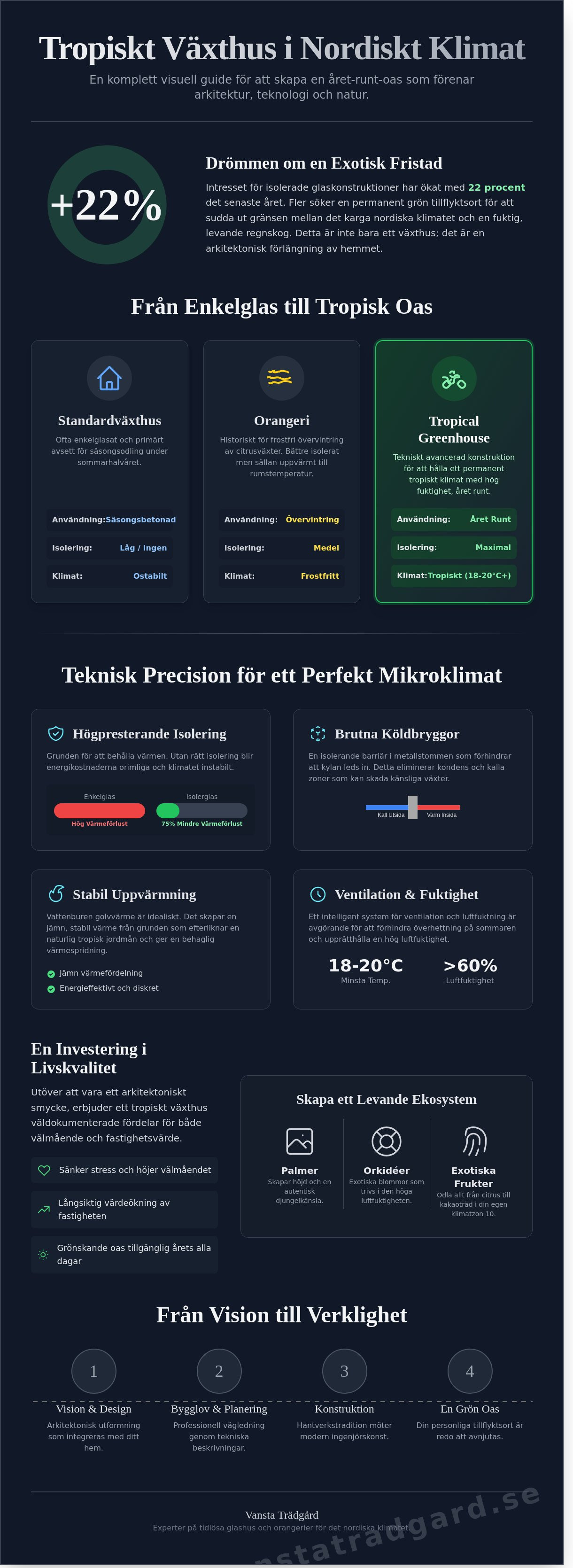
What will happen to your quality of life if the line between the harsh Nordic climate and a humid rainforest is completely blurred by 2026? It's easy to feel a deep longing for your own exotic sanctuary, but at the same time feel justified uncertainty about the technical challenges of building permits and the biting winter temperatures. We know that the fear that the glass house will not withstand heavy snow loads or that energy costs will become unreasonable often puts an end to the most grandiose garden dreams, despite the fact that interest in insulated glass structures increased by 22 percent in the past year according to industry analyses.
In this guide, you'll learn how to design and build a high-quality tropical greenhouse that combines British craftsmanship with modern engineering to withstand extreme weather conditions in style. You'll get a clear overview of how to create a lush oasis that acts as an architectural extension of your home and a long-term investment for the future. We delve into the technical requirements, material choices and the art of maintaining the perfect microclimate for your rarest exotic plants, ensuring your dream is both sustainable and timelessly beautiful.
Important Conclusions
- Understand the technical requirements for insulating glass and broken thermal bridges to maintain stable heat that defies the cold of the Nordic winter.
- Discover how an architecturally designed tropical greenhouse can be seamlessly integrated with your home to create a timeless and exclusive extension of your living space.
- Learn the art of curating a living ecosystem of palms and orchids by working with plant layers that create an authentic feel of the tropics.
- Get guidance through the process of building permits and technical descriptions to ensure your dream rests on a professional and sustainable foundation.
What defines a tropical greenhouse in a Nordic climate?
A tropical greenhouse is much more than just a place for growing; it is a technologically advanced glass structure designed to maintain a permanent tropical climate year-round. Unlike simpler glasshouses that rest during the winter, this environment requires a constant temperature of at least 18 to 20 degrees and a humidity that rarely drops below 60 percent. To understand the basics of how these structures work, you can ask yourself: What is a greenhouse? In its purest form, it is about mastering solar radiation and insulation, but in the tropical variant, advanced climate control systems are added. In 2026, we will see how the line between home and garden is increasingly blurred, where the greenhouse becomes an architectural extension of the home rather than a freestanding building on the plot.
The difference between a standard greenhouse, an orangery and a genuine tropical greenhouse lies primarily in insulation capacity and technical equipment. While a standard greenhouse is often single-glazed and seasonal, the tropical glasshouse is built with insulating glass and broken thermal bridges to withstand the trials of the Swedish winter. Interest in exotic cultivation in Sweden has reached new heights in 2026, driven by a longing for authentic nature experiences and the need for a private retreat that offers lush vitality regardless of the weather outside the glass.
To gain a deeper understanding of the concept and its possibilities, we recommend that you watch this inspiring video:
Climate zones and the dream of the exotic
Building a tropical greenhouse in the Nordics means creating your own zone 10 in the middle of a landscape that is otherwise characterized by much tougher conditions. It's about defying geographical limitations and inviting plants like palms, orchids and cocoa trees into your everyday life.The psychological benefits of staying in bright, oxygen-rich and green environments during the dark months are well documented; it lowers stress levels and significantly increases the quality of life. An investment in a high-quality glass house is also an investment in the value of the property. A well-designed glass structure with a timeless design acts as a jewel for the architecture and creates unique square meters that are used every day, all year round.
From orangery to tropical paradise
Historically, the dream of the exotic has existed in Europe since the 17th century, when the first orangeries were built to protect citrus fruits from frost. However, technological developments have taken us far beyond these original stone houses with large windows. A modern tropical paradise requires a completely different precision in terms of ventilation and irrigation systems compared to a classic conservatory
Technical requirements for maintaining a tropical climate year-round
Creating a true microclimate in our Nordic landscape requires technical precision that extends far beyond the limits of the traditional greenhouse. For your tropical greenhouse To thrive even when the mercury drops far below freezing, a symphony of insulation, sophisticated heating and intelligent ventilation is required. It's about creating an environment where technology works silently to protect the fragile and beautiful, a place where technical expertise meets botanical passion.
Insulation is the cornerstone of this design. The choice of high-performance insulating glass with a low-emissivity layer reduces heat loss by up to 75 percent compared to simple glass. However, glass alone is not enough. The frame must be equipped with thermal break bridges, which means that an insulating barrier breaks the thermal contact between the inside and outside of the profile. Without this artisanal detail, the metal becomes a highway for cold, which inevitably leads to harmful condensation and uneven temperature zones that can stress sensitive orchids or palm trees.
The heating system should be designed to be both discreet and powerful. Hydronic underfloor heating is often the first choice as it creates a stable thermal mass that mimics the warm earth of a rainforest. This is advantageously complemented by discreet convectors along the glass walls to counteract cold drafts during the darkest months. According to extensive studies on Technical requirements for tropical greenhouses Air circulation is at least as critical as the heat itself. Stagnant, saturated air is a breeding ground for pathogens, which is why an automated system that balances fresh air without draining the house of energy is an absolute necessity.
Insulation and glass quality
The difference between a simple glass structure and a winter-insulated house is fundamental to long-term sustainability. For tropical species, glass with a U-value that matches modern building codes is required. The frame material, often precision-cast aluminum or sustainably grown heartwood, ensures that the structure remains airtight over generations. It is the precision of the assembly that determines the result; every strip and seal must be fitted with surgical precision to eliminate drafts and preserve the precious energy stored indoors.
Climate control and automation
Modern control systems act like the brain and nervous system of a greenhouse. Sensors constantly monitor light, humidity and temperature to adjust skylights, shade curtains and heat sources in real time. When natural daylight is not enough during the winter months, plant lighting with a spectrum optimized for photosynthesis is required, often for 12 to 14 hours per day. For those seeking a deeper understanding of how these technologies are integrated into the home, our guide to winter gardens a good insight into the art of combining architectural elegance with year-round use.
Investing in the right technical foundation is the guarantee of an oasis that lasts. If you dream of a place where the boundaries between outside and inside are blurred, you can explore our solutions for exclusive glass houses which realizes the vision of an eternal, lush summer.
Architectural Design: Choosing the Right Structure for Your Tropical Oasis
An architectural vision begins with an understanding of how light and volume interact with the existing lines of the house. When planning your tropical greenhouse The choice between a freestanding structure and a wall-mounted model is crucial for both the aesthetic experience and long-term energy savings. A wall-mounted design takes advantage of the thermal mass of the residential building and creates a seamless transition between living room and jungle. For those building in our challenging Nordic climate, Efficient design for cold climates valuable insights into how the right angles and insulation optimize the environment for exotic species. The choice of materials defines the soul of the building; the slender and maintenance-free profiles of aluminum offer an almost ethereal lightness, while the weight of the cast stone anchors the orangery in history. The roof angle is not just a visual detail, it controls how the sun's rays reach the most light-demanding palm trees during the dark winter months.
THE ROSE and Vansta Classic: A comparison
Within our range, THE ROSE represents modern freedom where large glass surfaces and architectural flexibility allow dreams without limits. It is a structure that breathes space and allows a tropical greenhouse to grow at height, which is required for large-leaved banana plants and climbing lianas. As a sophisticated counterbalance, we find left classic orangeries. It is a tribute to British tradition where every joint and profile bears traces of a craftsmanship refined over decades. Vansta Classic is the choice for those seeking a timeless connection to the historic glass houses of the great English estates, where tradition meets modern technology.
Details that make the difference
The character of an exotic oasis often lies in the small but significant details that elevate the structure from a simple greenhouse to an architectural work of art. By integrating decorative elements, an environment is created that feels as well thought out as the rest of your home. We are seeing an increased demand for tailor-made solutions where each profile and color choice is adapted to the specific conditions and lighting conditions of the site.
- Color selection on profiles: A dark green shade allows the structure to harmonize with the greenery; a classic white or anthracite gray frames the architecture with graphic precision and sharpness.
- The elegance of cast stone: By using cast stone balustrades and columns, an architectural weight is created that transforms the greenhouse into a permanent and integrated part of the property.
- Functional aesthetics: Roof angles and profile choices are adjusted not only for the eye, but to maximize light entry during all seasons of 2026, which is vital for tropical ecosystems.
Creating a home for exotic plants requires a keen sense of how form meets function. Every project we undertake at Vansta Trädgård is considered a unique investment for generations to come, where sustainability and beauty go hand in hand. By combining technical precision with a poetic depiction of light and plant power, your glasshouse becomes a place of total recovery.
Plant selection and interior design in a tropical greenhouse
Stepping into a tropical greenhouse during a chilly Swedish winter month is a sensory experience that requires careful planning of both flora and interior.To create an authentic tropical oasis feel, a single potted plant is not enough. You need to work with volume, scent and texture in multiple layers to mimic nature's own architecture. To find the rarest and most thriving specimens for your collection, explore the range at Kaposvár Kertészet (Szoliter Kert), which specializes in exotic plants and unique ornamental trees. This vertical structure begins at the ground with ground-covering ferns and climbing Philodendron that work their way up the slender profiles of the glasshouse. Palm trees that Howea forsteriana provides the necessary height, while exotic orchids from the Vanda or Cattleya genera add jewel-like pops of color at eye level.
Create a living rainforest
To succeed in a living rainforest, species that thrive in constant heat are required. Stately specimens of Strelitzia reginae, also known as parrot flower, work great as architectural eye-catchers. Combine these with large-leaved species such as Monstera deliciosa and various forms of Ficus to create a dense, lush background. By grouping the plants closely, natural microclimates are created where the common evaporation raises the humidity locally by up to 15 percent. In an environment where temperatures often exceed 25 degrees, integrated plant protection is crucial. Use of beneficial animals, such as predatory mites Amblyseius swirskii, is a proven method for keeping pests away without disrupting the balance of the ecosystem.
Interior design with a sense of luxury
The choice of furniture in a tropical greenhouse is a balance between aesthetics and durability. The high humidity, which should be between 60 and 80 percent for optimal growth, places extreme demands on the materials. Handmade outdoor furniture from Oxleys is an obvious choice here; their sand-cast aluminum withstands moisture without corroding and retains its elegant finish for decades. To deepen the tranquil atmosphere, water elements are a central component. Strategically placed haddonstone fountains contribute a harmonious soundscape that masks the noise of the outside world, while also functioning as natural humidifiers.
- Lighting: Use hidden spotlights to illuminate the palm tree foliage from below, creating dramatic shadows as darkness falls.
- Material selection: Opt for natural stone or brick floors that store the day's heat and release it slowly during the night.
- Water: A fountain with running water reduces stagnant air and promotes a healthier indoor climate for both people and plants.
Every detail of the interior should reflect the same craftsmanship as the building itself. When materials such as cast iron, stone and glass interact with lush greenery, the greenhouse transforms from a simple growing space into a timeless extension of the home. It is an investment in quality of life that blurs the boundaries between outside and inside.
Explore our range of exclusive solutions and let us help you realize your dream of a Custom-made greenhouse from Vansta Trädgård.
From vision to finished project: Building permit and planning
To realize the dream of a tropical greenhouse is a journey that extends far beyond the initial sketches. In the Swedish climate, such a construction is almost exclusively considered a permanent building, mainly due to the advanced heating and insulation systems required to keep exotic species alive year-round. This means that the building permit process becomes a central part of the project.This is where the vision meets the legislative requirements for architectural harmony and technical safety. Vansta Trädgård acts as a safe guide through this complex procedure and ensures that every detail lives up to the high demands set by both the municipality and the future owner.
The planning begins below ground level. Creating a stable environment for sensitive palms and orchids requires a foundation with exceptional insulation. We often recommend a cast concrete slab with at least 200 millimeters of foam insulation and integrated underfloor heating. This technical solution eliminates thermal bridges and creates an even thermal mass that protects your investment when the temperature outside drops below zero. It's about building for generations, where craftsmanship and technical precision merge into a timeless whole.
The building permit process step by step
A successful building application requires meticulous work that includes five to seven specific technical documents. This includes detailed façade drawings at a scale of 1:100, a correctly dimensioned site plan and a technical description that accounts for the building's energy performance. A common pitfall when applying for permanent glass structures is to underestimate the requirements for fire protection or to place the building too close to the plot boundary. If the distance is less than 4.5 meters, written consent from the neighbors concerned is always required. By presenting architect-designed solutions with a clear connection to classic British craftsmanship, the municipality's assessment is facilitated, as these buildings often add aesthetic value to the cultural environment.
Long-term management of your investment
When your tropical greenhouse Once completed, a new phase of management begins. Owning a glasshouse of this calibre is a privilege that requires a certain amount of care to preserve its lustre over the decades. The powder-coated aluminium frame from our British manufacturers is virtually maintenance-free, but the glass should be cleaned twice a year to ensure optimal light for the plants. Choosing a supplier with deep passion and solid experience is crucial to the end result. We look not only at the immediate aesthetics but also at the life cycle and function of the building. For those who want to delve further into the art of integrating glasshouses into garden architecture, there is more inspiration in our comprehensive guide on greenhouse and their role as an extension of the home.
Realize the vision of a timeless oasis
Creating a tropical glass house in our challenging Nordic climate requires both technical finesse and a deep understanding of architectural aesthetics. Looking ahead to 2026, we see how advanced climate control systems allows us to transform the vision into a sustainable reality that flourishes year-round. This is an investment in quality of life that spans generations, where every detail contributes to a harmonious whole that stands the test of time.
With over 20 years of experience designing and building exclusive glass houses in Sweden, we know that success rests on a solid foundation of expertise. As the exclusive agent for Hartley Botanic in Scandinavia, we offer world-class craftsmanship that combines British gardening tradition with modern engineering. We guide you confidently through the entire process, from the first sketches to the often complex Swedish building permit handling. Your journey towards a verdant paradise begins with thoughtful planning and a passion for genuine craftsmanship.
Let us help you design your future tropical greenhouse, contact Vansta Trädgård today.
We look forward to working with you to create a place where light and growth power can be the center of your home.
Frequently Asked Questions About Tropical Greenhouses
What is the biggest difference between an orangery and a tropical greenhouse?
The primary difference lies in the thermal environment and area of use, where an orangery historically serves as a frost-free place for Mediterranean plants, while a tropical greenhouse requires a constant temperature above 18 degrees Celsius. An orangery is bustling with life during the winter months, but the tropical greenhouse creates an environment similar to a rainforest all year round. The technical construction of a tropical greenhouse requires more advanced insulation values to maintain constant heat and humidity regardless of the season.
How much does it cost to heat a tropical greenhouse during the winter?
The heating cost is entirely determined by the greenhouse's insulation capacity and the desired temperature difference to the outdoor climate. According to data from the Swedish Energy Agency from 2023, energy consumption can be reduced by 50 percent if modern insulating glass is chosen instead of traditional single glazing. Maintaining 20 degrees Celsius during a Swedish winter requires a careful calculation based on the specific U-value of the glass and the total volume of the house. Effective insulation and a well-planned heating system are crucial for sustainable operating costs over time.
What type of glass is best for a tropical climate in Sweden?
A triple-layer tempered insulating glass with a low U-value is the most optimal choice for creating a stable and energy-efficient tropical climate in Sweden. This type of glass effectively minimizes heat loss and prevents the thermal bridges that can otherwise harm sensitive exotic species during cold winter nights. We recommend glass constructions that balance maximum light transmission with high thermal performance to meet the aesthetic and functional requirements of the Nordic climate in 2026.
Do I need a building permit to build a tropical greenhouse?
Yes, a building permit is usually required if your tropical greenhouse exceeds the regulations for a 15 square meter shed or a 30 square meter Attefallshus. According to the Planning and Building Act, permanent glass structures that require extensive technical installations for heating and water often have to undergo a formal building permit examination by your municipality. It is important to check the local detailed plan carefully; distances to the plot boundary closer than 4.5 meters always require the neighbor's written consent or a decision by the authorities.
Can I grow edible tropical fruits like bananas and mangoes in my greenhouse?
It is entirely possible to harvest your own bananas and mangoes if you ensure a stable temperature that never falls below 16 degrees Celsius. Banana plants often require 12 hours of light per day and a humidity of around 70 percent to bear fruit in a Swedish environment. By integrating plant lighting with a spectrum adapted for photosynthesis, you can create the optimal conditions for a successful exotic harvest in the middle of the Swedish winter.
How do I deal with condensation on the glass in a humid environment?
Condensation is best managed through a well-thought-out combination of controlled ventilation and active air circulation using quiet fans. Well-insulated glass reduces the temperature difference between the inner and outer parts of the surface, which minimizes the risk of dew point formation on the glass. By using automatic roof windows controlled by humidity sensors, the humidity can be perfectly balanced; the glass remains clear and the plants are protected against fungal attacks caused by stagnant moist air.
What maintenance is required for an architect-designed aluminum greenhouse?
An architect-designed greenhouse made of powder-coated aluminum requires minimal maintenance beyond regular cleaning of glass surfaces and gutters once or twice a year.Aluminum's natural resistance to corrosion means the frame will retain its elegance for decades without the need for repainting or sanding. We recommend checking rubber strips and lubricating moving parts in the ventilation system every season to ensure all mechanics run smoothly and quietly for many years to come.
Can I integrate solar cells into my tropical glasshouse?
You can absolutely integrate solar cells into the structure by using semi-transparent solar panels that replace parts of the roof glass in your greenhouse. This technology is called BIPV and allows the necessary light for the plants while generating renewable energy for the house's air conditioning system. In 2025, the efficiency of these integrated systems increased by 15 percent, making them both an aesthetically pleasing and functional solution for the environmentally conscious owner who wants to lower their operating costs.