

A greenhouse is not only a place for cultivation; it is an architectural extension of your home that will stand the test of time for at least 50 years. Many garden enthusiasts today share the concern that a beautiful glass greenhouse...
Glass greenhouses: A guide to material selection, aesthetics and architectural quality in 2026
Apr 17, 2026
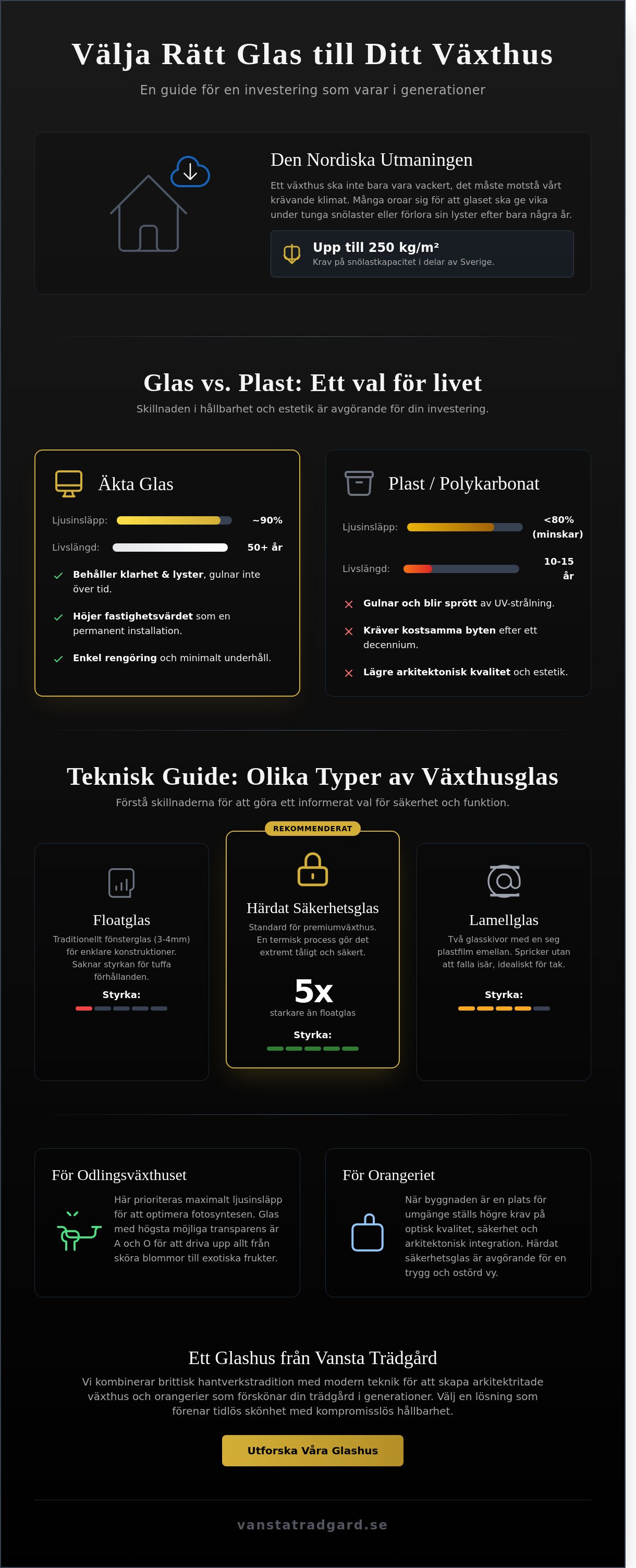
A greenhouse is not just a place for growing; it is an architectural extension of your home that will stand the test of time for at least 50 years. Many garden enthusiasts today share the concern that a beautiful greenhouse glass will crack under snow loads that in parts of Sweden can reach 250 kg per square meter, or lose their luster and look fragile after just a few seasons. It is a justified feeling, as the choice of material determines whether the building will be a lifelong jewel in the garden or a short-term disappointment that requires costly replacements before the decade is over.
We at Vansta Trädgård share your passion for genuine craftsmanship and the pursuit of that harmony where light travels undisturbed through the room. Through this guide, you will gain the knowledge to make conscious choices to create a greenhouse that combines timeless beauty with modern sustainability for 2026. We explore the differences between tempered safety glass and high-performance insulating glass, and give you the tools to choose a solution that preserves its architectural quality, a standard that we at Vansta Trädgård cherish and which is fundamental to a lasting greenhouse glass.
Important Conclusions
- Learn to navigate between different glass types to choose the right one greenhouse glass that balances timeless aesthetics with the durability required for our Nordic climate.
- Understand the technical differences between float glass and tempered safety glass to ensure a construction that safely handles both snow loads and wind pressure.
- Discover how the choice of glass directly affects your plants' photosynthesis and how you can create an optimal thermal climate without condensation problems through proper ventilation.
- Gain insight into how an architect-designed glasshouse with roots in British craft tradition transforms your garden into an exclusive place for both cultivation and recovery.
Why choose glass greenhouses? Aesthetics meets function
Choosing a greenhouse is about more than just creating protection for your plants; it's about creating an architectural expression that lasts over time. A glass greenhouse offers a clarity and light transmission that materials such as polycarbonate or plastic can never match. The glass's ability to transmit up to 90% of natural sunlight creates the optimal conditions for both photosynthesis and human well-being. For a deeper understanding of the historical and technical context of the glass house, you can take advantage of this Greenhouse overview which highlights the development and significance of the construction.
To better understand how the choice of materials affects the end result and the aesthetic experience of your building, you can watch this inspiring film:
The durability of a glass greenhouse is unmatched. Unlike plastic materials, which often yellow and become brittle after 10 to 15 years due to UV radiation, glass retains its brilliance and transparency for generations. It is an investment that not only benefits the gardener today, but also future owners of the property. The visual transparency blurs the line between outside and inside, creating a seamless flow where the colors and shades of the garden become a living part of the interior of the room. When the evening sun hits the glass surfaces, reflections are created that give the garden an almost magical aura, something that a matte plastic roof can never recreate.
The difference between greenhouses and orangeries
The choice of glass is often guided by the primary purpose of the building. In a pure cultivation greenhouse, maximum light penetration is prioritized to grow exotic fruits or fragile flowers.When the goal is instead one conservatory, Where social interaction is central, higher demands are placed on the optical quality and architectural integration of the glass. Here, sight lines and reflections are crucial; the glass acts as a lens to the outside world and often requires a different thickness or hardening to ensure both safety and an undisturbed view of the property.
Glass as an investment in quality of life
Staying in a room flooded with natural light has documented psychological benefits, especially during the dark Nordic months when daylight is in short supply. A well-designed glass greenhouse becomes a natural extension of the soul of the home and its architectural expression. It is a place of recovery where the solid craftsmanship in every profile and frame becomes a daily reminder of quality and long-termism. For a broader look at how these environments can be designed to maximize your quality of life, explore our comprehensive guide on greenhouse and its role in modern garden architecture.
- Light transmission: Glass maintains its transparency without becoming cloudy over time.
- Property value: A permanent glass structure is considered a fixed installation that increases market value.
- Maintenance: Glass is easy to clean and does not require replacement due to material fatigue.
Different Types of Greenhouse Glass: A Technical Reference Guide
The choice of greenhouse glass is one of the most crucial factors for both the aesthetics of the building and its long-term durability. It is about balancing the refraction of light against the material's ability to withstand the test of time and Nordic weather conditions. In classical glass art and modern garden architecture, glass choices are divided according to their specific properties and areas of use.
- Float glass: This is the traditional window glass often found in simpler designs. It is 3 to 4 millimeters thick and offers good transparency, but lacks the structural strength required for larger, unprotected surfaces.
- Tempered safety glass: This type of glass is standard in the premium segment and with manufacturers such as Hartley Botanic. Through a process of extreme heating and rapid cooling, the glass becomes up to 5 times stronger than regular glass.
- Laminated glass: Consists of two sheets of glass joined together with a tough plastic film. If the glass breaks, the shards are held in place by the film, making it the obvious choice for roof structures where falling glass poses a risk.
- Insulating glass: For those who wish to extend the season to year-round enjoyment, double or triple layers of glass with argon gas in between are used. This drastically minimizes heat loss and enables a comfortable indoor environment even when frost bites the ground.
Tempered glass vs. Regular glass
The difference in strength is significant. Tempered glass withstands mechanical impact from hail or branches significantly better than float glass. Another critical aspect is thermal stress. Ordinary glass often cracks at a temperature difference of 40 degrees, while tempered glass can withstand variations of up to 250 degrees. Safety is also a priority. Once tempered glass breaks, it granulates into thousands of small, blunt pieces. This minimizes the risk of serious cuts. This safety aspect makes the material a requirement for winter gardens where people live every day.
Special glass for specific needs
For the discerning grower, there are technical solutions that enhance the experience. Anti-reflective glass can reduce reflections by over 90 percent, creating an almost invisible barrier between inside and outside.Energy glass, also known as Low-E, has a microscopically thin coating of metal oxides that reflects heat radiation back into the room. This significantly lowers the U-value. The choice between clear glass and frosted glass is often about the balance between full light transmission and the need for privacy or natural shading for sensitive plants. By combining these technologies, an environment is created that is as functional as it is beautiful.
Investing in the right glass quality is investing in the growing joy of future generations. If you want to explore how these materials interact in a finished construction, you can take a closer look at our classic English greenhouses where craftsmanship meets technical perfection.
Safety and durability in glass structures
Choosing the right greenhouse glass is about more than just aesthetics; it is a matter of technical precision and long-term safety. According to Swedish building regulations from the Swedish National Board of Housing, Building and Planning, glass surfaces in environments where people live must be made of safety glass. We work exclusively with tempered safety glass, which is up to five times stronger than regular machine glass. If an accident should occur, the glass granulates into small, harmless pieces instead of sharp shards. This detail is crucial for creating a safe haven for both children and plants.
The stability of a glass house rests on the balance between the thickness of the glass and the rigidity of the framework. A standard 4 mm glass provides good basic stability for most structures, but for larger spans or particularly exposed locations, 6 mm glass is often required to ensure that the structure does not fail under pressure. To avoid stresses that can lead to cracking, the choice of fastening is crucial. By using high-quality rubber strips, a flexible barrier is created. The strips absorb vibrations from the wind and allow the glass to expand and contract in line with temperature changes without being pressed directly against the metal.
Building for the Nordic climate
The Scandinavian climate places extreme demands on load-bearing capacity. Snow loads in some parts of the country can reach up to 300 kg per square meter, which requires a static calculation that few standard models can handle. This is where the difference becomes clear. Professional architect-designed greenhouses are dimensioned with a precision that takes into account local conditions and wind pressure. To extend the life of your greenhouse, you should check the rubber strips and clean the gutters annually. A clean glass surface reduces the risk of point loads from ice formation and preserves the crystal clear light that is the heart of every cultivation.
Building permits and drawings for glass houses
Before you put a shovel in the ground, it is crucial to ensure that your planned glass greenhouse meets all local building regulations. In Sweden, building permit requirements can vary greatly depending on size, location and the municipality's detailed plan. An architect-designed greenhouse from Vansta Garden always includes detailed drawings and dimensioning calculations that facilitate the application process. Having accurate and professional documents from the start saves time and avoids costly misunderstandings with the building board. It also ensures that the construction is safe and durable over time, adapted to specific conditions.
From vision to reality
Making your dream of a glass greenhouse a reality is a journey that requires precision at every step. From the initial idea to the finished installation, it is a process where aesthetics, function and safety must go hand in hand. By choosing a supplier who Vansta Garden, By prioritizing quality and expertise, you ensure that your glasshouse will not only be a beautiful asset but also a safe and sustainable place for growing and relaxing for many years to come.It's about transforming a vision into a concrete reality that stands the test of time and the Nordic climate.
The role of glass in thermal comfort and growing climate
The choice of the right greenhouse glass is about the delicate balance between inviting life-giving sunlight and shutting out the biting cold. Glass acts as the heart of a building’s thermal system; this is where the magic happens. A single pane of glass often has a U-value of around 5.8 W/m²K. This means that heat quickly disappears as soon as the sun goes down. By choosing modern insulating glass with a U-value of down to 1.1 W/m²K instead, energy consumption can be reduced by up to 80 percent. This creates a stable environment where the well-being of plants is not dictated by temporary weather changes.
Condensation is a natural consequence when warm, humid air meets cold glass surfaces. Without proper management, moisture can promote unwanted fungal growth and reduce light transmission. Ventilation is therefore the most important partner of glass. Automated roof windows that react to temperature changes ensure that air circulates without creating drafts. During the most intense summer months, when the temperature in a glass house easily rises above 40 degrees, additional measures are required. Shading systems and specially adapted curtains can reflect up to 75 percent of the incoming solar energy, which preserves a pleasant atmosphere for both people and plants.
Create a tropical climate at home
To realize the dream of a tropical greenhouse places specific demands on the construction. This requires a constant humidity that often exceeds 65 percent. This places high demands on the tightness and insulation capacity of the glass construction to avoid energy leakage. The choice of insulating glass is a prerequisite here for maintaining the even heat that exotic species require. It is about creating a closed oasis where technical precision meets botanical passion.
Light quality and plant growth
The composition of light affects the architecture of plants as much as their growth rate. Different types of greenhouse glass filters the ultraviolet spectrum in various ways. While standard glass lets most of the light through, some types of glass can refract the rays to spread them more evenly across the foliage. This reduces the risk of burns from direct sunlight. In our left classic orangeries We see how this interplay between form and function creates an environment where light becomes an architectural detail in itself, while providing optimal nourishment for photosynthesis.
Explore our exclusive glass designs at vanstatradgard.se to find the perfect balance for your garden.
Vansta Garden: Architect-designed glass houses for generations
Vansta Trädgård represents a fusion of British craftsmanship and Scandinavian aesthetics. Through our exclusive partnership with Hartley Botanic, who have been manufacturing market-leading glasshouses since 1938, we offer solutions that stand the test of time. We believe that true sustainability is born from quality. Choosing the right greenhouse glass in combination with high-quality metal is not just an aesthetic decision, it is a long-term investment. A structure that is built to last for 50 or 100 years is the most effective strategy for reducing resource consumption over time.
Our philosophy is based on the idea that a greenhouse is an extension of the home and the soul. We design each building as a unique work of art where the glass and architectural lines harmonize with the surrounding nature. It is about technical precision that meets a poetic vision of light and space.When choosing materials, we focus on components that require minimal maintenance but age with unparalleled dignity.
From vision to reality
Every journey towards a new glass house begins with a personal dialogue. We work with architect-designed solutions that are adapted to the unique conditions of your garden and your specific dreams. The choice of greenhouse glass plays a crucial role in both the climate of the house and its visual expression. We offer expertise in everything from safety glass to insulating glass, depending on whether your goal is a lush growing area or a temperate orangery for social gatherings.
The precision of our craftsmanship is evident in the small details; the hidden screws, the elegant profiles and the seamless integration between foundation and frame. We guide you through the entire process, from the first sketches to the finished result, ensuring that every choice reflects your personal style and the history of the place.
Create your own oasis
A glass house from Vansta Trädgård is more than just a building, it is the heart of a complete outdoor environment. To enhance the classic feel, we recommend combining the architecture with timeless details. Integrating haddonstone fountains adjacent to the entrance creates a soundscape of running water that enhances the tranquility. The British heritage becomes clear when the hard stone meets the sheer transparency of the glass.
When decorating your new oasis, focus on blurring the lines between indoors and outdoors. Use natural stone pavers, site-built raised beds, and comfortable furniture that invites you to relax. By thinking of your greenhouse as an extra living room, you extend the season and create a place for relaxation at all hours of the day. Book a consultation with our experts today to begin transforming your garden into a place for future generations.
Let your garden dream take shape for 2026
Investing in a greenhouse glass is to create a lasting place for both growth and spiritual recovery. By combining technical precision in the choice of materials with a timeless architectural aesthetic, the garden is transformed into a seamless extension of the home. We see how the right choice of tempered safety glass and advanced thermal solutions create a growing climate that performs optimally for many decades to come.
As a family-owned business with over 20 years of experience in exclusive garden architecture, we understand the value of details that last for generations. Vansta Trädgård is the proud exclusive representative of British Hartley Botanic in Scandinavia, giving you unique access to a craft that has been celebrated since 1938. Every project we undertake rests on a solid foundation of expertise and a deep love for the classic heritage. We help you navigate between different glass types and constructions to find the perfect balance for your unique environment.
Book an architectural consultation for your dream greenhouse and take the first step towards a garden where vision and reality meet in crystal clear harmony.
Frequently asked questions about sustainable greenhouses
What thickness of glass is best for a greenhouse?
4 mm tempered safety glass is the optimal standard for a high-quality greenhouse glass which will withstand Nordic winds and snow loads. This thickness provides the weight and stability required for the construction to feel genuine and safe for many decades. Compared to thinner 3 mm glass, the risk of cracking is reduced by 40 percent when subjected to mechanical impact. It's about creating a safe environment for both your plants and your family.
Is tempered glass really necessary on the ceiling?
Yes, tempered safety glass in the roof is an absolute must to ensure safety in extreme weather conditions or accidents. In the unlikely event that the glass breaks, it will break into thousands of small, harmless pieces instead of large, sharp shards. British manufacturers such as Hartley Botanic have been using this standard for over 80 years to protect the grower. It is an investment in long-term security that allows you to enjoy your greenhouse without worry.
How do I best clean my greenhouse glass to avoid scratches?
Use a soft brush and plenty of lukewarm water mixed with a mild, pH-neutral detergent to maintain the glass's shine. Always avoid metal scrapers or hard sponges that can leave permanent marks on the surface. By washing the glass twice a year, preferably in March and October, you maintain optimal light transmission. A clean glass surface reflects light more beautifully and gives your plants the best conditions for vigorous growth.
Can I replace old glass with insulating glass in an existing structure?
It is rarely technically possible to replace single panes with insulating glass in older structures as the insulating glass thickness of 16 to 24 mm requires deeper profiles. In addition, a double-glazed window weighs twice as much as a regular one. greenhouse glass, which often exceeds the load-bearing capacity of the existing structure. To achieve a higher degree of insulation, a structure that is designed for the purpose from the beginning is usually required. A new, dedicated building is almost always a more sustainable solution in the long run.
What is the difference between Low-E glass and regular greenhouse glass?
Low-E glass has a microscopically thin metal coating that reflects long-wave thermal radiation back into the room, reducing heat loss by up to 30 percent. Regular glass lets energy through more easily, making it excellent for traditional cultivation during the summer months. In an orangery that will be used all year round, Low-E technology is crucial to creating a comfortable indoor climate. It is a sophisticated balance between maximum light penetration and modern energy efficiency for the conscious owner.
How does glass affect the chance of getting a building permit?
The choice of glass rarely affects the actual building permit, but the properties of the glass are central if the building is to be classified as a complementary building with permanent heating. According to Swedish building regulations, higher requirements are placed on the U-value if the surface area exceeds 15 square meters and is to be kept warm in winter. By choosing the right type of glass, you can more easily meet the technical property requirements in your building application. It is wise to consult an expert early on to ensure that the architecture harmonizes with local detailed plans.
What glass is recommended for a greenhouse against a wall?
For a wall greenhouse, tempered safety glass is always recommended, especially in areas close to the house's entrances or walkways. If the greenhouse is mounted against a home with high insulation requirements, it may be advantageous to choose energy-efficient glass to minimize thermal bridges. This placement takes advantage of the house wall's stored heat, creating a microclimate where the quality of the glass plays a major role. It becomes a seamless extension of the home where timeless aesthetics meet practical function.
How do I deal with condensation on the inside of the glass?
Condensation is best managed through well-planned ventilation with automatic roof hatches that react to temperature changes. Keeping the humidity below 70 percent reduces the risk of water droplets forming on the cool glass surfaces. Many classic English greenhouses have built-in gutters in the profiles that drain moisture away in an elegant way.Good air circulation is the heart of a healthy greenhouse and protects both the supporting structure and your most precious plants from moisture damage.